Thursday, September 08, 2011

BOOKS in the NEWS!


They're making Sunshine Sketches of a Little Town into a film starring Gordon Pinsent and Eric Peterson.  Sunshine Sketches is inspired by my hometown, Orillia, by Orillia's favourite son, Stephen Leacock. This book is very close to my heart due to its Orillia connections!


The World Fantasy Convention will be here in Toronto in 2012 and you can see Scott Lynch!  (and maybe friggin' Republic of Thieves will have been released by then; but I doubt it)

Adorable girl strives to make Horatio Lyle popular internationally on youtube 

Torontonians: 'tis fall -- and you know what that means! IFOA


At IFOA this Fall Rachel Recommends:

IAN RANKIN!!!!!


Rankin, Ian (c) Rankin
Ian Rankin’s first Rebus novel was published in 1987, and the Rebus series is now translated into 22 languages and are bestsellers on several continents. He is the recipient of four Crime Writers' Association Dagger Awards, winner of the Edgar Award for Resurrection Men and recently received the Order of the British Empire for services to literature. Rankin presents The Impossible Dead, the second novel in the Malcolm Fox series, in which a major inquiry into a neighboring police force leaves Fox and his colleagues unsure of territory, protocol or who they can trust.
...and I guess other people, like:


Ferguson, Will (c) Alex Ferguson
Published in 33 countries and 26 languages, Will Ferguson’s debut novel, Happiness, won the Stephen Leacock Memorial Medal for Humour and the Canadian Authors Association Award for Fiction. He also co-wrote the humour book How to Be a Canadian, which won the CBA Libris Award for Non-Fiction Book of the Year. In Canadian Pie, Ferguson shares stories from his travels to Yukon in search of gold, gives lessons of a mini-bar ninja and discusses his misadventures working on the Vancouver Olympics Closing Ceremonies.
Foran, Charles (c) James Lahey
Charles Foran is the author of eight books, including four novels and the essay collectionJoin the Revolution, Comrade. He also writes regularly for magazines and newspapers in Canada and abroad, and is a contributing reviewer for theGlobe and Mail. Foran presents his Charles Taylor Prize-winning work, Mordecai: The Life, a biography of one of Canada's most beloved and successful writers, Mordecai Richler.
Itani, Frances
Frances Itani is the author of 14 books, includingDeafening, which won the Commonwealth Writers’ Prize for Best Book (Caribbean and Canada) and Remembering the Bones, which was shortlisted for the International IMPAC Dublin Literary Award. She has taught creative writing for many years and her reviews, stories and articles have been widely published. She is also a Member of the Order of Canada. Itani’s Requiem tells the story of a recently widowed man who embarks on an unforgettable journey that encompasses art and music, love and hope
Johnston, Wayne (c) Neil Graham
Wayne Johnston was born and raised in Newfoundland. Once a reporter for the St. John's Daily News, Johnston eventually earned an MA in Creative Writing. His bestselling novels include The Custodian of ParadiseThe Navigator of New York and The Colony of Unrequited Dreams. He is also the author of the bestselling memoir, Baltimore's Mansion, winner of the Charles Taylor Prize for Literary Non-Fiction. Taking place in St. John’s, Princeton and North Carolina at the end of the 19th century, Johnston’s A World Elsewhere, is a sweeping tale that questions the loyalties of friends, family and the heart.
Urquhart, Jane (c) John Carter
Jane Urquhart is the internationally acclaimed author of six previous novels, a collection of short fiction, three books of poetry and a short biography of Lucy Maud Montgomery. She has received the Marian Engel Award and the Harbourfront Festival Prize, and is a Chevalier dans l'Ordre des Arts et des Lettres in France and an Officer of the Order of Canada. Urquhart presents Sanctuary Line, which weaves elements from 19th century Ireland and Ontario to create a gradually unfolding story of events that come to irrevocably alter the future of one family.

Wednesday, September 07, 2011

Great Adaptations III: 1998 Contemporary version, dir. Alfonso Cuaron

Here it is, kids, our modernized Great Expectations and the third instalment in Great Adaptations.
For this, we're all going to have to go back to the 1990s. If you, like me, were in high school, then this was very much like the Baz L. Romeo and Juliet: wherein it took a classic story you were studying and modernized it:


What the film is, at heart, is an exercise in obsession. What Cuaron takes from the novel is a strand that is prominent in all adaptations; but flashed viscerally to light here--- that of a young man fixed on an idea. Much as Magwitch ( here called Lustig) has set his sights in captivity to the realization of Pip (here called Finn) as a gentleman; so Finn is obsessed with his muse, the ice queen Estella.


Estella, in Cuaron's vision, is Finn's creative muse. She reaches him on more than one platitude and forces him to shave the past in hopes that his talent (more seen when he recreates the light she shines on him) will win him the success and fortune that will turn her head.


What the film fails at is reaching the heart of Dickens' powerful recalling of grace and redemption. No one here is redeemed, per se, rather their stories are tied with neat little bows.
"Like all happy endings, it was a tragedy.", Finn's narrative voice -over (near consistent in the tale ) informs us and we believe it to be: much so because there is only the hinting of a lesson learned. The sternest takeaway for Finn, for Estella and for the other peripheral characters caught in the web of their sensuous hold over each other, is that disillusionment is costly.


Visually, and as in Cuaron's other literary adaptations (namely Harry Potter and the Prisoner of Azkaban and A Little Princess, both worthy films with heartbreakingly lovely style), the use of colour infuses passion and stillness. It dissolutes the greying mansion belonging to the pathetically over-drawn Nora Dinsmore (this Miss Havisham; whose usage of lined makeup refers to Finn's over-exaggerated art form), and lightens the sea where Finn, in the opening sequence, putters along in a battered old boat. Not a blacksmith's apprentice, rather a fisherman, Finn and his Uncle Joe are reduced to finding odd jobs when times get tough. One of these odd jobs takes him to the over-grown garden of "Paradiso Perduto": Nora Dinsmore's decaying lair of lost paradise: Estella ushering us through stylistic snapshots of the Alhambra, of India, of riches gone to waste.
Here, the puppetry to which Estella and Finn fall victim at the playful cloys of Miss Havisham/Nora Dinsmore is more crassly apparent. Likewise, the basest dregs of Lustig's humanity play an interesting counter when Finn's expectations as a great New York artist are finally realized.


Thematically, as inferred earlier, this is a tale that sits well in a 20th Century context. Not century agnostic, the master brushstrokes of obvious obsession and lust and disillusionment are widely spread on Cuaron's canvas. Unfortunately, it is the slight idiosyncrasies that dust Dickens most powerful work. It is easy to look at Great Expectations through the lens of a tortured romance--- but it is so much more than the whole of its surface.


Lustig tells Finn that the hands are "the windows to the soul" and Finn's artistic endeavours certainly live true that statement; but the soul is much more than a fleeting kiss at a fountain or naked rendezvous with a girl unabashedly flinging her shirt to pose for a portrait.


This film has a lot of potential and, at its core, the prospect of a lot of heart. Finn wisely refers to an instance by comparing it to the most complicated of emotions: "Like love," he tells us, "it's completely undeserved." That statement is the truest to Dickens' intention. Yet, the love in Great Expectations modernized is a love borne of idea, fixation and obsession. This is true of the old novel; but the threads that sew the more problematic over-arching themes soften their blow to the reader.


Technically, the production does well at realizing a tale in a modern form. Finn's story as burgeoning artist, his awkwardly heartbreaking dismissal of his past, and of his Uncle Joe (as horrifying to behold against the New York backdrop here as it is in the London backdrop of the novel ), his crude awakening when Lustig appears at his door like a ghastly apparition and his horror at the instance he recognizes that Nora Dinsmore was not using him as a pawn to become equal to her cold ward, all play well here and all offer a deep comparative introspection when held up against their source material.


previously in "Great Adaptations": the more traditional re-telling in the 1999 BBC version

Tuesday, September 06, 2011

Unlikely Literary Confessions: the Alcott Edition


I mean to end this for once and for all….
I LIKE PROF. BHAER!
I know it is unpopular and I know that there are more Laurie/Jo shippers in the world than anything --- and I also know that Laurie and Amy make exactly as wretched a couple as you are imagining Laurie and Amy are making; but I always loved Prof. Bhaer for Jo.

From the first time I read Little Women.

I think it’s partly because I have always had a penchant for the older, professor type in literature and partly because he was German and bought the little Meg March/John Brooke babies fruits and nuts and daisies --- he has such a big heart; but mostly because he represents the greater world of culture and philosophy that Jo had always dreamed of.

Much like Alec in Eight Cousins and Rose in Bloom, Prof. Bhaer emblemizes a Transcendalist philosophy that Alcott’s father subscribed to. That sturdy undercurrent of morality, of finding the good in the world, of equality and purpose for women is very much sought out by Prof. Bhaer and his ilk. Moreover, his championing of Jo’s new prospect of opening a school for boys at Plumfield speaks wordlessly to his internal cause.

Prof. Bhaer encourages Jo in her writing. Many think that his directing of her focus from magazine serials to serious (albeit sentimentalized) fiction in the re-telling of her familial story sets her a boundary; but I think it liberates her. Prof. Bhaer forces Jo to face that which she has always known: that her talent as a writer lay in her knack for triviality, the familiar, the romance and adventure of the domestic hearth. After all, Jo’s conceptualization of the macabre and the sensational is deep rooted in the play-acting she undertook with her sisters and, to lesser degree, the journey fiction realized through their gripping encounters with John Bunyan. This is not unlike Gilbert Blythe holding the truth to Anne’s success: that Anne needs to revisit the life she has known and loved in Avonlea on the page…

Laurie is a suitable childhood friend and he does supply the witty repartee; likewise life-long love for the spirited, uncouth Jo in the tradition of boy/girl romances we pine for. But, Jo is mature beyond her years and Jo needs a man.

Romantics need look no further than the “Under the Umbrella” scene which concludes the Prof. Bhaer/ Jo story to realize its true romanticism. It makes falling in love in the rain, under the umbrella, clasping squelching damp hands together a realization of the most potent kind of love story.


Jo and Laurie would fight; they would never quite shirk the playful passion that encompasses their developmental years; but with Friedrich Bhaer, Jo has the chance of ultimate creative support and ambition as well as a solid foundation.

Think of all the things he can teach her: the languages, the scope of philosophy. In turn, think of how she thrives utmost when circumstances demand a tightening of the belt loop.

It’s a great, smart, “adult” romance and I have long known that the opinion I have harboured for, oh, almost two decades is an unpopular one; but for me there was never any alternative
(although I do love the scene when Laurie bids Jo to “fly at him again”)

This blogger likes him, too.

Monday, September 05, 2011

Out-of-Nowhere Aubrey/Maturin moment


The Peter Weir film (a.k.a. Rachel's favourite literary adaptation of all time ), does not just draw (as presumed) on the first book in the Patrick O'Brian canon (Master and Commander) and the tenth book (The Far Side of the World); but also on the third book, H.M.S. Surprise.

Remember when Stephen operates on himself on the Galapagos islands after Jack has turned from his pursuit of the Acheron to save his friend?  In H.M.S. Surprise (one of my favourites in the 20+ volume series), Stephen operates on himself after fighting a duel with his true love, Diana Villiers' (bitch. she is such a bitch, she treats Stephen mercilessly. For 20 books. bah) lover.

Remember when Stephen and Jack are walking on the Galapagos near the harboured Surprise and Stephen mentions he will name a great tortoise after Jack? Testudo Aubreii?

Yah. Also from H.M.S. Surprise.

Don't worry. This is fun and we can talk more about what Aubrey/Maturin moments are inspired and from where later on....

I am visiting my parents for the long weekend and at some point they bought me two beautiful hardcover Patrick O'Brian books to add to all the doubles (nay, triples) I have in my extensive collection. One was Surprise, so I was flipping through it last night.

Sunday, September 04, 2011

Great Adaptations Vol II: 1999 BBC Adaptation

For the next instalment of Great Adaptations, I am happy to present the most recent BBC adaptation, starring Ioan Gruffudd, Charlotte Rampling and Justine Waddell (w. Bernard Hill as Magwitch and Clive Russell as Joe).

[warning, these are a tad spoilery for those unfamiliar with the novel. So, read the novel. now. Okay?]

Unlike the 1981 adaptation we discussed the other day, this is a technically beautiful and visionary realization directed by Julian Jarrold.  It is very true to the story and fulfills most of the periphery storylines in the narrative.  Moreover, it is dark and gothic and the materialization of the troubled Miss Havisham amidst a dusty conglomeration of stopped clocks and murky mirrors to a bewildered young Pip is the stuff that slow-ticking horror films are made of.

Pip's first encounter with Magwitch is shown in rough, hand-held vision in the first few moments of the film with the rest of that fateful meeting unspilled in a dream-like flashback when Pip, previously on the marshes and near the cemetery, is back home.

Both Mrs. Joe and Joe Gargery are respectively well-played.  Clive Russell's Joe has a heart as big as his physical stature and it seems almost often near-to-burst; mostly with pride for Pip ( the scene where Pip and Joe are sitting by the hearth; Pip showing Joe a badly misspelled missive he has written him on a small slate recalls one of the most tender moments of the novel).
                                                              
The younger versions of Pip, Estella and Herbert Pocket are physically well-paired with their older incarnations.  Likewise, the transition of the story from younger Pip's life to the passing of age which ushers in older Pip is done with extreme subtlety: young Pip is hammering away at the forge in the first moments of his apprenticeship and slowly, the scene cuts to a larger hammer and a stronger arm.
                                                            
I really, really liked the Herbert Pocket in this adaptation: affable, open and generously-hearted he, like Biddy, Joe, and some extents, Wemmick and Magwitch, round out the only redeemable purveyors of kindness and grace in an otherwise depraved puppetry of tricks, money and greed.


Things the Adaptation Does Well:

->slight, small recurrences from the novel: like Jaggers continually washing his hands and Wemmick caring for "the aged"

->Plays well the idea that had Pip not been introduced to Miss Havisham and Estella, he never would have found anything lacking in his eventual apprenticeship to Joe ( or would he have? his yearning for education seems to suggest that he might have stumbled upon this past anyways)

->My mom mentioned ( and quite rightly ) that Pip is quite lost.  Reminiscent of Eliza Doolittle (My Fair Lady) after the ball and as she leaves Henry Higgins' to wander the streets and rediscover her flower girl days in Covent Garden, she recognizes she is not really fit for her new life or her old. Likewise, Pip is lost from the moment he enters Miss Havisham's through his fragmented apprenticeship to his realization of his expectations in London.  He doesn't really belong at the forge; he's unsuited for marsh life and yet his life in the city is built on a sandy, unsturdy foundation.
                                                        

(Mom also mentioned ( she was very helpful at weighing in on this ) that Miss Havisham seemed a tad young in her estimation; but that the costumes were spot-on ...moms are very fun to watch BBC miniseries with, FYI)

->I quite enjoyed Magwitch and how beguiled he was with his new "creation": the fixed idea that Herbert speaks of when he recounts what Pip has been to Magwitch in his Australian solitude. Magwitch's features soften when Pip speaks so politely with him that first day on the marshes and he admits to loving Pip as more than a son when the ungrateful Pip shies away from his patronage.  To watch him carefully tuck a shivering Pip under a blanket, to watch his eyes sparkle as he sees the result of the education Pip has had on his account (Pip reciting the Odyssey in Greek, as one example), is very, very moving.

However strongly Magwitch presupposes Pip's loyalty and affection, however, Pip's true father figure remains in the presence of Joe.   Joe, here, is just as heart-breaking as he always is: merely standing there as Pip completely forgets their connection.   In the interest of time, they slightly alter Pip and Joe's end reconciliation and have Joe find Pip in debtor's prison, delightedly moved to see him and having paid all of his debts.

->Biddy is also sweet and wonderful in this adaptation: watching Pip with the unrequited devotion and estimation true to her character as they grow up together and then transposing her love on the certainly worthy Joe at the end.

->The ending to Estella and Pip's "love" story ( as in the 1981 adaptation) is also well done here.

<

->Excellent production values; glorious sets and lighting; flashes of colour against the bleak, cobblestoned backdrop of London; Dickensian parallels shooting from the Butcher's shop to a line of soon-to-be-hanged convicts at Newgate, this is top-notch.

However, even as it remains one of the strongest adaptations I have seen to date, it is not perfect. It does not fare as well as the excellent, near-unmatched adaptations of Bleak House, say, or Little Dorrit.


Perhaps there is something about Great Expectations that just evades the screen. While there are so many marks in its favour, there is something about the tangible, strong and at times heartbreakingly redemptive spirit of the tale that seems best captured in words and pages. Which is why, as aforementioned, we so eagerly await the upcoming 2012 adaptations. I  want to see Great Expectations done perfectly right. For the time being, this is a worthy offering.

And Ioan Gruffudd is in it.  Right? Right.


Friday, September 02, 2011

Alias Barney Snaith: In Which Rachel Utilizes her Magnificent Powers of Internet Deduction

A few nights ago, I got an amazon recommendation for a book called The God of Relationships by Barney Snaith.

Yes, that’s right: Barney Snaith*. I thought this was just the most ironic thing. There was an actual Barney Snaith in the world… and he was a Christian relationships writer?  Something seemed too good to be true, here. I mean, seemingly, any living Christian with the actual name Barney Snaith needs to be a closer acquaintance of mine, n'est pas?

* Barney Snaith is the hero of L.M. Montgomery's 1926 novel, The Blue Castle. 

After snickering with my friends: “Barney Snaith? Christian? Writer? What?” , google- searching, and with the solid assurance that this Barney Snaith (like his literary counterpart) must be using the handle as a nom-de-plume, I remained puzzled.  Who would possibly pick that pseudonym? I didn’t think there was a gentleman on earth who knew who Mr. Snaith was (face it Blue Castle? Not "guy" book. At all).

At one point, for an infinitesimal moment, I even entertained the idea that it could all be a lovely, impractical practical joke.

A little bit about “Barney Snaith’s” book: it was published in June 2011 by  Createspace. It has one rather highly starred amazon.com review by a reviewer who keeps referring to the author as a John Di Marco.  I searched John Di Marco and discovered that he published a book with the same title for the same e-publishing company the year before; even boasting the exact same amazon.com review---except this time, the copyright was under the name Barney Snaith. I searched through the book and stumbled upon erudite paragraphs extolling valid ideas about Christ-centered relationships and the pursuit for a life-partner while simultaneously striving to maintain a Christ-centric ideal.

Yet, Barney Snaith, readers, was an alias.

Not satisfied, I needed to find out more about John Di Marco (who has a blog) this sounds stalkerish; but it was really just internet Sherlock Holmes ---you can’t just use the name Barney Snaith and expect to get away with it? Can you? Seriously. It’s bound to resonate…) and found out that a John DiMarco (the same one, perchance?) writes graphic art and design books for Wiley and seems very educated, assistant professor at a prestigious institute, and what not.  I flipped through his amazon books ( same title; under both Di Marco and Snaith) and from what I read he seems like a relatively relevant and intellectual chap So, if you are so inclined please explore. Perhaps, inadvertently, this blog post will direct interested parties to an author they may never have otherwise stumbled upon. And, "Barney Snaith", will google search to find an entry which refers to his book and not, possibly for the first time ever, eighteen thousand searches pertaining to that other Barney Snaith. Ahh… the power of the internet.

The story goes slightly deeper. I decided to look up the amazon profile of Di Marco/Snaith’s enthusiastic four- star reviewer and discovered this guy --- who also seems like a decent, intelligent human being ---Joni Erickson Tada gave one of his books a shout-out. That’s clout in Christian circles, friends.

[He notes a very interesting interest (for our intents and purposes in his bio]

So, Andrew Case and John Di Marco (whomever you are)--- live long, prosper and write well and often--- this is posted with the most good-natured of intentions ---
Your pseudonym, Mr. Di Marco, sparked very fun and distracting intervals of sleuthdom for this rabid Montgomery fan and I wish you well in your future endeavours. A Christian writer named Barney Snaith dapples in life-long-dream territory for many bibliophilic, albeit, Christ-following gals.

 I think we all learned something here --- Using an alias from a lesser-known; but well-beloved L.M. Montgomery hero will garner you some attention….

Mea Culpa John DiMarco and Andrew Case--- best wishes. If you are back-tracking to see where you  have left indelible thumbprints on the internet, please feel free to let us know what inspired Barney Snaith as a pseudonym. If you have read (and enjoyed) the Blue Castle, I would really like to know…. ‘cause guys don’t DO Montgomery ( at least that was my previous impression)

R.I.P. Challenge ...Again


I am so excited that Carl V's ( of Stainless Steel Droppings) R.I.P. Challenge is here once more.  This is my favourite blog challenge because it is so atmospheric and it ushers in my favourite reading time of year: The languid transition from Fall to Winter: harrowing winds, chilly nights, incendiary leaves in a cornucopia of colour, rain-shone pavement after misty precipitation, lanterns flickering---- a biblophile's dreamworld for Things That Go Bump in the Night and mysterious yarns. R.I.P. runs from September 1 to October 31st and it is open to everyone!


I am going to participate in Peril the First: Read four books, any length, that you feel fit (my very broad definitions) of R.I.P. literature. It could be Stephen King or Sir Arthur Conan Doyle, Ian Fleming or Edgar Allan Poe…or anyone in between.


The Genre Criteria for R.I.P. remains as it has for past years:
Mystery.
Suspense.
Thriller.
Dark Fantasy.
Gothic.
Horror.
Supernatural.


I am so looking forward to reading some marvellously mysterious yarns! 
This year,  I am planning on reading:


A Stranger in Mayfair by Charles Finch 


The Forgotten Garden by Kate Morton


Among the Shadows by L.M. Montgomery (re-read)


Fear the Worst by Linwood Barclay


The Black Hand by Will Thomas


I may add to this list if I find some other novels which fit the criteria of R.I.P. over the next few months.


Next, I am going to participate in Peril on the Screen


For this challenge, I am quite excited to pursue an activity similar to my Great Adaptations series: I have decided to revisit Sherlock Holmes film and television adaptations.  A few favourites, some different takes on the Holmes' canon , some versions great and some not-so-great.  Expect to see the following on the blog over the next two months:


The Great Mouse Detective :-)
The BBC Sherlock (Benedict Cumberbatch)
The Granada Sherlock Holmes( Jeremy Brett)
The Hound of the Baskervilles( Richard Roxburgh)
The Hound of the Baskervilles(Peter Cushing)
The Seven-Percent Solution
Sherlock Holmes and The Case of the Silk Stocking (Rupert Everett)
Sherlock Holmes (Robert Downey Jr.)
House, M.D. (Hugh Laurie)
Sherlock Holmes and the Baker Street Irregulars (Jonathan Pryce)
Murder by Decree (Christopher Plummer)
Sherlock Holmes and the Leading Lady (Christopher Lee)
Without a Clue (Michael Caine)
Basil Rathbone ( his name is in italics for no reason)
Ronald Howard
...you get the point


...and, assumedly, several more ( maybe even a nod to those HORRIBLE Matt Frewer adaptations).


I don't promise these adaptations are all stellar; all are re-visits and some I was never fond of ... but, watching Sherlock Holmes movies is a talent of mine...and no one can think of R.I.P. without thinking of his Victorian gaslit streets...we'll hopefully ignite some great conversation on their source material, too---as i subscribe to any and all things Sherlockian


Thursday, September 01, 2011

Stuff Barney Snaith Actually Says


So we all went to the recent Jane Eyre adaptation and we all went a little blarmey when Rochester is all, like: “You have transfixed me quite.” 

For those (few) of you I have not yet converted to the Church of “Blue Castledom” (read this article, if you will. This one is fun, too, if you want a good reader comment weigh in whether or not Valancy and Barney had sex ---it even references the Hitchcock film 'Notorious' and you can read my CONVINCING you to read The Blue Castle in Aarti's With Reverent Hands series, because we like that)  I give you…

Stuff Barney Snaith Actually Says:

“Ever dream of ballooning?”
“If you buy your experience, it’s your own…Someone else’s experience can never be yours.”
“I never satisfy curiousity.”
“Piffle”
“Those silences at the back of the north wind got me. I’ve never belonged to myself since.”
“So do you want anything but salt codfish, then?”
“It will exonerate me in the eyes of your kindred from the suspicion of having poisoned you.”
“Once in a thousand years, you know, one cat is allowed to speak.”
“The moon belongs to everybody”
“I’m really quite a middle-aged dog.”
“You think you are free now because you’ve escaped from a peculiarly unbearable kind of bondage. But are you? You love me…that’s a bondage.”
“That’s all we can hope for---the freedom to choose our prison.”
“You’re maddening---especially in twilight or moonlight.”
“In spite of your ancestry, there’s something wild and remote and untamed about you.”
“There are so many different kinds of loveliness, Valancy.”
“Forsooth” (he actually says forsooth. *giggle *)
You’re in the very core of my heart. I hold you there like a jewel. Didn’t I promise you I’d never tell you a lie? Love you! I love you with all there is of me to love. Heart, soul, brain. Every fibre of body and spirit thrilling to the sweetness of you. There’s nobody in the world for me but you, Valancy.”


And …. The ultimate: “You know nothing of the beauty of the world. We’ll climb mountains, hunt for treasures in the bazaars of Samarcand---search out the magic of the east and west---run hand in hand to the rim of the world. I want to show you it all—see it again through your eyes. Girl, there are a million things I want to show you---do with you --- say to you. It’ll take a lifetime.”

Do any of Montgomery’s other heroes get such AWESOME page-time.
Well-played, Mr. Snaith, well-played.


A Fair Substitute for Heaven: dedicated to shameless and irrational Barney Snaith love since 2006.


Just for Unexpected Fun: amazon.com recommended this book for me this evening. I wonder if this guy knows what name he has.

Wednesday, August 31, 2011

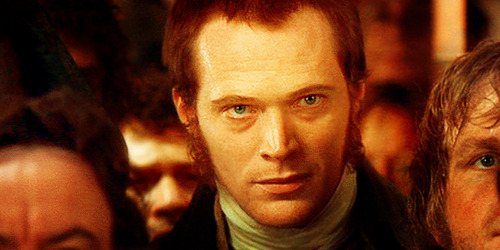
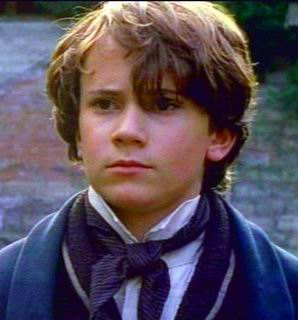
Great Adaptations Vol 1: BBC Miniseries (1981)


The 1981 BBC adaptation of Great Expectations looks exactly like you would expect a 1981 BBC adaptation of Great Expectations to look like: (meaning, we are completely devoid of production values, I think we forgot to remove that mic. from in front of the camera lens and I don’t think it looks very period appropriate dangling there; but, we cannot afford to fix it because we spent ALL of our money on sideburns with double-sided tape on the back so that our actors who, still surprisingly look like they live in 1981, have an aura of authenticity). The sets are bad; the lighting is bad; it looks far more like someone held up a camcorder ( a 1980s one, at that ) to a staged version of GE and went to town.


But I harbour some affection for it because a.) it doesn’t have a malicious bone in its body--- it is trying so earnestly hard and b.) uber-fidelity: if you want scene-by-scene, line-by-line to be funneled straight from the book to the small screen then, dudes, this is where it’s AT.

 
A few years back, the BBC released boxed sets of all sub-production-par  albeit faithful literary installments of the day and if you have seen the grainily lit, meandering Pride and Prejudice or even Silas Marner (oh Ben Kingsley) or even ADAM BEDE with chick that played Jane in the BBC Pride and Prej (1995) then you know what you are in for.


I have often noted that while adaptations of GE I have seen hit on one or two notes really well, no adaptation thus far (I am holding out hope, 2012! Don’t let me down!) captures the entire spirit or essence of the book. We don’t have a pitch-perfect medium-switch here.
Instead, This one touches a few points well:
Herbert Pocket and Pip’s relationship---this is often sacrificed a lot in in the interest of screen time; but this series goes on for friggin’ ever and so it has hours to draw this out--- and it does. Up to Pip going to Wemmick to try and sneak some of his Magwitch-fortune to his roommate/bestie.
[There are some awkward hugs when Pip and Herbert tentatively part --- and some weird crying--- and then Herbert awkwardly hugs Clara and weirdly cries some more--- ]
Bromance for the WIN

 
Joe Gargery’s Wisdom--- Joe is the salt of the earth and he is packed full of some of the sagest Dickensian lines in the world. Like, stuff about not lying because you’ll be crooked and some of us are blacksmiths and some of us goldsmiths and never the twain shall meet and what is betwixt friends, old chap, what larks ! ( heftily paraphrased: see source material )--- all these little nuggets are here and uttered with integrity-on-speed. This Joe is just a little too happy to be doing everything and is almost too good to be true ( you don’t see the dark, pained edges) but hell, he means well and he does actually say all of these lines….and he doesn’t know what to do with his hat when he goes to London and it is as FRIGGIN awkward as in the book ---made more awkward still by the bad production values and everyone’s sideburns…larks, kids, larks indeed!

The Estella Ending: Readers, remember the end of Villette and how frustratingly ambiguous it is and how half the team are (with Charlotte’s father) on the “NO! that cannot be right! What the heck you stupid shipwreck!” ship and the other half of the team is like, “Dude, he’s so friggin’ dead—but that’s okay because Lucy has independence and a cot of her own”? Well, Dickens did the same thing with the interchangeable, dvd -special- feature- alternate- ending to Pip and Estella’s “love” story. The series does this well.


This edition is so, so very cheesy; but it is trying so, so hard--- for hours—and hours---it might take less time to read the book.But, jiminy crickets! I am a-fond of it, y’all. It tries so hard to be nice and good ...
And WORD BY WORD it recounts every stupid, friggin’ line.

Ten points for the actress playing Mrs. Joe (Pip’s sister) post-forge attack. She just sits there as Biddy spoons broth at her gaping mouth---for HOURS

 
I am willing to bet you can find some of this on youtube, if you are so inclined

Tuesday, August 30, 2011

Arthur Slade and the E-Book Industry on LE RADIO


Fair readers, you all know that we subscribe to the school of All Things Arthur Slade. He is, as you know, Canada's best YA novelist ( at least in my awesome opinion) and a personal favourite of mine. As someone who works in the publishing industry (albeit on the educational side), I find Slade's consistent fascination and experimentation with the tenets of Canadian publishing appealing. That, and he does Skype visits to lucky classroom children across the globe.

Without further ado, I give you Arthur Slade on the Radio (once again proving he has the EXACT same speaking voice as my high school drama teacher--whom I liked, so that's a good thing):

Directions:
->Go to CBC Sunday Edition Website here
->Search under the Hour One paragraph and click midway through the black box there ( past all that asbestos exports stuff--- though that is interesting, too, if you are so inclined).

Slade speaks to his infatuation with Star Wars and how it triggered his imagination so acutely he began writing screenplays, teleplays and short, self-proclaimed "gory" stories.

As per always, most resonant of the Slade written agenda are the glorious glades of the Cypress Hills in rural Saskwatchewan.  This landscape informs so much of his fictional backdrop (he speaks to pouring poison down gopher hills in his youth---this guilt perhaps exorcised in Jolted) from Dust to Megiddo's Shadow.

He speaks to his respect for W.O. Mitchell, his over-active imagination and how his favourite librarian was a bit of a Google search engine for him ( especially when it came to hunting down books on medieval torture devices...)

He even speaks of Iron Maiden, his favourite "literary" band...

It's a veritable smorgasbord of fun.

Yes, he talks to the e-book thing.

YOUR TO-DO LIST:

  1. Listen to Arthur Slade ( as mentioned)
  2. Go to his website
  3. Read this amazing blog entry (funniest author blogpost ever)
  4. and buy ALL of his books (e-book or otherwise)


hurrah.

[Funny story: I once had a blog reader comment and ask me what my commission was and if he could hire me to promote his new book the way I promoted Arthur Slade around the web.
Sooo funny...
I just like promoting Canadian writers (especially the good-natured and talented ones)

Great Adaptations: Prelude


I love Great Expectations. It is my favourite Dickens novel and one of my favourite books ---ever since I read it at the tender age of 14 (the first chapters devoured while babysitting for kids from our church congregation. They had played with Legos. They went to bed. I read about Pip and his first, dreary encounter with Magwitch...)

If you read this blog, you will notice that Great Expectations occasionally comes up in conversation. I defended it for the Classics Circuit: Dickens vs. Austen Challenge, featured it in a Dickens Meme, and re-visited it through a religious lens.
Next year, to celebrate Dickens’ Bi-Centenary, we will be treated to not one; but TWO adaptations (one Hollywood; one BBC miniseries) of this classic novel. I am very closely following casting and production news on Dickensblog (where Gina extols every tidbit she picks up on in her close following of any and all things Dickens).

I thought that this transitory period between end of Summer and beginning of Fall was the perfect space to cuddle into this coziest of yarns. I re-visit parts of the novel often ( confession: I even have it bookmarked in Project Gutenburg edition at work); but wanted to re-visit some of the adaptations I have seen//own, as well as speak to those adaptations I have not been fortunate enough to see yet.


Adaptations I have seen previously and will be re-visiting for this series:

 1946 adaptation, dir. David Lean: featuring John Mills, Jean Simmons, Alec Guinness


1981 BBC miniseries adaptation: featuring Gerry Sundquist, Jason Smart

1998 adaptation, dir. Alfonso Cuaron (modernized): featuring Gwyneth Paltrow, Ethan Hawke, Robert DeNiro

1999 BBC miniseries adaptation: featuring Ioan Gruffudd, Charlotte Rampling, Justine Waddell


REVIEWS:

1946:
1981: Great Adaptations Vol 1 read review here
1998: Great Adaptations Vol III: read review here
1999: Great Adaptations Vol II read review here 
2011:Great Adaptations Vol IV: read review here 
2012:


There are adaptations I have not had the privilege of viewing, including the 1989 Disney Channel adaptation which many cite as being a great and accessible adaptation.[ See Dickensblog review ]
The above is not available on DVD and no amazon sellers will ship to Toronto due to its VHS format (sadness)

Another familiar adaptation from 1974 features Michael York and Sarah Miles -- supposedly written as a musical, this lesser production (according to reviewers) is the result of a musical movie stripped of its musical numbers and the blanks in between apparently cannot hold weight)

Upcoming 2012 editions:


BBC miniseries starring Mark Addy, Gillian Anderson, Shaun Dooley, etc. (REVIEW)

2012 adaptation dir. Mike Newell featuring Helena Bonham-Carter, Jason Flemyng, Ralph Fiennes

I look forward to reviewing and blogging about the aforementioned movies: focusing on proximity to text, sensibility and malleability of medium.