A few weeks ago I had the privilege of attending a series of screenings and lectures on Dickens on Screen at the TIFF Bell Lightbox.
I have summarized it and this is posted over at Dickensblog. Take a look.
Thanks, Gina... for letting me ramble :D
"A plate of apples, an open fire, and a 'jolly goode booke' are a fair substitute for heaven", vowed Barney. -L.M. Montgomery, 'The Blue Castle'
Showing posts with label dickens.. Show all posts
Saturday, December 29, 2012
Monday, December 17, 2012
DICKENS DICKENS DICKENS DICKENS DICKENS
I have had the most amazing and informative weekend of Dickensian bliss.
Right now, at the TIFF Bell Lightbox, they are screening a multitude of Dickens films in honour of the Bicentenary.
Since Thursday, Toronto has had the privilege of having Adrian Wootton ( late of the BFI and the curator of the Dickens and Film project) on hand to lecture and to introduce some of the fabulous and rare footage and films offered to avid Dickensians.
Thursday night, it started with the beautiful 1946 David Lean adaptation of Great Expectations; then continued Friday and Saturday with an array of lectures and screenings and.... oh my!
It has been one of the highlights of my year. I enjoyed settling into Cinema 4 of the TIFF Bell Lightbox and immersing myself in all things Dickens.
As a precursor, I attended the Soulpepper Production of A Christmas Carol on Wednesday evening couched in the beautiful Victorian Christmas market. At the same time, in the same place, the Word Festival 2012 celebrated Dickens with ongoing, voluntary reading of A Tale of Two Cities streamed everywhere in the world.
I will be writing about these lovely things in more detail; but wanted to check in on my blog readers and let them know that, yes, I DO live in the most magnificent city in the world.
WHAT LARKS!
Right now, at the TIFF Bell Lightbox, they are screening a multitude of Dickens films in honour of the Bicentenary.
Since Thursday, Toronto has had the privilege of having Adrian Wootton ( late of the BFI and the curator of the Dickens and Film project) on hand to lecture and to introduce some of the fabulous and rare footage and films offered to avid Dickensians.
Thursday night, it started with the beautiful 1946 David Lean adaptation of Great Expectations; then continued Friday and Saturday with an array of lectures and screenings and.... oh my!
It has been one of the highlights of my year. I enjoyed settling into Cinema 4 of the TIFF Bell Lightbox and immersing myself in all things Dickens.
As a precursor, I attended the Soulpepper Production of A Christmas Carol on Wednesday evening couched in the beautiful Victorian Christmas market. At the same time, in the same place, the Word Festival 2012 celebrated Dickens with ongoing, voluntary reading of A Tale of Two Cities streamed everywhere in the world.
I will be writing about these lovely things in more detail; but wanted to check in on my blog readers and let them know that, yes, I DO live in the most magnificent city in the world.
WHAT LARKS!
Friday, September 14, 2012
FIlm Review: 'Great Expectations, 2012'
Gina at Dickensblog was kind enough to post my review of the 2012 Great Expectations which debuted at the Toronto International Film Festival the other night....complete with my blurry blackberry pic :)
Take a gander at dickensblog
Monday, June 04, 2012
Over at Dickensblog....
Gina was nice enough to let me ramble about Esther Summerson from Bleak House and our society's obsession with physical appearance
Thursday, April 19, 2012
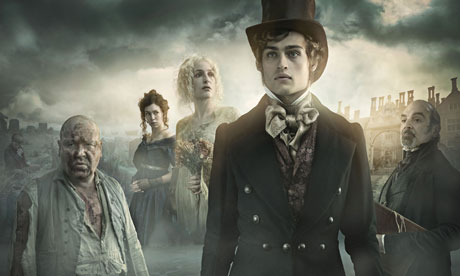
Great Adaptations IV: 2011 BBC
The characterization is deft and taut and each of these
well-known personages, who could easily become caricatures so inferenced are
they in our cultural psyche, are instead the embodiment of pathos and light, of
humour and heartbreak: of proof that, above all, Great Expectations is a
narrative borne of extraordinary acts of unwarranted kindness.
It is no surprise that I am completely befuddled and
bewildered by the continual influence this particular tale has on me: how it
exposes my vulnerability, my strengths, and the darker tenets of human
expectation: the trajectory, and further tragedy, begotten of our wanting
something more…. But this particular series drew from creaked corner into
luminous light the characters I have often felt between the pages of my
well-worn novel. During the Bicentenary
Celebrations earlier this year, one statistic ( which I cannot cite,
unfortunately) listed both Miss Havisham and Joe Gargery as two of the 10 best-known
Dickensian characters. Great
Expectations---whether having been forced on readers in high school---or having
been re-visited with stylistic enterprise in the 90s or whether (fortunately)
given weight in two current adaptations
( this miniseries and the upcoming Hollywood) film or even as a funky premise
for a South Park episode--- is an inescapable portion of the Western
canon. Perhaps because we can see so
much of ourselves in Pip, we can see so much of what we would like to be in the
actions of Joe and Herbert and Magwitch, we enjoy the Soap Operatic twists and
turns linking Estella, her bat-crazy adoptive mother and the sinister Jaggers
and his erstwhile maid Molly---- it’s human relations: sex, power, money, loss
of money, disillusionment, odd reconciliation at its best.
There’s crime, almost murder, escaped convicts, boat chases, whirls of balls and abusive
husbands…. Who wouldn’t want this?
As ultimately complex as the tale is and as many characters
as it introduces ( some completely left out of this particular imagining: most
noticeably Biddy) it is, at its core, a sleek bildungsroman pitting a young and
good-hearted orphan against the sudden Cinderella-like fate that follows him to
his apprenticeship years as a blacksmith in the Kent Marshes.
This adaptation has received numerous BAFTA nominations for its
craft and presentation and it is quite easy to see why: it is a tangible and delectable world that
you can smell and see and touch: it is gritty and horrible, it is crusted with
the mould of Satis House and encrypted in the smoke billowing from the forge and
as Pip sheds his cocoon to dress in the gentleman’s clothes that propel him out
into society with his lovely pal Herbert, we see the finest threads carefully
woven to speak their intricate tailorship: a perfect recognition of the period
and the Era’s finery.
It also includes some of my favourite performances of some
of the best-loved Dickensian characters.
For my part, I feel that this
adaptation’s Herbert Pocket, Magwitch, Joe Gargery, Pip and Miss Havisham are
the best I have seen.
I encourage you to spend some time in this world. I have
revisited it quite a bit. This past
week, I was traveling for work and ended up steeping some tea in my hotel room
and catching it again on iTunes:
obsessed? Perhaps a little; but more enamored and bewitched that a dazzling
presentation has wrought from my mind’s eye to camera’s lens a kaleidoscopic
Victorian world I crave to seep into time and again.
Wednesday, February 15, 2012
In Which I pull a few BBC miniseries out of my vast collection....
This past weekend I re-visited two BBC miniseries from the Golden Age of adaptation: the mid-1990s
The first, Martin Chuzzlewit, was in honour of Dickens’ bi-centenary. The second, Middlemarch, was a borne of an impulse to revisit the complicated whir of industrial events spinning the cogs in the lives of Dorothea Brooke and Tertius Lydgate.
Martin Chuzzlewit has never been a favourite Dickens novel of mine. I do appreciate its thesis on avarice, selfishness and the slow, tormented descent into sheer villainess; but its peripheral characters far outshine the main characters and the love story of the younger Martin Chuzzlewit and the almost possibly good Mary Graham pale when I compare them to, say, Lucie and Sydney Carton or Amy Dorrit and Arthur Clennam. Nevertheless, the secondary characters are divinely, colourfully Dickensian: including the stalwart Tom Pinch, the greedy and horrifyingly abusive and murderous Jonas Chuzzlewit and the dastardly Pecksniff.
Montague Tig and Mrs. Gamp as well as the refined old gent Chuffey help round out a myriad of some of Dickens’ most eccentric oddities. Merry and Cherry Pecksniff are deliciously silly and frivolous and the adorable Mark Tapley revives some of the dragging scenes with his fresh zest and optimism.
Martin Chuzzlewit is known for painting a primitively dirty America to instill a sense of new world dread in its English readers. Certainly the scenes in the series which find Mark and Martin in supposed Eden (rather a malaria-ridden swamp) are as well-painted here as in the novel. The moments where the lovely and good-hearted and golden Tom Pinch looks up from the organ where he practices at the cathedral to feast on the angelic countenance of Mary Graham captures you with the same sense of devotedly unrequited romance as bespeaks Tom’s journey in between the pages of the novel.
The casting of the series is excellent. Paul Scofield provides a WONDERFUL Martin Chuzzlewit, Tom Wilkinson and Keith Allen (Sheriff of Nottingham in ROBIN HOOD!!!) are both equally horrifying villains as Pecksniff and Jonas Chuzzlewit respectively, Pete Postlethwaite is inspired as Montague Tigue …and John Mills makes a sweet Chuffey. I cannot recommend the casting highly enough. The character depth and realization is multi-dimensional here and no one is static: each revolves, evolves and changes due to circumstance and plot developments and it really is a wonderful to behold how they have transferred something so intuitively Dickens and painted it on screen.
Andrew Davies (one of the finest screenwriters and adaptors of all time) does well in focusing his attention to great detail when it comes to painting the definition of each of these three threaded storylines. Equal weight is given and enough backstory and character development ensues. Viewing Middlemarch is, at base, an enriching experience: the frosting is the eccentric population supporting these three sects: the wonderfully noble yet prone to gambling chaplain Mr. Farebrother, the tediously loquacious Arthur Brooke, the conniving Mr. Bulstrode who cannot leave his past behind him…. Plate this against the Great Reform Bill and the expansion of the railroad, and you have a wonderfully historical portrayal of life in a provincial community.
If you are a fan of BBC period pieces and you have not seen either of these, I heartily recommend them. Moreover, seek out their source material and bask in the multi-layered, heavily caricatured tapestry of Victorian Literature’s greatest.
Sunday, February 12, 2012
Mortimer and Eugene, a Study in Friendship
Hey friends,
Gina was kind enough to post my rambles about Mortimer and Eugene from Our Mutual Friend over at dickensblog today.
Read it here. I'm sure you'll agree that Mortimer needs some love at the end of the story too!
Gina was kind enough to post my rambles about Mortimer and Eugene from Our Mutual Friend over at dickensblog today.
Read it here. I'm sure you'll agree that Mortimer needs some love at the end of the story too!
Thursday, February 09, 2012
Our Mutual Friend
To celebrate Dickens’ Birthday on the 7th, I decided to re-watch Our Mutual Friend: one of the best miniseries ever produced by the BBC and one I had not seen in an age.
Our Mutual Friend has long been one of my favourite Dickens’ novels ( next to Great Expectations it is, indeed, my favourite) because it is such a whirling universe unto itself. We are forever see-sawed from the murky depths of the Thames to the furnished, veneered ponce and circumstance of London’s elite. It is Victorian overload: propelling us from one end of the social sphere to the other, reminding us that there was no way for middleground to subsist.
From the moment we meet the Lamleys: fated to spend a life of misapprehension due to their failure to recognize that neither had property or wealth upon their wedding, we realize that this will be Dickens' thesis on wealth and greed: on new money and old, on the violence and mystery shrouding wills and estates, of a Jarndyce and Jarndyce scale of horror at the supposed death of heir to the dust fortune, John Harmon.
Dickens does nothing shoddily and every character and every well-developed scene serves its purpose in building the blocks of this intricate universe. Our shift from Gaffer Hexam and his gloriously mute daughter Lizzie dragging corpses from the Thames on a moonlit night to the flash of the Lamley’s wedding party is meant to beguile and shake our senses and it does. Like the best adaptations, the miniseries does well at offering screentime to all major players while slowly and painstakingly doling out the Dickensian secrets of history and mystery that will all add up together in the end.
To walk you through a recap of all the minute details of the plot would be to no avail. Like all complicated Dickens (think Bleak House! Think Little Dorrit !) it is best for you to see and unravel the mysteries on your own. This was Dickens' last completed novel and it is certainly his most competent. While critics argued that Oliver Twist was a hodgepodge of loose plot ends, Dickens has tightened his style, has mapped out an impressive amount of well-developed and dimensional characters and has excelled at his forte: bringing seemingly unrelated circumstances together and welding them into revelations about the characters, their story, and the plight and injustice of society.
Our Mutual Friend is notable for colouring two of Dickens’ most beguiling heroines and their respective love stories (Bella Wilfer and John Rokesmith, Lizzie Hexam and Eugene Wrayburn), for introducing us to the charmingly bored pair of Eugene and Mortimer Lightwood, for ushering us into the world of the Boffins: well-deserving folk with hearts as big as their new fortune, to Sloppy, the slow and happy child-like mangler, to Venus who deals in bones and Rogue Riderhood who scrapes the Thames for fortune, to Bradley Headstone who hovers with passionate possession in the foreground and traipses the streets of London at night (Dickens was known to spend many evenings plotting while strolling the maze of his favoured city and we can see where his efforts paid off in his well-drawn descriptions), to Mr. Tremlow: the oft silenced voice of reason in a hodge-podge of socially stuffy nonsense.
The casting of the miniseries is perfect. I first watched it after finishing the book for a Dickens’ seminar in university and I was impressed at exactly how faithful to the broad and intimidating breadth of the text it was. Our Mutual Friend is often overlooked when we recount our favourite Dickens and our favourite characters. The problem(?) is that he wrote so prolifically and introduced us to such a multi-layered universe constructed with such intricate detail and such a plethora of pervading and flamboyant characterization---from social high to degrading low—that it is as easy to narrow in on a favourite Dickens as it is to choose a member of your family. You can’t cut one part out without understanding the whole. So, if you have yet to read Our Mutual Friend, I envy you for you have yet to stumble upon a wealth of mystery and intrigue of aliases and romance I wish I had yet unread and in my reading future…. And if you haven’t seen the miniseries yet; I highly, highly recommend it as one of the strongest BBC adaptations ever produced.
Our Mutual Friend has long been one of my favourite Dickens’ novels ( next to Great Expectations it is, indeed, my favourite) because it is such a whirling universe unto itself. We are forever see-sawed from the murky depths of the Thames to the furnished, veneered ponce and circumstance of London’s elite. It is Victorian overload: propelling us from one end of the social sphere to the other, reminding us that there was no way for middleground to subsist.
From the moment we meet the Lamleys: fated to spend a life of misapprehension due to their failure to recognize that neither had property or wealth upon their wedding, we realize that this will be Dickens' thesis on wealth and greed: on new money and old, on the violence and mystery shrouding wills and estates, of a Jarndyce and Jarndyce scale of horror at the supposed death of heir to the dust fortune, John Harmon.
Dickens does nothing shoddily and every character and every well-developed scene serves its purpose in building the blocks of this intricate universe. Our shift from Gaffer Hexam and his gloriously mute daughter Lizzie dragging corpses from the Thames on a moonlit night to the flash of the Lamley’s wedding party is meant to beguile and shake our senses and it does. Like the best adaptations, the miniseries does well at offering screentime to all major players while slowly and painstakingly doling out the Dickensian secrets of history and mystery that will all add up together in the end.
To walk you through a recap of all the minute details of the plot would be to no avail. Like all complicated Dickens (think Bleak House! Think Little Dorrit !) it is best for you to see and unravel the mysteries on your own. This was Dickens' last completed novel and it is certainly his most competent. While critics argued that Oliver Twist was a hodgepodge of loose plot ends, Dickens has tightened his style, has mapped out an impressive amount of well-developed and dimensional characters and has excelled at his forte: bringing seemingly unrelated circumstances together and welding them into revelations about the characters, their story, and the plight and injustice of society.
Our Mutual Friend is notable for colouring two of Dickens’ most beguiling heroines and their respective love stories (Bella Wilfer and John Rokesmith, Lizzie Hexam and Eugene Wrayburn), for introducing us to the charmingly bored pair of Eugene and Mortimer Lightwood, for ushering us into the world of the Boffins: well-deserving folk with hearts as big as their new fortune, to Sloppy, the slow and happy child-like mangler, to Venus who deals in bones and Rogue Riderhood who scrapes the Thames for fortune, to Bradley Headstone who hovers with passionate possession in the foreground and traipses the streets of London at night (Dickens was known to spend many evenings plotting while strolling the maze of his favoured city and we can see where his efforts paid off in his well-drawn descriptions), to Mr. Tremlow: the oft silenced voice of reason in a hodge-podge of socially stuffy nonsense.
The casting of the miniseries is perfect. I first watched it after finishing the book for a Dickens’ seminar in university and I was impressed at exactly how faithful to the broad and intimidating breadth of the text it was. Our Mutual Friend is often overlooked when we recount our favourite Dickens and our favourite characters. The problem(?) is that he wrote so prolifically and introduced us to such a multi-layered universe constructed with such intricate detail and such a plethora of pervading and flamboyant characterization---from social high to degrading low—that it is as easy to narrow in on a favourite Dickens as it is to choose a member of your family. You can’t cut one part out without understanding the whole. So, if you have yet to read Our Mutual Friend, I envy you for you have yet to stumble upon a wealth of mystery and intrigue of aliases and romance I wish I had yet unread and in my reading future…. And if you haven’t seen the miniseries yet; I highly, highly recommend it as one of the strongest BBC adaptations ever produced.
Tuesday, February 07, 2012
200
| John Harmon wins the love of Bella Wilfer in "Our Mutual Friend" |
You let me hide between your pages when the world seemed ostracizing
Somehow you understood me so much you threw Amy Dorrit and Bella Wilfer in my way.
You hold a mirror up to myself when I am in need of self-reflection: when greed and jealousy blights my path when I need to be re-told that love leads to redemption and that characters from the lowest depths to the highest heights can pepper a graceless world with a sense of ardent light
You string romance and set my cheeks burning
You paint pathos and my eyes will never cease to tear
There are times when living in the vast world you created usurps my present reality as I slink, comfortably, as if to the hearth of a friend.
Many have been the times when I have looked up, enraptured, frazzled and heated from a spree between your pages and been surprised not to find you sitting across from me: spilling your strange head-tilts and myriad of dialects and voices from across a table or beyond my bedpost.
| Lucie and Sydney Carton in "A Tale of Two Cities" |
I have friends, yes, of the flesh and blood sort; but sometimes we imaginative types are beyond the grind of the traditional world. I yearn for sentiment and the groggy depths of your mired world; of the bells tolling and ash on cobblestone, of the wayward path that leads orphans to makeshift home and teaches the ungrateful of higher power and metes justice and humanity to those deserving.
It's not just a case of your indelible print on social construction or the way that people were forced to extend a knowing hand to charity, to wake up and realize the potently unscrupulous world around them, it is the light and happy way you doled out moments of sheer trifle.... they are, as you said, the sum of life.
| Arthur Clennam, "Little Dorrit" |
Sometimes my life is tumultuous and my world doesn't make any sense so, without you minding, I hope, I slink into yours. I have for years. You teach me about myself time and again, you urge me to strive to see people as my equals, to extend a hand of courtesy, to take a moment and steal a thought for the downtrodden. I never met you and yet I have spent more time with you than I have people of my nearest acquaintance. It's because I cannot separate myself from your thumbprint: your existence has stolen miles of my imaginary construct and not one day goes by when something you taught me: consciously or inadvertently doesn't scrape across my mind's eye.
Wednesday, February 01, 2012
In which I write about "Great Expectations" for FEMNISTA
Hello all, Femnista is celebrating the Dickens Bicentenary with an issue wholly devoted to the Great Victorian Author we LOVE!
My article can be found here on p.26 entitled "Unconditional Love" and our good friend Gina (of Dickensblog) also has an exceptionally eye-opening piece about the enigma that is Sydney Carton.
As per always, there is a faith-driven slant to Femnista matched with some great literary thoughts and ideas. I was super excited to be part of this endeavour.
Check out at Charity's Place for more editions of this awesome e-zine.
I will be featured in two upcoming editions of Femnista as well and will keep you posted when they go live!
My article can be found here on p.26 entitled "Unconditional Love" and our good friend Gina (of Dickensblog) also has an exceptionally eye-opening piece about the enigma that is Sydney Carton.
As per always, there is a faith-driven slant to Femnista matched with some great literary thoughts and ideas. I was super excited to be part of this endeavour.
Check out at Charity's Place for more editions of this awesome e-zine.
I will be featured in two upcoming editions of Femnista as well and will keep you posted when they go live!
Wednesday, January 04, 2012
Great Adaptations in Context: The Lasting Appeal of "Great Expectations"
[images displayed in this post are from the 2011 BBC adaptation of Great Expectations]
2012 will offer viewers two new adaptations of Great Expectations: the 2011 BBC miniseries starring Ray Winstone and Gillian Anderson (to premiere on Masterpiece Theatre in April) and the big-screen adaptation by Director Mike Newell.
The long-standing appeal of this particular Dickens novel allows it to sit well in a year where the Dickens Bi-Centenary will seep into the literary stratosphere. Great Expectations , and the many characters which dwell between its covers, remains a household experience for students and lovers of English Literature. It's interesting to note how this has become one of Dickens' best-loved novels: considering his prolific offering and the numerous books which could easily have taken up the Recommended Reading Lists of high schools and universities across the Globe. Yet, there is something about Great Expectations that loans itself to timelessness.
Dickens' usual themes of orphan children caught in a climate of social injustice ( you need turn no further than Uncle Pumblechook and Mrs. Joe's Christmas dinner sermonizing to realize how little children were thought of ) is resonant here. The kuntsleroman bridge that sees the flourishing of David Copperfield and, to some extent, Oliver Twist, features the (mis)adventures of Pip: a Cinderella-boy who climbs the social ladder under the most unlikely of circumstances.
From the Toronto Public Library ( where all good things are housed), I signed out a documentary: part of the Discovery Channel's Great Books series and narrated by Donald Sutherland. This was a great piece to help me reflect on my recent re-visitation of one of my favourite tales.
John Irving, Alfonso Cuaron (director of the modernized 1998 film adaptation), Ethan Hawke and a myriad of Dickensian scholars are on hand to talk to the lasting work. Cuaron references Great Expectations as "essential to the human spirit." Obviously meant to appeal to the high school literature student, the documentary relies heavily on interspersing its narration with clips from adaptations of the tale on screen: from a silent film version, through the 1946 David Lean version, pulling on a couple of BBC television serials and even showing parts of the modernized take.
John Irving speaks to how it inspired him to become a writer and the narrator speaks to the intensely theatrical presence of Dickens as a melange of popstar, politician and icon. The most important English writer since Shakespeare, that which is Dickensian is a universe unto itself: from the festive spirit of his trademark Christmas Carol to the downtrodden orphans which pulled on his acute sense of social justice.
Dickens believed ( and knew from firsthand experience), that children have a special capacity for perceiving the world; thus every orphan, such as Pip, is an emblem of himself. Pip moreso because he shared a similar physical upbringing to Dickens: that of the Kent marshes. For a child who was crassly pulled from a comfortable upbringing to work in a blacking shop to support his father's time in Marshalsea debtor's prison ( think Little Dorrit and also think of the harrowing prospect awaiting Pip before the intervention of Joe Gargery in GE), Dickens very much understood the power of social prospect. The fortune that befalls Pip looms like the Cinderella story we all yearn for: reward for seeming nothing.
Dickens was able to speak to this and to recall his own vapid childhood years while in the height of his creative powers. The public was putty in his hands and the medium through which he spun his yarns (that of serialization) allowed him to improvise: should the public outcry of critique resound upon the end of a weekly serial, then he could do what was needed to later change the outcome for more promising applause. Great Expectations, ambiguous ending and all, was a similar product to this method: published in 36 instalments in Dickens' magazine All the Year Round.
As New Yorkers eagerly awaited the ship bearing a manuscript which would seal Little Nell's fate ( in the infamously sentimentalized Old Curiousity Shop), so were readers left deliberately hanging for the next view of Magwitch, the secret wrapped up in the relationship between Compeyson and Havisham, the twist (a majorly lovely plot twist at that) surrounding Estella's estranged parentage. When Pip discovers he's a pawn used by Miss Havisham, Jaggers and, to some extent, Magwitch, the audience feels greatly with him. They are caught in his soap opera. His story becomes, like Dickens' own experience, very much their own.
Especially for Londoners. Dickens was known to refer to London as his "magic lantern" and a thriving, bristling, bubbling character it becomes in all of his great sequences of action. In Great Expectations, Dickens allows the reader to glimpse a bit of his personal childhood experience; but leads him still greater into the abyss of Newgate, high fortune, punting on the thames, excess and delusion.
Pip's illusion becomes our own as the orb of Great Expectations speaks to George Orwell's belief that Dickens' works were "not a series of books; but a world).
A lot of what was explored in his short documentary is familiar to those who have a past with Dickens (I studied him extensively as part of my Victorian specialist degree: even took a seminar devoted to him); but what it speaks to is the lasting presence of Dickens on society.... and to the lasting impression Great Expectations makes on social construction as a whole. The most gentlemanly acts, according to the documentary, and viscerally viewed in the novel, are those which act out of grace and redemption. What is a gentleman?, is a question that can well be asked of Pip as he mires through the mazes of self-discovery. What the documentary speaks to and what you will soon learn as you visit this tale, is that the most gentlemanly moments Pip has have little to do with his mysterious patronage or sudden fortune. Rather, the gentle way he speaks to a prisoner on the marshes; the way Joe gently guides Pip through childhood, Pip's loyalty and devotion to Magwitch as he nears the end of his life in blackened disgrace.
The measure of Dickens' humanity, in circumspect, is threaded in the tales that best reflect a mirror to our own shortcomings : a reflection like Great Expectations.
John Irving, interviewed, mentioned that he was saving one unread Dickens ( in his case Our Mutual Friend), for a rainy day. I think it's lovely that he has one unturned to look forward to, especially having heard him speak to the great influence that Great Expectations particularly had on his creative disposition. Irving mentions that he was disappointed in advance at the looming end of the novel; that it was one of the glorious books that made you want to slow down as you paced forward, for fear that you would run out of sentences too soon.
I sometimes wish I could rewind my reading history and meet the multitude of eccentrics I first encountered in the pages of a Dickens' novel in my latter childhood and teen years; but, alas, I am bereft of a rainy-day Dickens and must console myself with the prospect of revisitation: sometimes in the fortunate medium of film and television adaptations.
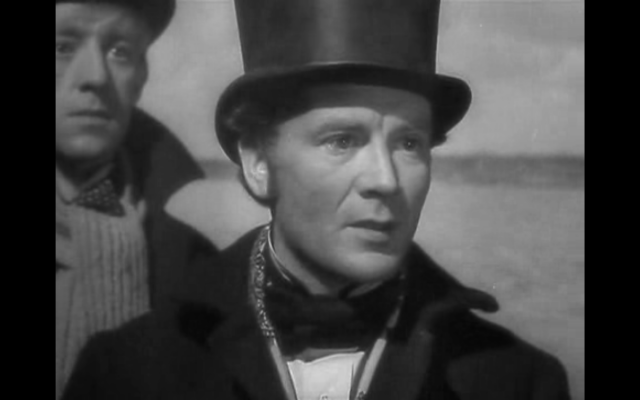
2012 will offer viewers two new adaptations of Great Expectations: the 2011 BBC miniseries starring Ray Winstone and Gillian Anderson (to premiere on Masterpiece Theatre in April) and the big-screen adaptation by Director Mike Newell.
The long-standing appeal of this particular Dickens novel allows it to sit well in a year where the Dickens Bi-Centenary will seep into the literary stratosphere. Great Expectations , and the many characters which dwell between its covers, remains a household experience for students and lovers of English Literature. It's interesting to note how this has become one of Dickens' best-loved novels: considering his prolific offering and the numerous books which could easily have taken up the Recommended Reading Lists of high schools and universities across the Globe. Yet, there is something about Great Expectations that loans itself to timelessness.
Dickens' usual themes of orphan children caught in a climate of social injustice ( you need turn no further than Uncle Pumblechook and Mrs. Joe's Christmas dinner sermonizing to realize how little children were thought of ) is resonant here. The kuntsleroman bridge that sees the flourishing of David Copperfield and, to some extent, Oliver Twist, features the (mis)adventures of Pip: a Cinderella-boy who climbs the social ladder under the most unlikely of circumstances.
From the Toronto Public Library ( where all good things are housed), I signed out a documentary: part of the Discovery Channel's Great Books series and narrated by Donald Sutherland. This was a great piece to help me reflect on my recent re-visitation of one of my favourite tales.
John Irving, Alfonso Cuaron (director of the modernized 1998 film adaptation), Ethan Hawke and a myriad of Dickensian scholars are on hand to talk to the lasting work. Cuaron references Great Expectations as "essential to the human spirit." Obviously meant to appeal to the high school literature student, the documentary relies heavily on interspersing its narration with clips from adaptations of the tale on screen: from a silent film version, through the 1946 David Lean version, pulling on a couple of BBC television serials and even showing parts of the modernized take.
John Irving speaks to how it inspired him to become a writer and the narrator speaks to the intensely theatrical presence of Dickens as a melange of popstar, politician and icon. The most important English writer since Shakespeare, that which is Dickensian is a universe unto itself: from the festive spirit of his trademark Christmas Carol to the downtrodden orphans which pulled on his acute sense of social justice.
Dickens believed ( and knew from firsthand experience), that children have a special capacity for perceiving the world; thus every orphan, such as Pip, is an emblem of himself. Pip moreso because he shared a similar physical upbringing to Dickens: that of the Kent marshes. For a child who was crassly pulled from a comfortable upbringing to work in a blacking shop to support his father's time in Marshalsea debtor's prison ( think Little Dorrit and also think of the harrowing prospect awaiting Pip before the intervention of Joe Gargery in GE), Dickens very much understood the power of social prospect. The fortune that befalls Pip looms like the Cinderella story we all yearn for: reward for seeming nothing.
Dickens was able to speak to this and to recall his own vapid childhood years while in the height of his creative powers. The public was putty in his hands and the medium through which he spun his yarns (that of serialization) allowed him to improvise: should the public outcry of critique resound upon the end of a weekly serial, then he could do what was needed to later change the outcome for more promising applause. Great Expectations, ambiguous ending and all, was a similar product to this method: published in 36 instalments in Dickens' magazine All the Year Round.
As New Yorkers eagerly awaited the ship bearing a manuscript which would seal Little Nell's fate ( in the infamously sentimentalized Old Curiousity Shop), so were readers left deliberately hanging for the next view of Magwitch, the secret wrapped up in the relationship between Compeyson and Havisham, the twist (a majorly lovely plot twist at that) surrounding Estella's estranged parentage. When Pip discovers he's a pawn used by Miss Havisham, Jaggers and, to some extent, Magwitch, the audience feels greatly with him. They are caught in his soap opera. His story becomes, like Dickens' own experience, very much their own.
Especially for Londoners. Dickens was known to refer to London as his "magic lantern" and a thriving, bristling, bubbling character it becomes in all of his great sequences of action. In Great Expectations, Dickens allows the reader to glimpse a bit of his personal childhood experience; but leads him still greater into the abyss of Newgate, high fortune, punting on the thames, excess and delusion.
Pip's illusion becomes our own as the orb of Great Expectations speaks to George Orwell's belief that Dickens' works were "not a series of books; but a world).
A lot of what was explored in his short documentary is familiar to those who have a past with Dickens (I studied him extensively as part of my Victorian specialist degree: even took a seminar devoted to him); but what it speaks to is the lasting presence of Dickens on society.... and to the lasting impression Great Expectations makes on social construction as a whole. The most gentlemanly acts, according to the documentary, and viscerally viewed in the novel, are those which act out of grace and redemption. What is a gentleman?, is a question that can well be asked of Pip as he mires through the mazes of self-discovery. What the documentary speaks to and what you will soon learn as you visit this tale, is that the most gentlemanly moments Pip has have little to do with his mysterious patronage or sudden fortune. Rather, the gentle way he speaks to a prisoner on the marshes; the way Joe gently guides Pip through childhood, Pip's loyalty and devotion to Magwitch as he nears the end of his life in blackened disgrace.
The measure of Dickens' humanity, in circumspect, is threaded in the tales that best reflect a mirror to our own shortcomings : a reflection like Great Expectations.
John Irving, interviewed, mentioned that he was saving one unread Dickens ( in his case Our Mutual Friend), for a rainy day. I think it's lovely that he has one unturned to look forward to, especially having heard him speak to the great influence that Great Expectations particularly had on his creative disposition. Irving mentions that he was disappointed in advance at the looming end of the novel; that it was one of the glorious books that made you want to slow down as you paced forward, for fear that you would run out of sentences too soon.
I sometimes wish I could rewind my reading history and meet the multitude of eccentrics I first encountered in the pages of a Dickens' novel in my latter childhood and teen years; but, alas, I am bereft of a rainy-day Dickens and must console myself with the prospect of revisitation: sometimes in the fortunate medium of film and television adaptations.
Monday, November 21, 2011
'Great Expectations' Photos make THIS gal VERY happy!
Thanks to our friend Gina at Dickensblog, I have been kept in the near loop of all things Great Expectations and I remain super duper excited about the new adaptations in our near midst!
Check out these photos! :


[Source]
Also, make sure to check out Dickensblog to learn everything you would ever want to know (and that still wouldn't be enough) about Charles Dickens, film adaptations and where all things Dickensian can be found on the web!
Check out these photos! :
[Source]
Also, make sure to check out Dickensblog to learn everything you would ever want to know (and that still wouldn't be enough) about Charles Dickens, film adaptations and where all things Dickensian can be found on the web!
Wednesday, October 12, 2011
My guest spot on 31 Days of Hallowe'en: Dickens and Hallowe'en
I was fortunate enough to feature in Read All Over Review's 31 Days of Hallowe'en and even more fortunate to speak on a favourite subject, DICKENS! I have reposted it here for you to see; but make sure you check out the website and follow all 31 gruesome, literary days!
31 Days of Halloween { guest post } Dickens and Hallowe’en:
Today we are joined by Rachel from A Fair Substitute For Heaven, who talks about one of my favorite subject: Charles Dickens!
During October many readers pine for the fiction that makes our skin creep and crawl, for things that go bump in the night, for the chilling ghost stories of The Headless Horseman or James’ The Turn of the Screw. In literary fiction, Charles Dickens, fed heaps of the grueling macabre into his fiction. This Hallowe’en, I want to walk you through a few chilling vignettes of Dickens at his most gruesome. We’ll meet ghosts, thieves, witness murders, learn of Dickens’ penchant for descriptions of the gallows and paint a clear, rain-soaked cobblestoned world of gaslight and fright.Here are a few examples of the dreariest Dickensian tales, a snapshot of some of their most malevolent characters and hopefully enough tingly-feelings to beguile you to revisit their worlds once more:OLIVER TWIST
Photo Caption: Fagin waits to be hangedThere is a portentous sense of the macabre hovering in many of Dickens’ grim Victorian worlds including the conniving Fagin, the bandleader of a pack of boy thieves and Bill Sykes, the murderous henchman who skulks the streets of London at night: pilfering here and there, his mangy dog in tow.Nearer the beginning of Oliver Twist, the scene is an undertaker’s: Oliver leads funeral processions for children’s funerals in a tall, be-plumed black hat and his forced to sleep in the dank dusk with coffins awaiting their next corpse.According to eyewitness accounts, during Dickens’ numerous reading tours of Europe and North America, audiences were moved to fainting when Dickens read of the brutal death of Nancy at the hands of her lover, Bill Sykes.GREAT EXPECTATIONS
Photo Caption: Miss Havisham shows Pip the remnants of her abandoned wedding feast.The macabre pervades Great Expectations from the opening scene: a gloomy graveyard where the young and impressionable Pip visits his deceased parents and long dead siblings. From out of the fog of the marshes he is pounced upon by a convict, a veritable bogeyman. The haunting of young Pip’s formative years continues with a house as gothically eerie as they come: Satis House wherein the phantom-like Miss Havisham strolls in yellowed white wedding dress, her untouched wedding feast rotting upon a long table: alive with maggots, beetles, mice and rats; the clocks all stopped timelessly, her long sinewy fingers folded as she plays maniacal matchmaker with Pip and her coldhearted ward Estella.If that’s not enough, the villainous Orlick meanders in: an embittered blacksmith’s help who is as violent as his stalkerish behavior would allot.OUR MUTUAL FRIEND
Photo Caption: the ThamesVillains are pronounced in Our Mutual Friend, this meandering and carousel-like novel featuring unidentified corpses, cases of mistaken identity, lies, betrayal and the theft of goods from bodies lost to the river, Not unlike the dastardly M. Thenardier scraping the corpses of the barricades after the July Revolution in Les Miserables, so Gaffer Hexam and Rogue Riderhood skulk the dirty river Thames by moonlight in hopes of finding a rare diamond in the rough. When Rogue Riderhood betrays his partner, Gaffer Hexam, it is for a murder: that of the unfortunate John Harmon. Other characters in this dim tale include the taxidermist, Mr. Venus, who is in love with bones and Bradley Headstone: whose name is just as pernicious as it sounds…. When we’re not wallowing in talk of the dust pile heaps that employee many helpless and hopeless of the downtrodden, we are riveted by the manic motives of the jealous Headstone who rages in violent episodes as he pines for the beautiful Lizzie Hexam.Other Dickens novels feature moments that greatly fall into the category of plain creepy….LITTLE DORRITPoe’s The Fall of the House of Usher puts one immediately in mind of its predecessor, the fall of the House of Clennam in Little Dorrit : years of secrets, violence and shame crumble under the dusty weight of a structure ravaged to the ground.A TALE OF TWO CITIESThe Vengeful Madame Defarge performing that most mundane of domestic tasks, knitting, at the foot of the guillotine: her lust for blood as quick and frenzied as her hands clacking her speedy needles.A CHRISTMAS CAROL
Caption: Scrooge is led by the Ghost of the Future to his gravesite: abandoned and aloneThe famous Haunting of Scrooge may be a few months too early for our purposes yet is one of the most famous Ghost stories: appropriating ethereal supernatural presence for both good and ill purposes. Near the end, the miser Scrooge comes face-to-face with his mortality and the vapid existence he led when his abandoned gravestone is pointed out to him amidst the unfeeling snow.BLEAK HOUSEBleak House: features the batty Miss Flite—who christens her caged birds with apocalyptic names awaiting the day of judgment and a court case that consumes young, fresh and impressionable wards in a life-sucking way not unlike vampirismWhile Bleak House’s Lady Deadlock is deliciously, drearily stagnant, awaiting the colour in life that will never fill the dark contours of her dreary life; so Mr. Tulkinghorn, her nemesis, skulks nearby with evidence that reminds of the most compelling of murder mysteries. Speaking of murder: the uncomely demise of Captain “Nemo” Hawdon features prominently in the story’s many threads, confused parentage and foreboding manners pepper the ongoing mysterious nature and the novel features Inspector Bucket: noted to be the one of the first (if not the first ) fictional detective.As seen in David Copperfield, Oliver Twist and Great Expectations (to name a few examples), grim pictures of an orphan’s life were not unknown to Dickens’ pen and what could be more eerie than a creaking, rat-ridden, squelching damp hovel of a school for boys.In NICHOLAS NICKLEBY: the aptly-named Wackford Squeers’ School for Boys is one of the most dark, dreary and scary places in literary fiction Squeers takes unwanted children: those crippled, deformed or abandoned and squeezes money out of them while horrendously mistreating themThe aforementioned are just snapshots of some of the more horrific and terribly tantalizing moments and features of the greatest Dickens’ novels. Charles Dickens may not have been wholly conscious that his work would be appropriated by those who love the ghoulish, the supernatural and the things-that-go-bump-in-the-night; but his eerie atmosphere was embedded naturally. First, he had the perfect setting: dank, overcrowded Victorian London: a place that he walked for hours every night while conjuring the spirits of the pen to help him paint the often grotesque portraits we see above. Secondly, he underwent a dark childhood full of life in a debtor’s prison (not unlike his heroine Amy “Little” Dorrit, in her eponymous tale, and filled with the fumes of an inhumane blacking factory. These dark tenets of his developing imagination as well as the vivid way in which he was able to reconstruct humanity: from its basest and darkest to its loftiest and most noble rendered him a perfect Hallowe’eny writer. Though not technically horror in the same way we label the genre frequented by Poe, Dickens’ dark atmosphere loans the chills and thrills required for those rainy October nights when branches tap the trees and you ache to be lost in a book where every crevice, squeak and move will recall ghosts, gruesomeness and shadow.
Wednesday, September 07, 2011
Great Adaptations III: 1998 Contemporary version, dir. Alfonso Cuaron
Here it is, kids, our modernized Great Expectations and the third instalment in Great Adaptations.
For this, we're all going to have to go back to the 1990s. If you, like me, were in high school, then this was very much like the Baz L. Romeo and Juliet: wherein it took a classic story you were studying and modernized it:
What the film is, at heart, is an exercise in obsession. What Cuaron takes from the novel is a strand that is prominent in all adaptations; but flashed viscerally to light here--- that of a young man fixed on an idea. Much as Magwitch ( here called Lustig) has set his sights in captivity to the realization of Pip (here called Finn) as a gentleman; so Finn is obsessed with his muse, the ice queen Estella.
Estella, in Cuaron's vision, is Finn's creative muse. She reaches him on more than one platitude and forces him to shave the past in hopes that his talent (more seen when he recreates the light she shines on him) will win him the success and fortune that will turn her head.
What the film fails at is reaching the heart of Dickens' powerful recalling of grace and redemption. No one here is redeemed, per se, rather their stories are tied with neat little bows.
"Like all happy endings, it was a tragedy.", Finn's narrative voice -over (near consistent in the tale ) informs us and we believe it to be: much so because there is only the hinting of a lesson learned. The sternest takeaway for Finn, for Estella and for the other peripheral characters caught in the web of their sensuous hold over each other, is that disillusionment is costly.
Visually, and as in Cuaron's other literary adaptations (namely Harry Potter and the Prisoner of Azkaban and A Little Princess, both worthy films with heartbreakingly lovely style), the use of colour infuses passion and stillness. It dissolutes the greying mansion belonging to the pathetically over-drawn Nora Dinsmore (this Miss Havisham; whose usage of lined makeup refers to Finn's over-exaggerated art form), and lightens the sea where Finn, in the opening sequence, putters along in a battered old boat. Not a blacksmith's apprentice, rather a fisherman, Finn and his Uncle Joe are reduced to finding odd jobs when times get tough. One of these odd jobs takes him to the over-grown garden of "Paradiso Perduto": Nora Dinsmore's decaying lair of lost paradise: Estella ushering us through stylistic snapshots of the Alhambra, of India, of riches gone to waste.
Here, the puppetry to which Estella and Finn fall victim at the playful cloys of Miss Havisham/Nora Dinsmore is more crassly apparent. Likewise, the basest dregs of Lustig's humanity play an interesting counter when Finn's expectations as a great New York artist are finally realized.
Thematically, as inferred earlier, this is a tale that sits well in a 20th Century context. Not century agnostic, the master brushstrokes of obvious obsession and lust and disillusionment are widely spread on Cuaron's canvas. Unfortunately, it is the slight idiosyncrasies that dust Dickens most powerful work. It is easy to look at Great Expectations through the lens of a tortured romance--- but it is so much more than the whole of its surface.
Lustig tells Finn that the hands are "the windows to the soul" and Finn's artistic endeavours certainly live true that statement; but the soul is much more than a fleeting kiss at a fountain or naked rendezvous with a girl unabashedly flinging her shirt to pose for a portrait.
This film has a lot of potential and, at its core, the prospect of a lot of heart. Finn wisely refers to an instance by comparing it to the most complicated of emotions: "Like love," he tells us, "it's completely undeserved." That statement is the truest to Dickens' intention. Yet, the love in Great Expectations modernized is a love borne of idea, fixation and obsession. This is true of the old novel; but the threads that sew the more problematic over-arching themes soften their blow to the reader.
Technically, the production does well at realizing a tale in a modern form. Finn's story as burgeoning artist, his awkwardly heartbreaking dismissal of his past, and of his Uncle Joe (as horrifying to behold against the New York backdrop here as it is in the London backdrop of the novel ), his crude awakening when Lustig appears at his door like a ghastly apparition and his horror at the instance he recognizes that Nora Dinsmore was not using him as a pawn to become equal to her cold ward, all play well here and all offer a deep comparative introspection when held up against their source material.
previously in "Great Adaptations": the more traditional re-telling in the 1999 BBC version
For this, we're all going to have to go back to the 1990s. If you, like me, were in high school, then this was very much like the Baz L. Romeo and Juliet: wherein it took a classic story you were studying and modernized it:
What the film is, at heart, is an exercise in obsession. What Cuaron takes from the novel is a strand that is prominent in all adaptations; but flashed viscerally to light here--- that of a young man fixed on an idea. Much as Magwitch ( here called Lustig) has set his sights in captivity to the realization of Pip (here called Finn) as a gentleman; so Finn is obsessed with his muse, the ice queen Estella.
Estella, in Cuaron's vision, is Finn's creative muse. She reaches him on more than one platitude and forces him to shave the past in hopes that his talent (more seen when he recreates the light she shines on him) will win him the success and fortune that will turn her head.
What the film fails at is reaching the heart of Dickens' powerful recalling of grace and redemption. No one here is redeemed, per se, rather their stories are tied with neat little bows.
"Like all happy endings, it was a tragedy.", Finn's narrative voice -over (near consistent in the tale ) informs us and we believe it to be: much so because there is only the hinting of a lesson learned. The sternest takeaway for Finn, for Estella and for the other peripheral characters caught in the web of their sensuous hold over each other, is that disillusionment is costly.
Visually, and as in Cuaron's other literary adaptations (namely Harry Potter and the Prisoner of Azkaban and A Little Princess, both worthy films with heartbreakingly lovely style), the use of colour infuses passion and stillness. It dissolutes the greying mansion belonging to the pathetically over-drawn Nora Dinsmore (this Miss Havisham; whose usage of lined makeup refers to Finn's over-exaggerated art form), and lightens the sea where Finn, in the opening sequence, putters along in a battered old boat. Not a blacksmith's apprentice, rather a fisherman, Finn and his Uncle Joe are reduced to finding odd jobs when times get tough. One of these odd jobs takes him to the over-grown garden of "Paradiso Perduto": Nora Dinsmore's decaying lair of lost paradise: Estella ushering us through stylistic snapshots of the Alhambra, of India, of riches gone to waste.
Here, the puppetry to which Estella and Finn fall victim at the playful cloys of Miss Havisham/Nora Dinsmore is more crassly apparent. Likewise, the basest dregs of Lustig's humanity play an interesting counter when Finn's expectations as a great New York artist are finally realized.
Thematically, as inferred earlier, this is a tale that sits well in a 20th Century context. Not century agnostic, the master brushstrokes of obvious obsession and lust and disillusionment are widely spread on Cuaron's canvas. Unfortunately, it is the slight idiosyncrasies that dust Dickens most powerful work. It is easy to look at Great Expectations through the lens of a tortured romance--- but it is so much more than the whole of its surface.
Lustig tells Finn that the hands are "the windows to the soul" and Finn's artistic endeavours certainly live true that statement; but the soul is much more than a fleeting kiss at a fountain or naked rendezvous with a girl unabashedly flinging her shirt to pose for a portrait.
This film has a lot of potential and, at its core, the prospect of a lot of heart. Finn wisely refers to an instance by comparing it to the most complicated of emotions: "Like love," he tells us, "it's completely undeserved." That statement is the truest to Dickens' intention. Yet, the love in Great Expectations modernized is a love borne of idea, fixation and obsession. This is true of the old novel; but the threads that sew the more problematic over-arching themes soften their blow to the reader.
Technically, the production does well at realizing a tale in a modern form. Finn's story as burgeoning artist, his awkwardly heartbreaking dismissal of his past, and of his Uncle Joe (as horrifying to behold against the New York backdrop here as it is in the London backdrop of the novel ), his crude awakening when Lustig appears at his door like a ghastly apparition and his horror at the instance he recognizes that Nora Dinsmore was not using him as a pawn to become equal to her cold ward, all play well here and all offer a deep comparative introspection when held up against their source material.
previously in "Great Adaptations": the more traditional re-telling in the 1999 BBC version
Sunday, September 04, 2011
Great Adaptations Vol II: 1999 BBC Adaptation
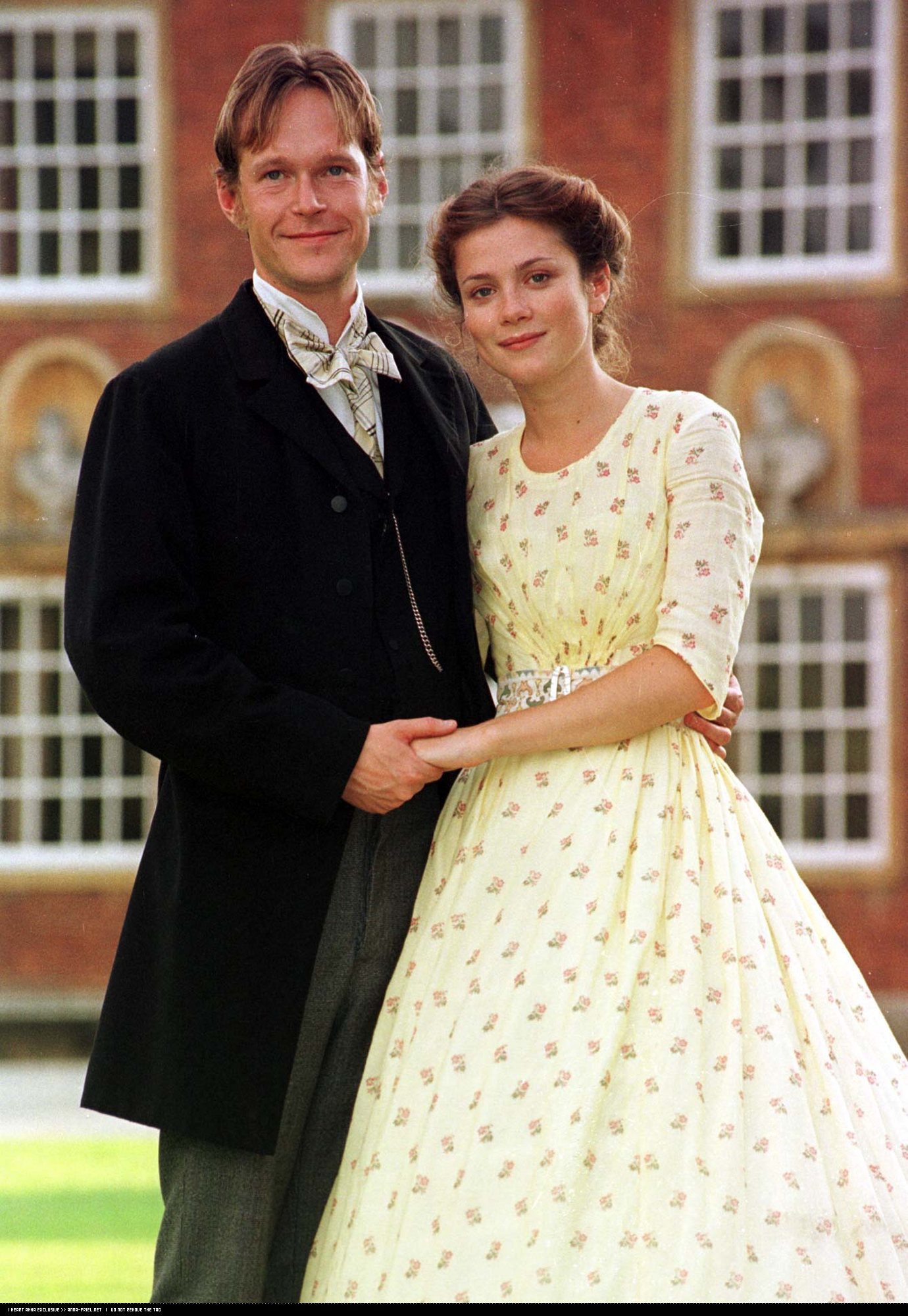
For the next instalment of Great Adaptations, I am happy to present the most recent BBC adaptation, starring Ioan Gruffudd, Charlotte Rampling and Justine Waddell (w. Bernard Hill as Magwitch and Clive Russell as Joe).
[warning, these are a tad spoilery for those unfamiliar with the novel. So, read the novel. now. Okay?]
Unlike the 1981 adaptation we discussed the other day, this is a technically beautiful and visionary realization directed by Julian Jarrold. It is very true to the story and fulfills most of the periphery storylines in the narrative. Moreover, it is dark and gothic and the materialization of the troubled Miss Havisham amidst a dusty conglomeration of stopped clocks and murky mirrors to a bewildered young Pip is the stuff that slow-ticking horror films are made of.
Pip's first encounter with Magwitch is shown in rough, hand-held vision in the first few moments of the film with the rest of that fateful meeting unspilled in a dream-like flashback when Pip, previously on the marshes and near the cemetery, is back home.
Both Mrs. Joe and Joe Gargery are respectively well-played. Clive Russell's Joe has a heart as big as his physical stature and it seems almost often near-to-burst; mostly with pride for Pip ( the scene where Pip and Joe are sitting by the hearth; Pip showing Joe a badly misspelled missive he has written him on a small slate recalls one of the most tender moments of the novel).
The younger versions of Pip, Estella and Herbert Pocket are physically well-paired with their older incarnations. Likewise, the transition of the story from younger Pip's life to the passing of age which ushers in older Pip is done with extreme subtlety: young Pip is hammering away at the forge in the first moments of his apprenticeship and slowly, the scene cuts to a larger hammer and a stronger arm.
I really, really liked the Herbert Pocket in this adaptation: affable, open and generously-hearted he, like Biddy, Joe, and some extents, Wemmick and Magwitch, round out the only redeemable purveyors of kindness and grace in an otherwise depraved puppetry of tricks, money and greed.
Things the Adaptation Does Well:
->slight, small recurrences from the novel: like Jaggers continually washing his hands and Wemmick caring for "the aged"
->Plays well the idea that had Pip not been introduced to Miss Havisham and Estella, he never would have found anything lacking in his eventual apprenticeship to Joe ( or would he have? his yearning for education seems to suggest that he might have stumbled upon this past anyways)
->My mom mentioned ( and quite rightly ) that Pip is quite lost. Reminiscent of Eliza Doolittle (My Fair Lady) after the ball and as she leaves Henry Higgins' to wander the streets and rediscover her flower girl days in Covent Garden, she recognizes she is not really fit for her new life or her old. Likewise, Pip is lost from the moment he enters Miss Havisham's through his fragmented apprenticeship to his realization of his expectations in London. He doesn't really belong at the forge; he's unsuited for marsh life and yet his life in the city is built on a sandy, unsturdy foundation.
(Mom also mentioned ( she was very helpful at weighing in on this ) that Miss Havisham seemed a tad young in her estimation; but that the costumes were spot-on ...moms are very fun to watch BBC miniseries with, FYI)
->I quite enjoyed Magwitch and how beguiled he was with his new "creation": the fixed idea that Herbert speaks of when he recounts what Pip has been to Magwitch in his Australian solitude. Magwitch's features soften when Pip speaks so politely with him that first day on the marshes and he admits to loving Pip as more than a son when the ungrateful Pip shies away from his patronage. To watch him carefully tuck a shivering Pip under a blanket, to watch his eyes sparkle as he sees the result of the education Pip has had on his account (Pip reciting the Odyssey in Greek, as one example), is very, very moving.
However strongly Magwitch presupposes Pip's loyalty and affection, however, Pip's true father figure remains in the presence of Joe. Joe, here, is just as heart-breaking as he always is: merely standing there as Pip completely forgets their connection. In the interest of time, they slightly alter Pip and Joe's end reconciliation and have Joe find Pip in debtor's prison, delightedly moved to see him and having paid all of his debts.
->Biddy is also sweet and wonderful in this adaptation: watching Pip with the unrequited devotion and estimation true to her character as they grow up together and then transposing her love on the certainly worthy Joe at the end.
->The ending to Estella and Pip's "love" story ( as in the 1981 adaptation) is also well done here.
<>
->Excellent production values; glorious sets and lighting; flashes of colour against the bleak, cobblestoned backdrop of London; Dickensian parallels shooting from the Butcher's shop to a line of soon-to-be-hanged convicts at Newgate, this is top-notch.
However, even as it remains one of the strongest adaptations I have seen to date, it is not perfect. It does not fare as well as the excellent, near-unmatched adaptations of Bleak House, say, or Little Dorrit.
Perhaps there is something about Great Expectations that just evades the screen. While there are so many marks in its favour, there is something about the tangible, strong and at times heartbreakingly redemptive spirit of the tale that seems best captured in words and pages. Which is why, as aforementioned, we so eagerly await the upcoming 2012 adaptations. I want to see Great Expectations done perfectly right. For the time being, this is a worthy offering.
And Ioan Gruffudd is in it. Right? Right.
[warning, these are a tad spoilery for those unfamiliar with the novel. So, read the novel. now. Okay?]
Unlike the 1981 adaptation we discussed the other day, this is a technically beautiful and visionary realization directed by Julian Jarrold. It is very true to the story and fulfills most of the periphery storylines in the narrative. Moreover, it is dark and gothic and the materialization of the troubled Miss Havisham amidst a dusty conglomeration of stopped clocks and murky mirrors to a bewildered young Pip is the stuff that slow-ticking horror films are made of.
Pip's first encounter with Magwitch is shown in rough, hand-held vision in the first few moments of the film with the rest of that fateful meeting unspilled in a dream-like flashback when Pip, previously on the marshes and near the cemetery, is back home.
Both Mrs. Joe and Joe Gargery are respectively well-played. Clive Russell's Joe has a heart as big as his physical stature and it seems almost often near-to-burst; mostly with pride for Pip ( the scene where Pip and Joe are sitting by the hearth; Pip showing Joe a badly misspelled missive he has written him on a small slate recalls one of the most tender moments of the novel).
The younger versions of Pip, Estella and Herbert Pocket are physically well-paired with their older incarnations. Likewise, the transition of the story from younger Pip's life to the passing of age which ushers in older Pip is done with extreme subtlety: young Pip is hammering away at the forge in the first moments of his apprenticeship and slowly, the scene cuts to a larger hammer and a stronger arm.
I really, really liked the Herbert Pocket in this adaptation: affable, open and generously-hearted he, like Biddy, Joe, and some extents, Wemmick and Magwitch, round out the only redeemable purveyors of kindness and grace in an otherwise depraved puppetry of tricks, money and greed.
Things the Adaptation Does Well:
->slight, small recurrences from the novel: like Jaggers continually washing his hands and Wemmick caring for "the aged"
->Plays well the idea that had Pip not been introduced to Miss Havisham and Estella, he never would have found anything lacking in his eventual apprenticeship to Joe ( or would he have? his yearning for education seems to suggest that he might have stumbled upon this past anyways)
->My mom mentioned ( and quite rightly ) that Pip is quite lost. Reminiscent of Eliza Doolittle (My Fair Lady) after the ball and as she leaves Henry Higgins' to wander the streets and rediscover her flower girl days in Covent Garden, she recognizes she is not really fit for her new life or her old. Likewise, Pip is lost from the moment he enters Miss Havisham's through his fragmented apprenticeship to his realization of his expectations in London. He doesn't really belong at the forge; he's unsuited for marsh life and yet his life in the city is built on a sandy, unsturdy foundation.
(Mom also mentioned ( she was very helpful at weighing in on this ) that Miss Havisham seemed a tad young in her estimation; but that the costumes were spot-on ...moms are very fun to watch BBC miniseries with, FYI)
->I quite enjoyed Magwitch and how beguiled he was with his new "creation": the fixed idea that Herbert speaks of when he recounts what Pip has been to Magwitch in his Australian solitude. Magwitch's features soften when Pip speaks so politely with him that first day on the marshes and he admits to loving Pip as more than a son when the ungrateful Pip shies away from his patronage. To watch him carefully tuck a shivering Pip under a blanket, to watch his eyes sparkle as he sees the result of the education Pip has had on his account (Pip reciting the Odyssey in Greek, as one example), is very, very moving.
However strongly Magwitch presupposes Pip's loyalty and affection, however, Pip's true father figure remains in the presence of Joe. Joe, here, is just as heart-breaking as he always is: merely standing there as Pip completely forgets their connection. In the interest of time, they slightly alter Pip and Joe's end reconciliation and have Joe find Pip in debtor's prison, delightedly moved to see him and having paid all of his debts.
->Biddy is also sweet and wonderful in this adaptation: watching Pip with the unrequited devotion and estimation true to her character as they grow up together and then transposing her love on the certainly worthy Joe at the end.
->The ending to Estella and Pip's "love" story ( as in the 1981 adaptation) is also well done here.
<
->Excellent production values; glorious sets and lighting; flashes of colour against the bleak, cobblestoned backdrop of London; Dickensian parallels shooting from the Butcher's shop to a line of soon-to-be-hanged convicts at Newgate, this is top-notch.
However, even as it remains one of the strongest adaptations I have seen to date, it is not perfect. It does not fare as well as the excellent, near-unmatched adaptations of Bleak House, say, or Little Dorrit.
Perhaps there is something about Great Expectations that just evades the screen. While there are so many marks in its favour, there is something about the tangible, strong and at times heartbreakingly redemptive spirit of the tale that seems best captured in words and pages. Which is why, as aforementioned, we so eagerly await the upcoming 2012 adaptations. I want to see Great Expectations done perfectly right. For the time being, this is a worthy offering.
And Ioan Gruffudd is in it. Right? Right.
Wednesday, August 31, 2011
Great Adaptations Vol 1: BBC Miniseries (1981)
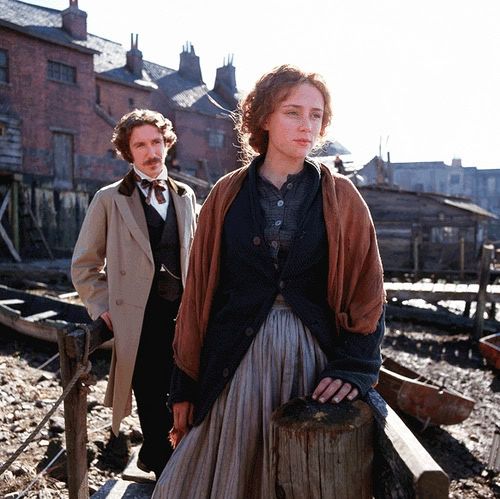
The 1981 BBC adaptation of Great Expectations looks exactly like you would expect a 1981 BBC adaptation of Great Expectations to look like: (meaning, we are completely devoid of production values, I think we forgot to remove that mic. from in front of the camera lens and I don’t think it looks very period appropriate dangling there; but, we cannot afford to fix it because we spent ALL of our money on sideburns with double-sided tape on the back so that our actors who, still surprisingly look like they live in 1981, have an aura of authenticity). The sets are bad; the lighting is bad; it looks far more like someone held up a camcorder ( a 1980s one, at that ) to a staged version of GE and went to town.
But I harbour some affection for it because a.) it doesn’t have a malicious bone in its body--- it is trying so earnestly hard and b.) uber-fidelity: if you want scene-by-scene, line-by-line to be funneled straight from the book to the small screen then, dudes, this is where it’s AT.
A few years back, the BBC released boxed sets of all sub-production-par albeit faithful literary installments of the day and if you have seen the grainily lit, meandering Pride and Prejudice or even Silas Marner (oh Ben Kingsley) or even ADAM BEDE with chick that played Jane in the BBC Pride and Prej (1995) then you know what you are in for.
I have often noted that while adaptations of GE I have seen hit on one or two notes really well, no adaptation thus far (I am holding out hope, 2012! Don’t let me down!) captures the entire spirit or essence of the book. We don’t have a pitch-perfect medium-switch here.
Instead, This one touches a few points well:
Herbert Pocket and Pip’s relationship---this is often sacrificed a lot in in the interest of screen time; but this series goes on for friggin’ ever and so it has hours to draw this out--- and it does. Up to Pip going to Wemmick to try and sneak some of his Magwitch-fortune to his roommate/bestie.
[There are some awkward hugs when Pip and Herbert tentatively part --- and some weird crying--- and then Herbert awkwardly hugs Clara and weirdly cries some more--- ]
Bromance for the WIN
Joe Gargery’s Wisdom--- Joe is the salt of the earth and he is packed full of some of the sagest Dickensian lines in the world. Like, stuff about not lying because you’ll be crooked and some of us are blacksmiths and some of us goldsmiths and never the twain shall meet and what is betwixt friends, old chap, what larks ! ( heftily paraphrased: see source material )--- all these little nuggets are here and uttered with integrity-on-speed. This Joe is just a little too happy to be doing everything and is almost too good to be true ( you don’t see the dark, pained edges) but hell, he means well and he does actually say all of these lines….and he doesn’t know what to do with his hat when he goes to London and it is as FRIGGIN awkward as in the book ---made more awkward still by the bad production values and everyone’s sideburns…larks, kids, larks indeed!
The Estella Ending: Readers, remember the end of Villette and how frustratingly ambiguous it is and how half the team are (with Charlotte’s father) on the “NO! that cannot be right! What the heck you stupid shipwreck!” ship and the other half of the team is like, “Dude, he’s so friggin’ dead—but that’s okay because Lucy has independence and a cot of her own”? Well, Dickens did the same thing with the interchangeable, dvd -special- feature- alternate- ending to Pip and Estella’s “love” story. The series does this well.
This edition is so, so very cheesy; but it is trying so, so hard--- for hours—and hours---it might take less time to read the book.But, jiminy crickets! I am a-fond of it, y’all. It tries so hard to be nice and good ...
And WORD BY WORD it recounts every stupid, friggin’ line.
Ten points for the actress playing Mrs. Joe (Pip’s sister) post-forge attack. She just sits there as Biddy spoons broth at her gaping mouth---for HOURS
I am willing to bet you can find some of this on youtube, if you are so inclined
Subscribe to:
Posts (Atom)