Showing posts with label great adaptations. Show all posts

Tuesday, July 23, 2013

Theatrical Adventures: 'Anything Goes' and 'Great Expectations'

Anything Goes contains a slipshod plot (plot is a strong word) to which P.G. Wodehouse was contributor about the crazy happenings, disguises and mistaken identities aboard a cruise ship. I won’t go into the plot, or lack thereof, because, like most screwball comedies of the 1930s, it really doesn't matter. It is the antics, the characters and the chemistry and…here… the singing and the dancing that make this a visual and musical treat.


What we have here, splayed like a deck of shiny playing cards, is the best of the crème de la crème Cole Porter.  More than any other musical featuring his prolific work ( I think, first, of Kiss Me , Kate ) Anything Goes has a songlist that shines with De Lovely, the titular song, Blow, Gabriel, Blow and the eerie discordance of Easy to Love.

His lyrics, easy to trip over the tongue and far deeper and list-like ( think You’re the Top, I Get a Kick Outta You) than meets the ear, add a deft layer to an otherwise frivolous story about a rag tag crew at sea.

The Roundabout Theatre production starring Rachel York ( who is a goddess. I first saw her on stage in Kiss Me, Kate  in London's West End  and have worshipped her voice forever ) features a brilliant orchestra, expert direction and staging, succinct choreography, energy and flair which garnered one of the most enthusiastic audience responses I have ever seen in a theatre.

I was boggled by the immense talent of everyone on stage: no one hit a wrong note, the voices were high and belty and, in York’s case, brandished with the salty cadence of a brash, golden-tongued dame of the age, the tapping was fleet and fast and the comedic timing was to die for.

This is a musical throwback to a golden époque.  For those who are tiring of the technical spectacles that Broadway has become ( don’t get me wrong, I love me some special effects; but we don’t always need flashes and bangs) then what you have here is a stage set for the showcase of supreme talent: led mostly by York who is so riveting, dashing and jaw-droppingly gorgeous and brassy that you might not be able to take your eyes off of her throughout the production.


                                                                         * * * 

In stark contrast, I had the opportunity to see Soulpepper’s intelligent remount of Great Expectations last night, adapted and directed by Michael Shamata.  who, for the Soulpepper lot,  is no stranger to Dickens having his thumbprint on the renowned version of a Christmas Carol they stage every other year.

First and foremost, I was entranced by how much of the original text he used ---- wavering from some of the usual nuances of adaptation and including more of the story than I thought was possible.  Having seen and studied adaptations of this novel for decades, I know the usual ways that directors decide to cut and paste the story and bring it to light due to restraints of time and audience limitation.   Shamata’s version doesn't talk down to us. But, I do wonder if some of the off-hand way the guiding information that sews up this complex plot is soliloquized quickly and not without confusion to the audience.  I was with a friend who had no previous knowledge of the source material and could completely understand what facets of the tale threw her off when presented in a quick and somewhat hurried manner.

The language transposed with Dickensian flair and uttered with such supreme confidence by Jeff Lillico’s Pip was a bit of genius. He opens the play as a retrospective Pip, immediately uttering some of the most famous lines of the book as he looks back on his childhood. There, the sparse staging ( theatre in the round, a handful of chairs, a bricked beam that acts as chimney and building side and forge alike ) gives way to the imaginative marshes: the lighting at times eerie, exuberant and, when Pip finally reaches London to experience his eponymous expectations, muddled and bright.

The action on the stage melded well with the space and I was caught immediately in imaginative flux: my brain sinking into the depth of the story and the fascinating aura of each and every character.   Lillico is a strong, if dour, Pip who tends to forget the moments of lightness.  He whines a lot about his past decisions
 ( well-wrought considering what an insufferable and ignorant snob he becomes in Act II ) ; but we rarely see that counterbalance—something I love about Pip--- he has a tough circumstance, sure , but he meets it with gumption. 

Kate Trotter’s Miss Havisham, doesn’t possess the psychological complexities of the character: rather features a prominently bitter old lady who is a hybrid of depression and anger.  At times, I found her grating. She could have been softer. She needn’t have raised the  timbre of her interestingly squeaky voice or flourished large movements in order to convey the heartbreak of her past. 

Herbert Pocket was a delight. There, nothing more to say on that. DELIGHT.

Uncle Pumblechook and Magwitch were passable ---both made more so by some of the great lines given both.   A side note: Pip, as narrator, often intercepts the fastly spinning action with beats of lines quick and succinct that help the flow of the story while reiterating his importance as the center of it. It is his biased perspective and he has every right to break the action and swiftly speak to the audience. 

The strongest cast member was Oliver Dennis who may actually be my favourite actor in the Soulpepper Company so wide and competent is his range. The play does extremely well at diving deep into the Pip and Joe relationship and its fundamental crux in Pip’s development.  Their friendship is early established as his Joe’s innate greatness.  Having already taken liberties of some plot points ( due to time constraints, I am sure),  Joe’s payment of Pip’s debts at the end ( in my estimation the most poignant and important part of the story ---symbolically and figuratively) sinks somewhat into the general act of Pip falling on the recently wedded Joe and Biddy’s kindness and their giving their forgiveness freely.

Double casting is not a favourite device of mine; but here, is quite wonderful:  Wemmick/Joe, Estella/Biddy, Mrs. Joe/ Molly.  Each actor is so confident and so changed that you do not think at all of their pairings, rather lose yourself in each individual scene.

The ending is not as stark a contrast as Pip has fed us his self-awareness of his ingratitude throughout.  These narrative breaks are not unlike the same disposition of the novel and show that Schamata is confident with his source material.

It isn’t without flaws; but those flaws are borne of adapting a perfect work of literature and its transposition to another, shorter medium.  The careful attention to detail as well as the obvious love the director and I share for the story set it with the best of literary stagings I have seen.  I often think that the best adaptations are not those without liberties; but those which capture the essence of the novel. This captures the essence of the novel. 

Friday, September 14, 2012

FIlm Review: 'Great Expectations, 2012'

Gina at Dickensblog was kind enough to post my review of the 2012 Great Expectations which debuted at the Toronto International Film Festival the other night....complete with my blurry blackberry pic :)

Take a gander at dickensblog


Wednesday, September 12, 2012

WHAT LARKS!

Just after picking up my ticket at Roy Thomson
a good quality picture of Jeremy Irvine (Pip), Toby Irvine (Jeremy's brother and Young Pip) and Ralph Fiennes (Magwitch) on the red carpet (top) my blurry blackberry pic from inside the theatre (Mike Newell, director, Ralph Fiennes, Jerermy Irvine, Holliday Grainger, Toby Irvine) 
I totally had the opportunity to see the World Premiere of Mike Newell's brand new Great Expectations last night here in Toronto at the Toronto International Film Festival: a gala held at Roy Thomson Hall.

Review coming shortly on Dickensblog and I will make sure you kids all see it.

It was a great night:  I scored free popcorn from the Orville Redenbacher folks, the nice people in line gave me a champagne token c/o Visa and I got UPGRADED from the public balcony viewing area to the main floor at RTH --- I ended up being just beyond the reserved press seating---about 8 rows back.

in the theatre: upgraded ticket,  notes to write up review for dickensblog,
newly won BlackBerry Playbook
The acoustics, of course, were wonderful.  It was thrilling to see so many of the actors in the film sitting in the audience and on stage beforehand excited to experience the film with a throng of movie-goers.

The best part of the night ?  I won a BLACKBERRY PLAYBOOK from the BlackBerry folk who were wandering about the ticket line pre-show.  It was a momentous and completely unexpected moment and I am thrilled to the gills with it: mostly because it has a Kobo reading app so I have even more ways to receive review copies of books. Moreover, it is compatible with the software that the Toronto Public Library uses to loan e-books which is awesome. Because now I can read everything.

I can also watch Hell on Wheels in whatever format I want ( sidenote: I am currently addicted to Hell on Wheels) : If I wanna watch it on my macbook? fine.  If I wanna watch it on Blackberry Playbook? yep!

woop!

More to come....

Thursday, April 19, 2012

Great Adaptations IV: 2011 BBC


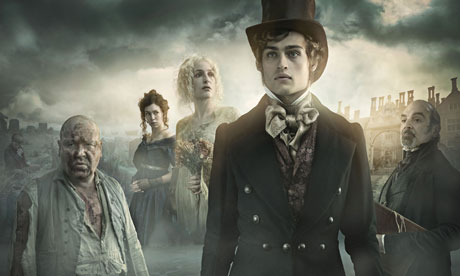
It’s been awhile since Great Adaptations last showed up on le blog.  However, that was because even though I watched the 2011 BBC version at Christmas, I wanted to ensure that all North American friends had the chance to view it on Masterpiece Theatre.  Since my DVD arrived last week, I have spent many an hour carefully perusing it and experiencing each minute detail which has more sternly formulated my opinion that it is the best film adaptation to date. That’s not to say that it isn’t without flaws or that it doesn’t distance itself from the text; but its choices make a lot of sense and it “feels” like Great Expectations: from the murky marshes to the clouded, cloistered cobblestones of Pip’s London, through the satined lace of young women lined like a garland at a party as Pip takes Estella’s ivory hand to the decrepitly ravished wedding feast of the irreplaceable Miss Havisham.

The characterization is deft and taut and each of these well-known personages, who could easily become caricatures so inferenced are they in our cultural psyche, are instead the embodiment of pathos and light, of humour and heartbreak: of proof that, above all, Great Expectations is a narrative borne of extraordinary acts of unwarranted kindness.

It is no surprise that I am completely befuddled and bewildered by the continual influence this particular tale has on me: how it exposes my vulnerability, my strengths, and the darker tenets of human expectation: the trajectory, and further tragedy, begotten of our wanting something more…. But this particular series drew from creaked corner into luminous light the characters I have often felt between the pages of my well-worn novel.  During the Bicentenary Celebrations earlier this year, one statistic ( which I cannot cite, unfortunately) listed both Miss Havisham and Joe Gargery as two of the 10 best-known Dickensian characters.  Great Expectations---whether having been forced on readers in high school---or having been re-visited with stylistic enterprise in the 90s or whether (fortunately) given weight  in two current adaptations ( this miniseries and the upcoming Hollywood) film or even as a funky premise for a South Park episode--- is an inescapable portion of the Western canon.   Perhaps because we can see so much of ourselves in Pip, we can see so much of what we would like to be in the actions of Joe and Herbert and Magwitch, we enjoy the Soap Operatic twists and turns linking Estella, her bat-crazy adoptive mother and the sinister Jaggers and his erstwhile maid Molly---- it’s human relations: sex, power, money, loss of money, disillusionment, odd reconciliation at its best.

There’s crime, almost murder, escaped convicts,  boat chases, whirls of balls and abusive husbands…. Who wouldn’t want this? 

As ultimately complex as the tale is and as many characters as it introduces ( some completely left out of this particular imagining: most noticeably Biddy) it is, at its core, a sleek bildungsroman pitting a young and good-hearted orphan against the sudden Cinderella-like fate that follows him to his apprenticeship years as a blacksmith in the Kent Marshes.


This adaptation has received numerous BAFTA nominations for its craft and presentation and it is quite easy to see why:  it is a tangible and delectable world that you can smell and see and touch: it is gritty and horrible, it is crusted with the mould of Satis House and encrypted in the smoke billowing from the forge and as Pip sheds his cocoon to dress in the gentleman’s clothes that propel him out into society with his lovely pal Herbert, we see the finest threads carefully woven to speak their intricate tailorship: a perfect recognition of the period and the Era’s finery.
 
It also includes some of my favourite performances of some of the best-loved Dickensian characters.  For my part, I feel  that this adaptation’s Herbert Pocket, Magwitch, Joe Gargery, Pip and Miss Havisham are the best I have seen.


I encourage you to spend some time in this world. I have revisited it quite a bit.  This past week, I was traveling for work and ended up steeping some tea in my hotel room and catching it again on iTunes:  obsessed? Perhaps a little; but more enamored and bewitched that a dazzling presentation has wrought from my mind’s eye to camera’s lens a kaleidoscopic Victorian world I crave to seep into time and again.

Wednesday, January 04, 2012

Great Adaptations in Context: The Lasting Appeal of "Great Expectations"

[images displayed in this post are from the 2011 BBC adaptation of Great Expectations]

2012 will offer viewers two new adaptations of Great Expectations:  the 2011 BBC miniseries starring Ray Winstone and Gillian Anderson (to premiere on Masterpiece Theatre in April) and the big-screen adaptation by Director Mike Newell.

The long-standing appeal of this particular Dickens novel allows it to sit well in a year where the Dickens Bi-Centenary will seep into the literary stratosphere.  Great Expectations , and the many characters which dwell between its covers, remains a household experience for students and lovers of English Literature.  It's interesting to note how this has become one of Dickens' best-loved novels: considering his prolific offering and the numerous books which could easily have taken up the Recommended Reading Lists of high schools and universities across the Globe.  Yet, there is something about Great Expectations that loans itself to timelessness.

Dickens' usual themes of orphan children caught in a climate of social injustice ( you need turn no further than Uncle Pumblechook and Mrs. Joe's Christmas dinner sermonizing to realize how little children were thought of ) is resonant here. The kuntsleroman bridge that sees the flourishing of David Copperfield and, to some extent, Oliver Twist, features the (mis)adventures of Pip: a Cinderella-boy who climbs the social ladder under the most unlikely of circumstances.


From the Toronto Public Library ( where all good things are housed), I signed out a documentary: part of the Discovery Channel's Great Books series and narrated by Donald Sutherland. This was a great piece to help me reflect on my recent re-visitation of one of my favourite tales.

John Irving, Alfonso Cuaron (director of the modernized 1998 film adaptation), Ethan Hawke and a myriad of Dickensian scholars are on hand to talk to the lasting work.  Cuaron references Great Expectations as "essential to the human spirit."  Obviously meant to appeal to the high school literature student, the documentary relies heavily on interspersing its narration with clips from adaptations of the tale on screen: from a silent film version, through the 1946 David Lean version, pulling on a couple of BBC television serials and even showing parts of the modernized take.

John Irving speaks to how it inspired him to become a writer and the narrator speaks to the intensely theatrical presence of Dickens as a melange of popstar, politician and icon.  The most important English writer since Shakespeare, that which is Dickensian is a universe unto itself: from the festive spirit of his trademark Christmas Carol to the downtrodden orphans which pulled on his acute sense of social justice.


Dickens believed ( and knew from firsthand experience), that children have a special capacity for perceiving the world; thus every orphan, such as Pip, is an emblem of himself. Pip moreso because he shared a similar physical upbringing to Dickens: that of the Kent marshes.   For a child who was crassly pulled from a comfortable upbringing to work in a blacking shop to support his father's time in Marshalsea debtor's prison ( think Little Dorrit and also think of the harrowing prospect awaiting Pip before the intervention of Joe Gargery in GE), Dickens very much understood the power of social prospect.  The fortune that befalls Pip looms like the Cinderella story we all yearn for: reward for seeming nothing.

Dickens was able to speak to this and to recall his own vapid childhood years while in the height of his creative powers.  The public was putty in his hands and the medium through which he spun his yarns (that of serialization) allowed him to improvise: should the public outcry of critique resound upon the end of a weekly serial, then he could do what was needed to later change the outcome for more promising applause.  Great Expectations, ambiguous ending and all, was a similar product to this method: published in 36 instalments in Dickens' magazine All the Year Round.


As New Yorkers eagerly awaited the ship bearing a manuscript which would seal Little Nell's fate ( in the infamously sentimentalized Old Curiousity Shop), so were readers left deliberately hanging for the next view of Magwitch, the secret wrapped up in the relationship between Compeyson and Havisham, the twist (a majorly lovely plot twist at that) surrounding Estella's estranged parentage.  When Pip discovers he's a pawn used by Miss Havisham, Jaggers and, to some extent, Magwitch, the audience feels greatly with him.  They are caught in his soap opera.  His story becomes, like Dickens' own experience, very much their own.

Especially for Londoners.  Dickens was known to refer to London as his "magic lantern"  and a thriving, bristling, bubbling character it becomes in all of his great sequences of action.  In Great Expectations, Dickens allows the reader to glimpse a bit of his personal childhood experience; but leads him still greater into the abyss of Newgate, high fortune, punting on the thames, excess and delusion.

Pip's illusion becomes our own as the orb of Great Expectations speaks to George Orwell's belief that Dickens' works were "not a series of books; but a world).

A lot of what was explored in his short documentary is familiar to those who have a past with Dickens (I studied him extensively as part of my Victorian specialist degree: even took a seminar devoted to him); but what it speaks to is the lasting presence of Dickens on society.... and to the lasting impression Great Expectations makes on social construction as a whole.  The most gentlemanly acts, according to the documentary, and viscerally viewed in the novel, are those which act out of grace and redemption. What is a gentleman?, is a question that can well be asked of Pip as he mires through the mazes of self-discovery. What the documentary speaks to and what you will soon learn as you visit this tale, is that the most gentlemanly moments Pip has have little to do with his mysterious patronage or sudden fortune.  Rather, the gentle way he speaks to a prisoner on the marshes; the way Joe gently guides Pip through childhood, Pip's loyalty and devotion to Magwitch as he nears the end of his life in blackened disgrace.

The measure of Dickens' humanity, in circumspect, is threaded in the tales that best reflect a mirror to our own shortcomings : a reflection like Great Expectations.

John Irving, interviewed, mentioned that he was saving one unread Dickens ( in his case Our Mutual Friend), for a rainy day.  I think it's lovely that he has one unturned to look forward to, especially having heard him speak to the great influence that Great Expectations particularly had on his creative disposition.  Irving mentions that he was disappointed in advance at the looming end of the novel; that it was one of the glorious books that made you want to slow down as you paced forward, for fear that you would run out of sentences too soon.


I sometimes wish I could rewind my reading history and meet the multitude of eccentrics I first encountered in the pages of a Dickens' novel in my latter childhood and teen years; but, alas, I am bereft of a rainy-day Dickens and must console myself with the prospect of revisitation: sometimes in the fortunate medium of film and television adaptations.

Monday, November 21, 2011

'Great Expectations' Photos make THIS gal VERY happy!

Thanks to our friend Gina at Dickensblog, I have been kept in the near loop of all things Great Expectations and I remain super duper excited about the new adaptations in our near midst!

Check out these photos! :


[Source]
Also, make sure to check out Dickensblog to learn everything you would ever want to know (and that still wouldn't be enough) about Charles Dickens, film adaptations and where all things Dickensian can be found on the web!

Wednesday, September 07, 2011

Great Adaptations III: 1998 Contemporary version, dir. Alfonso Cuaron

Here it is, kids, our modernized Great Expectations and the third instalment in Great Adaptations.
For this, we're all going to have to go back to the 1990s. If you, like me, were in high school, then this was very much like the Baz L. Romeo and Juliet: wherein it took a classic story you were studying and modernized it:


What the film is, at heart, is an exercise in obsession. What Cuaron takes from the novel is a strand that is prominent in all adaptations; but flashed viscerally to light here--- that of a young man fixed on an idea. Much as Magwitch ( here called Lustig) has set his sights in captivity to the realization of Pip (here called Finn) as a gentleman; so Finn is obsessed with his muse, the ice queen Estella.


Estella, in Cuaron's vision, is Finn's creative muse. She reaches him on more than one platitude and forces him to shave the past in hopes that his talent (more seen when he recreates the light she shines on him) will win him the success and fortune that will turn her head.


What the film fails at is reaching the heart of Dickens' powerful recalling of grace and redemption. No one here is redeemed, per se, rather their stories are tied with neat little bows.
"Like all happy endings, it was a tragedy.", Finn's narrative voice -over (near consistent in the tale ) informs us and we believe it to be: much so because there is only the hinting of a lesson learned. The sternest takeaway for Finn, for Estella and for the other peripheral characters caught in the web of their sensuous hold over each other, is that disillusionment is costly.


Visually, and as in Cuaron's other literary adaptations (namely Harry Potter and the Prisoner of Azkaban and A Little Princess, both worthy films with heartbreakingly lovely style), the use of colour infuses passion and stillness. It dissolutes the greying mansion belonging to the pathetically over-drawn Nora Dinsmore (this Miss Havisham; whose usage of lined makeup refers to Finn's over-exaggerated art form), and lightens the sea where Finn, in the opening sequence, putters along in a battered old boat. Not a blacksmith's apprentice, rather a fisherman, Finn and his Uncle Joe are reduced to finding odd jobs when times get tough. One of these odd jobs takes him to the over-grown garden of "Paradiso Perduto": Nora Dinsmore's decaying lair of lost paradise: Estella ushering us through stylistic snapshots of the Alhambra, of India, of riches gone to waste.
Here, the puppetry to which Estella and Finn fall victim at the playful cloys of Miss Havisham/Nora Dinsmore is more crassly apparent. Likewise, the basest dregs of Lustig's humanity play an interesting counter when Finn's expectations as a great New York artist are finally realized.


Thematically, as inferred earlier, this is a tale that sits well in a 20th Century context. Not century agnostic, the master brushstrokes of obvious obsession and lust and disillusionment are widely spread on Cuaron's canvas. Unfortunately, it is the slight idiosyncrasies that dust Dickens most powerful work. It is easy to look at Great Expectations through the lens of a tortured romance--- but it is so much more than the whole of its surface.


Lustig tells Finn that the hands are "the windows to the soul" and Finn's artistic endeavours certainly live true that statement; but the soul is much more than a fleeting kiss at a fountain or naked rendezvous with a girl unabashedly flinging her shirt to pose for a portrait.


This film has a lot of potential and, at its core, the prospect of a lot of heart. Finn wisely refers to an instance by comparing it to the most complicated of emotions: "Like love," he tells us, "it's completely undeserved." That statement is the truest to Dickens' intention. Yet, the love in Great Expectations modernized is a love borne of idea, fixation and obsession. This is true of the old novel; but the threads that sew the more problematic over-arching themes soften their blow to the reader.


Technically, the production does well at realizing a tale in a modern form. Finn's story as burgeoning artist, his awkwardly heartbreaking dismissal of his past, and of his Uncle Joe (as horrifying to behold against the New York backdrop here as it is in the London backdrop of the novel ), his crude awakening when Lustig appears at his door like a ghastly apparition and his horror at the instance he recognizes that Nora Dinsmore was not using him as a pawn to become equal to her cold ward, all play well here and all offer a deep comparative introspection when held up against their source material.


previously in "Great Adaptations": the more traditional re-telling in the 1999 BBC version

Sunday, September 04, 2011

Great Adaptations Vol II: 1999 BBC Adaptation

For the next instalment of Great Adaptations, I am happy to present the most recent BBC adaptation, starring Ioan Gruffudd, Charlotte Rampling and Justine Waddell (w. Bernard Hill as Magwitch and Clive Russell as Joe).

[warning, these are a tad spoilery for those unfamiliar with the novel. So, read the novel. now. Okay?]

Unlike the 1981 adaptation we discussed the other day, this is a technically beautiful and visionary realization directed by Julian Jarrold.  It is very true to the story and fulfills most of the periphery storylines in the narrative.  Moreover, it is dark and gothic and the materialization of the troubled Miss Havisham amidst a dusty conglomeration of stopped clocks and murky mirrors to a bewildered young Pip is the stuff that slow-ticking horror films are made of.

Pip's first encounter with Magwitch is shown in rough, hand-held vision in the first few moments of the film with the rest of that fateful meeting unspilled in a dream-like flashback when Pip, previously on the marshes and near the cemetery, is back home.

Both Mrs. Joe and Joe Gargery are respectively well-played.  Clive Russell's Joe has a heart as big as his physical stature and it seems almost often near-to-burst; mostly with pride for Pip ( the scene where Pip and Joe are sitting by the hearth; Pip showing Joe a badly misspelled missive he has written him on a small slate recalls one of the most tender moments of the novel).
                                                              
The younger versions of Pip, Estella and Herbert Pocket are physically well-paired with their older incarnations.  Likewise, the transition of the story from younger Pip's life to the passing of age which ushers in older Pip is done with extreme subtlety: young Pip is hammering away at the forge in the first moments of his apprenticeship and slowly, the scene cuts to a larger hammer and a stronger arm.
                                                            
I really, really liked the Herbert Pocket in this adaptation: affable, open and generously-hearted he, like Biddy, Joe, and some extents, Wemmick and Magwitch, round out the only redeemable purveyors of kindness and grace in an otherwise depraved puppetry of tricks, money and greed.


Things the Adaptation Does Well:

->slight, small recurrences from the novel: like Jaggers continually washing his hands and Wemmick caring for "the aged"

->Plays well the idea that had Pip not been introduced to Miss Havisham and Estella, he never would have found anything lacking in his eventual apprenticeship to Joe ( or would he have? his yearning for education seems to suggest that he might have stumbled upon this past anyways)

->My mom mentioned ( and quite rightly ) that Pip is quite lost.  Reminiscent of Eliza Doolittle (My Fair Lady) after the ball and as she leaves Henry Higgins' to wander the streets and rediscover her flower girl days in Covent Garden, she recognizes she is not really fit for her new life or her old. Likewise, Pip is lost from the moment he enters Miss Havisham's through his fragmented apprenticeship to his realization of his expectations in London.  He doesn't really belong at the forge; he's unsuited for marsh life and yet his life in the city is built on a sandy, unsturdy foundation.
                                                        

(Mom also mentioned ( she was very helpful at weighing in on this ) that Miss Havisham seemed a tad young in her estimation; but that the costumes were spot-on ...moms are very fun to watch BBC miniseries with, FYI)

->I quite enjoyed Magwitch and how beguiled he was with his new "creation": the fixed idea that Herbert speaks of when he recounts what Pip has been to Magwitch in his Australian solitude. Magwitch's features soften when Pip speaks so politely with him that first day on the marshes and he admits to loving Pip as more than a son when the ungrateful Pip shies away from his patronage.  To watch him carefully tuck a shivering Pip under a blanket, to watch his eyes sparkle as he sees the result of the education Pip has had on his account (Pip reciting the Odyssey in Greek, as one example), is very, very moving.

However strongly Magwitch presupposes Pip's loyalty and affection, however, Pip's true father figure remains in the presence of Joe.   Joe, here, is just as heart-breaking as he always is: merely standing there as Pip completely forgets their connection.   In the interest of time, they slightly alter Pip and Joe's end reconciliation and have Joe find Pip in debtor's prison, delightedly moved to see him and having paid all of his debts.

->Biddy is also sweet and wonderful in this adaptation: watching Pip with the unrequited devotion and estimation true to her character as they grow up together and then transposing her love on the certainly worthy Joe at the end.

->The ending to Estella and Pip's "love" story ( as in the 1981 adaptation) is also well done here.

<> 

->Excellent production values; glorious sets and lighting; flashes of colour against the bleak, cobblestoned backdrop of London; Dickensian parallels shooting from the Butcher's shop to a line of soon-to-be-hanged convicts at Newgate, this is top-notch.

However, even as it remains one of the strongest adaptations I have seen to date, it is not perfect. It does not fare as well as the excellent, near-unmatched adaptations of Bleak House, say, or Little Dorrit.


Perhaps there is something about Great Expectations that just evades the screen. While there are so many marks in its favour, there is something about the tangible, strong and at times heartbreakingly redemptive spirit of the tale that seems best captured in words and pages. Which is why, as aforementioned, we so eagerly await the upcoming 2012 adaptations. I  want to see Great Expectations done perfectly right. For the time being, this is a worthy offering.

And Ioan Gruffudd is in it.  Right? Right.


Wednesday, August 31, 2011

Great Adaptations Vol 1: BBC Miniseries (1981)


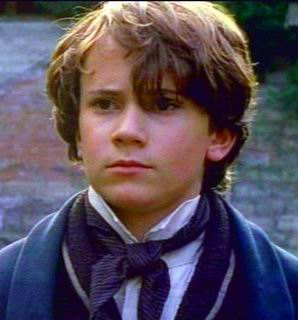
The 1981 BBC adaptation of Great Expectations looks exactly like you would expect a 1981 BBC adaptation of Great Expectations to look like: (meaning, we are completely devoid of production values, I think we forgot to remove that mic. from in front of the camera lens and I don’t think it looks very period appropriate dangling there; but, we cannot afford to fix it because we spent ALL of our money on sideburns with double-sided tape on the back so that our actors who, still surprisingly look like they live in 1981, have an aura of authenticity). The sets are bad; the lighting is bad; it looks far more like someone held up a camcorder ( a 1980s one, at that ) to a staged version of GE and went to town.


But I harbour some affection for it because a.) it doesn’t have a malicious bone in its body--- it is trying so earnestly hard and b.) uber-fidelity: if you want scene-by-scene, line-by-line to be funneled straight from the book to the small screen then, dudes, this is where it’s AT.

 
A few years back, the BBC released boxed sets of all sub-production-par  albeit faithful literary installments of the day and if you have seen the grainily lit, meandering Pride and Prejudice or even Silas Marner (oh Ben Kingsley) or even ADAM BEDE with chick that played Jane in the BBC Pride and Prej (1995) then you know what you are in for.


I have often noted that while adaptations of GE I have seen hit on one or two notes really well, no adaptation thus far (I am holding out hope, 2012! Don’t let me down!) captures the entire spirit or essence of the book. We don’t have a pitch-perfect medium-switch here.
Instead, This one touches a few points well:
Herbert Pocket and Pip’s relationship---this is often sacrificed a lot in in the interest of screen time; but this series goes on for friggin’ ever and so it has hours to draw this out--- and it does. Up to Pip going to Wemmick to try and sneak some of his Magwitch-fortune to his roommate/bestie.
[There are some awkward hugs when Pip and Herbert tentatively part --- and some weird crying--- and then Herbert awkwardly hugs Clara and weirdly cries some more--- ]
Bromance for the WIN

 
Joe Gargery’s Wisdom--- Joe is the salt of the earth and he is packed full of some of the sagest Dickensian lines in the world. Like, stuff about not lying because you’ll be crooked and some of us are blacksmiths and some of us goldsmiths and never the twain shall meet and what is betwixt friends, old chap, what larks ! ( heftily paraphrased: see source material )--- all these little nuggets are here and uttered with integrity-on-speed. This Joe is just a little too happy to be doing everything and is almost too good to be true ( you don’t see the dark, pained edges) but hell, he means well and he does actually say all of these lines….and he doesn’t know what to do with his hat when he goes to London and it is as FRIGGIN awkward as in the book ---made more awkward still by the bad production values and everyone’s sideburns…larks, kids, larks indeed!

The Estella Ending: Readers, remember the end of Villette and how frustratingly ambiguous it is and how half the team are (with Charlotte’s father) on the “NO! that cannot be right! What the heck you stupid shipwreck!” ship and the other half of the team is like, “Dude, he’s so friggin’ dead—but that’s okay because Lucy has independence and a cot of her own”? Well, Dickens did the same thing with the interchangeable, dvd -special- feature- alternate- ending to Pip and Estella’s “love” story. The series does this well.


This edition is so, so very cheesy; but it is trying so, so hard--- for hours—and hours---it might take less time to read the book.But, jiminy crickets! I am a-fond of it, y’all. It tries so hard to be nice and good ...
And WORD BY WORD it recounts every stupid, friggin’ line.

Ten points for the actress playing Mrs. Joe (Pip’s sister) post-forge attack. She just sits there as Biddy spoons broth at her gaping mouth---for HOURS

 
I am willing to bet you can find some of this on youtube, if you are so inclined

Tuesday, August 30, 2011

Great Adaptations: Prelude


I love Great Expectations. It is my favourite Dickens novel and one of my favourite books ---ever since I read it at the tender age of 14 (the first chapters devoured while babysitting for kids from our church congregation. They had played with Legos. They went to bed. I read about Pip and his first, dreary encounter with Magwitch...)

If you read this blog, you will notice that Great Expectations occasionally comes up in conversation. I defended it for the Classics Circuit: Dickens vs. Austen Challenge, featured it in a Dickens Meme, and re-visited it through a religious lens.
Next year, to celebrate Dickens’ Bi-Centenary, we will be treated to not one; but TWO adaptations (one Hollywood; one BBC miniseries) of this classic novel. I am very closely following casting and production news on Dickensblog (where Gina extols every tidbit she picks up on in her close following of any and all things Dickens).

I thought that this transitory period between end of Summer and beginning of Fall was the perfect space to cuddle into this coziest of yarns. I re-visit parts of the novel often ( confession: I even have it bookmarked in Project Gutenburg edition at work); but wanted to re-visit some of the adaptations I have seen//own, as well as speak to those adaptations I have not been fortunate enough to see yet.


Adaptations I have seen previously and will be re-visiting for this series:

 1946 adaptation, dir. David Lean: featuring John Mills, Jean Simmons, Alec Guinness


1981 BBC miniseries adaptation: featuring Gerry Sundquist, Jason Smart

1998 adaptation, dir. Alfonso Cuaron (modernized): featuring Gwyneth Paltrow, Ethan Hawke, Robert DeNiro

1999 BBC miniseries adaptation: featuring Ioan Gruffudd, Charlotte Rampling, Justine Waddell


REVIEWS:

1946:
1981: Great Adaptations Vol 1 read review here
1998: Great Adaptations Vol III: read review here
1999: Great Adaptations Vol II read review here 
2011:Great Adaptations Vol IV: read review here 
2012:


There are adaptations I have not had the privilege of viewing, including the 1989 Disney Channel adaptation which many cite as being a great and accessible adaptation.[ See Dickensblog review ]
The above is not available on DVD and no amazon sellers will ship to Toronto due to its VHS format (sadness)

Another familiar adaptation from 1974 features Michael York and Sarah Miles -- supposedly written as a musical, this lesser production (according to reviewers) is the result of a musical movie stripped of its musical numbers and the blanks in between apparently cannot hold weight)

Upcoming 2012 editions:


BBC miniseries starring Mark Addy, Gillian Anderson, Shaun Dooley, etc. (REVIEW)

2012 adaptation dir. Mike Newell featuring Helena Bonham-Carter, Jason Flemyng, Ralph Fiennes

I look forward to reviewing and blogging about the aforementioned movies: focusing on proximity to text, sensibility and malleability of medium.