Showing posts with label bbc. Show all posts

Monday, March 18, 2013

Parade's End BBC

I kinda of think of Parade's End as Downton Abbey for grownups. It is an enticing, compelling and highly nuanced tale of love, war and the end of a civilization. Based on the tetralogy (though greatly condensed by the genius Tom Stoppard) by Ford Madox Ford (often called one of the greatest literary works of the 20th Century), the experience found here is not unlike sitting in a theatre, the proscenium arch resounding the echoes of well-spoken, taut and perfectly threaded words and sentences. Where emotions run deep; but are clouded by well-mannered visage, where the action and plot takes left stage to the higher thematic norms of the centre.

Benedict Cumberbatch plays the tortured Christopher Tietjens, the last "Tory" an English country gentleman and statistician in an age where the squires and landowners are being politically overthrown and there is a new land of suffragettes, modern philosophy and battles (both literal and figurative) on the horizon.  Tietjens is plagued by honour.  He cannot fathom doing something that would break his moral code of conduct. Trapped in a loveless marriage to the absolutely fascinating Sylvia (seriously: Rebecca Hall is beautiful and beguiling in this role, she's as much a chameleon as Benedict ), Tietjens cannot reconcile happiness which doesn't fall into the carefully constructed line of social norms instilled in him by his great landowning Yorkshire father.

Sylvia is Catholic and doesn't believe in divorce, Tietjens moral code forbids divorce. So, even though it is questioned as to whether his son ( whom he loves to distraction ) is his own and no matter the nature of his wife's infidelity, Christopher is long-suffering.  Several characters paint the canvas of both the Tietjens' town and country worlds: including a minister's wife and her mad husband, a Scottish critic who acts as friend and confidante to Christopher, and the indomitable suffragette Valentine Wannop, a young athlete and radical whom Christopher meets and subsequently muses on for most of the series.

So much of the prelude to the War is an intricate waltz between Sylvia and Tietjens. Sylvia is mad for her husband and desperately wants his attention. Christopher isn't sure what to do with his wayward wife; but refuses to take a mistress no matter how it would equalize their playing field and perhaps, as Sylvia muses, bring them closer together.

What begins is the downward spiral of a tragic hero. The rumours which begin spinning about
Christopher's own infidelity are made even worse by the forbearance he shows against their telling. In one case, he is said to have been involved in a sexual affair on a train; whereas, in actuality, he was escorting a woman and offering help to his friend and his friend's new mistress.  It is heartbreaking to see someone who falls on his sword again and again to do what is right, be cast off again and again by a society who cannot believe in his inherent honour. Indeed, it seems more as if they cannot tolerate his goodness because they know they cannot live up to it. He must be taken down a peg.

Even Sylvia knows that her husband would never dishonour her; though his rapport with Valentine irks her jealousy until she begins spreading a few tall tales of her own.

At several points  I wanted to shake everyone: pay attention, Christopher! Your wife is just trying to get you to notice her! Sylvia, come on! He doesn't expect you to be up to his level, he is taking you as you are and there is NO NEED to be a conniving fox.   Christopher's strict and stalwart core make him a martyr for his own cause. He needs happiness! Love! A chance!


c/o bbc.co.uk

If this waltz had continued, it might have played into the soap-like tendencies of Fellowes' Downton; instead it introduces the War and severs entirely the world that Tietjens knew.

Tietjens comes into his own not when he is acting in high command, training Canadian troops (he sticks up for the Canadians as more than conscripts! Score! ) ; but when he is lowered into the trenches, forced to confront the enemy, without his title or his traditions to hide behind. One lovely moment sees a young soldier bringing him coffee and a sandwich on a china tea service while the muck and debris of the trench falls around him. After finishing his dainty repast---a complete contrast to his present situation--- Tietjens smashes the china tea cup against the muddy wall.  He is someone else now, he has come into his own when stripped of high title and ranking and equalized with the war.

All of the uncertainty, all of the muddled confusion strips away and Tietjens finds a new purpose and family. When the war is over and he returns home to find that his wife has heartlessly chopped down the great ancient cedar at Groby Estate, a symbol of era upon era of Tietjen prosperity and reign, he can finally throw a chopped log of its once-grand branches into a fire, he can dance alongside his new officer comrades, he can take his suffragette into his arms.

The world has changed. The last Tory has expired: not from death; but from new life. A man went through the war (on the home front and in the trenches) and emerged the best of a waking civilization. He just had to leave a lot behind.



Thursday, April 19, 2012

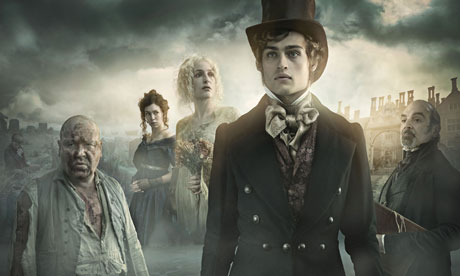
Great Adaptations IV: 2011 BBC


It’s been awhile since Great Adaptations last showed up on le blog.  However, that was because even though I watched the 2011 BBC version at Christmas, I wanted to ensure that all North American friends had the chance to view it on Masterpiece Theatre.  Since my DVD arrived last week, I have spent many an hour carefully perusing it and experiencing each minute detail which has more sternly formulated my opinion that it is the best film adaptation to date. That’s not to say that it isn’t without flaws or that it doesn’t distance itself from the text; but its choices make a lot of sense and it “feels” like Great Expectations: from the murky marshes to the clouded, cloistered cobblestones of Pip’s London, through the satined lace of young women lined like a garland at a party as Pip takes Estella’s ivory hand to the decrepitly ravished wedding feast of the irreplaceable Miss Havisham.

The characterization is deft and taut and each of these well-known personages, who could easily become caricatures so inferenced are they in our cultural psyche, are instead the embodiment of pathos and light, of humour and heartbreak: of proof that, above all, Great Expectations is a narrative borne of extraordinary acts of unwarranted kindness.

It is no surprise that I am completely befuddled and bewildered by the continual influence this particular tale has on me: how it exposes my vulnerability, my strengths, and the darker tenets of human expectation: the trajectory, and further tragedy, begotten of our wanting something more…. But this particular series drew from creaked corner into luminous light the characters I have often felt between the pages of my well-worn novel.  During the Bicentenary Celebrations earlier this year, one statistic ( which I cannot cite, unfortunately) listed both Miss Havisham and Joe Gargery as two of the 10 best-known Dickensian characters.  Great Expectations---whether having been forced on readers in high school---or having been re-visited with stylistic enterprise in the 90s or whether (fortunately) given weight  in two current adaptations ( this miniseries and the upcoming Hollywood) film or even as a funky premise for a South Park episode--- is an inescapable portion of the Western canon.   Perhaps because we can see so much of ourselves in Pip, we can see so much of what we would like to be in the actions of Joe and Herbert and Magwitch, we enjoy the Soap Operatic twists and turns linking Estella, her bat-crazy adoptive mother and the sinister Jaggers and his erstwhile maid Molly---- it’s human relations: sex, power, money, loss of money, disillusionment, odd reconciliation at its best.

There’s crime, almost murder, escaped convicts,  boat chases, whirls of balls and abusive husbands…. Who wouldn’t want this? 

As ultimately complex as the tale is and as many characters as it introduces ( some completely left out of this particular imagining: most noticeably Biddy) it is, at its core, a sleek bildungsroman pitting a young and good-hearted orphan against the sudden Cinderella-like fate that follows him to his apprenticeship years as a blacksmith in the Kent Marshes.


This adaptation has received numerous BAFTA nominations for its craft and presentation and it is quite easy to see why:  it is a tangible and delectable world that you can smell and see and touch: it is gritty and horrible, it is crusted with the mould of Satis House and encrypted in the smoke billowing from the forge and as Pip sheds his cocoon to dress in the gentleman’s clothes that propel him out into society with his lovely pal Herbert, we see the finest threads carefully woven to speak their intricate tailorship: a perfect recognition of the period and the Era’s finery.
 
It also includes some of my favourite performances of some of the best-loved Dickensian characters.  For my part, I feel  that this adaptation’s Herbert Pocket, Magwitch, Joe Gargery, Pip and Miss Havisham are the best I have seen.


I encourage you to spend some time in this world. I have revisited it quite a bit.  This past week, I was traveling for work and ended up steeping some tea in my hotel room and catching it again on iTunes:  obsessed? Perhaps a little; but more enamored and bewitched that a dazzling presentation has wrought from my mind’s eye to camera’s lens a kaleidoscopic Victorian world I crave to seep into time and again.

Wednesday, February 15, 2012

In Which I pull a few BBC miniseries out of my vast collection....

This past weekend I re-visited two BBC miniseries from the Golden Age of adaptation: the mid-1990s

The first, Martin Chuzzlewit, was in honour of Dickens’ bi-centenary.  The second, Middlemarch, was a borne of an impulse to revisit the complicated whir of industrial events spinning the cogs in the lives of Dorothea Brooke and Tertius Lydgate.

Martin Chuzzlewit has never been a favourite Dickens novel of mine.  I do appreciate its thesis on avarice, selfishness and the slow, tormented descent into sheer villainess; but its peripheral characters far outshine the main characters and the love story of the younger Martin Chuzzlewit and the almost possibly good Mary Graham pale when I compare them to, say, Lucie and Sydney Carton or Amy Dorrit and Arthur Clennam. Nevertheless, the secondary characters are divinely, colourfully Dickensian: including the stalwart Tom Pinch, the greedy and horrifyingly abusive and murderous Jonas Chuzzlewit and the dastardly Pecksniff.


Montague Tig and Mrs. Gamp as well as the refined old gent Chuffey help round out a myriad of some of Dickens’ most eccentric oddities.  Merry and Cherry Pecksniff are deliciously silly and frivolous and the adorable Mark Tapley revives some of the dragging scenes with his fresh zest and optimism.

Martin Chuzzlewit is known for painting a primitively dirty America to instill a sense of new world dread in its English readers. Certainly the scenes in the series which find Mark and Martin in supposed Eden (rather a malaria-ridden swamp) are as well-painted here as in the novel.   The moments where the lovely and good-hearted and golden Tom Pinch looks up from the organ where he practices at the cathedral to feast on the angelic countenance of Mary Graham captures you with the same sense of devotedly unrequited romance as bespeaks Tom’s journey in between the pages of the novel.

The casting of the series is excellent. Paul Scofield provides a WONDERFUL Martin Chuzzlewit, Tom Wilkinson and Keith Allen (Sheriff of Nottingham in ROBIN HOOD!!!) are both equally horrifying villains as Pecksniff and Jonas Chuzzlewit respectively, Pete Postlethwaite is inspired as Montague Tigue …and John Mills makes a sweet Chuffey. I cannot recommend the casting highly enough.  The character depth and realization is multi-dimensional here and no one is static: each revolves, evolves and changes due to circumstance and plot developments and it really is a wonderful to behold how they have transferred something so intuitively Dickens and painted it on screen.


Middlemarch remains one of my all-time favourite BBC series because it does well at capturing the essence of a remarkably complicated and twirling novel. Whenever I have talked to readers intimidated by beginning what has been called the definitive and finest Victorian novel, I tell them just to think of it as three different strands braided together: Dorothea Brooke and her untimely and loveless marriage to the wretchedly possessive scholar Edward Casaubon and later love of the romantic artist Will Ladislaw. Idealistic doctor Tertius Lydgate and his passion for research and reform: squelched by the vanity and social-assumption and spoiled nature of his beautiful wife, Rosamund Vincy.The good-hearted; but unlucky and wayward Fred Vincy and his pursuit for Mary Garth. Inasmuch as these three stories propel the themes of social reform, industrial change and growth in a small, middling community, all action revolves around/or is witnessed by these three sets.

Andrew Davies (one of the finest screenwriters and adaptors of all time) does well in focusing his attention to great detail when it comes to painting the definition of each of these three threaded storylines. Equal weight is given and enough backstory and character development ensues.  Viewing Middlemarch is, at base, an enriching experience: the frosting is the eccentric population supporting these three sects: the wonderfully noble yet prone to gambling chaplain Mr. Farebrother, the tediously loquacious Arthur Brooke, the conniving Mr. Bulstrode who cannot leave his past behind him….  Plate this against the Great Reform Bill and the expansion of the railroad, and you have a wonderfully historical portrayal of life in a provincial community.


Like Les Miserables by Hugo and Hard Times by Dickens ( well, a lot of Dickens, at that); Middlemarch was written under the grain of social activism and the detailing of Brooke’s life in politics, Will Ladislaw’s dappling in the newspaper and Dorothea’s passion for her cottages  and benevolently providing a better way of life for her land tenants give us a superb snapshot of the issues of the day. The casting is, as always, perfect and Dorothea is the perfect angel imprisoned by her ill-fated marriage, Tertius Lydgate is heart-wrenching as the doctor doomed to a life of remonstrance at the ill-advised expenditures of his clueless wife.


If you are a fan of BBC period pieces and you have not seen either of these, I heartily recommend them.  Moreover, seek out their source material and bask in the multi-layered, heavily caricatured tapestry of Victorian Literature’s greatest.