Wednesday, May 13, 2009

Boston! and a Passion Most Pure


I am currently reading A Passion Most Pure by Julie Lessman (visit her blog here)

I had heard a lot about this novel --- mostly reviews stating that it pushed boundaries of Christian fiction.

It certainly is not your grandmother’s Christian fiction. There is plenty of---albeit well-regulated---spice and simmer.

It is incredibly fun to read and very atmospheric. Lessman does well to capture the Irish dialect and culture in Boston circa 1915. Also, she paints an interesting picture of a steno pool.

I am heading for Boston tomorrow for a trip. I have never been before and I am quite excited! It is quite apropos, therefore, that I am reading the first in the Daughters of Boston series in preparation.

I, of course, will remember Meissner’s Shape of Mercy when I visit Salem and the ARC I finished reading for Siri Mitchell’s breathtaking Love’s Pursuit ( stay tuned for a full review).

I am also quite looking forward to tracking down Orchard House in Concord: the home of Louisa May Alcott: a write whose works have greatly influenced my formative years.

Beyond Little Women ( quite popular in Christian circles for its great moral values and universal truths), I love Alcott’s Eight Cousins and Rose in Bloom: two novels I read at Christmas every year. I love traditions like this.

The BEST part of going to Boston ( besides the historical ambience and harbour and trips to the surrounding area and ANTIQUARIAN bookstores) is my reconnecting with my best friend: who moved from Toronto to Massachusetts to finish her doctoral thesis last August.

I very very much miss her and as much as I am looking forward to exploring and learning and taking lots of photographs, I am most looking forward to laughing with my friend and catching up.

Saturday, May 09, 2009

WaterBrook Blog Tour: Enduring Justice by Amy Wallace


rating:***
publisher: WaterBrook


When I first saw this book, I wondered what it had to do with a Mother's Day tour: obviously the story, at first blurb, seemed not to correlate.

Enduring Justice is a book about love, justice, vengeance, forgiveness and healing and I reconciled myself to the fact that any story about a strong woman with a strong family and a possibility of redemption flows well with the ageless theme of mothers and their immediate resonance of love.


I have heard Amy Wallace compared to Dee Henderson, and if you enjoy thrilling, fast-past narratives with lightning action and a bit of romance on the side, then this is the perfect read for you.


Hanna Kessler ( the heroine of the two previous Defender's of Justice series: neither of which I have read), must face demons and confront issues of trust when a past incident resurfaces.


A deeply Christian novel, Wallace does well at combatting difficult issues such as rape, racism, pornography and child molestation. She does in a manner deeply-rooted faith and the reader knows that the light she sheds is a portal through which she is transposing God's Grace from reality to a fictional story. Wallace does well to show perspectives from both the heroine and criminal perspective.

In a poignant author's note at the end, Wallace reveals her own history of rape.

Her novel is a gripping message tied up in thrilling fiction.


Visit here to find out where you can get a copy of Enduring Justice and Amy Wallace's other novels online.

Wednesday, May 06, 2009

random: the thinking girl's guide to coping with panic


This past week has been very stressful for me with work and with getting legal documents together.

I have had many moments mid-scrambling, where my usually effervescent personality and positive outlook have been challenged by all-too-human foible and circumstance.

I hate not having everything in order and not being prepared for things. I am a plotter, a planner, a to-do list maker.

On top of looming allergies and those horrible stress feelings you get when you find things are spinning out of your control, I have had to push through to get everything done and in order.

The week has been a bit of a blur. But, I realize in the midst of it, how fortunate I am. My job is high-pressure at this time of year but only because it needs to make a difference in literacy and I am grateful I work in a recession-proof area.

I have had boxes of gorgeous, shiny galleys show up on my doorstep and although an ARC by one of my absolute favourite authors will probably not be read until this scuffle is over, I recognize how fortunate I am to receive such lovely books from a range of publishers. (and I smile just itching to pick up my new ARC !!)

I had two wonderful laugh-til-you-cry conversations on Friday night: the first with my friend who I am in visiting in Boston next week ( she and I can laugh at anything and I couldn’t breathe I was chuckling so hard when I was yipping with her ) and the second with a friend here in Toronto: a giddy, late night conversation that had us in stitches.

I wouldn’t trade those moments for anything. My friends are my second family and few people are blessed with such a tight group as I am.

Though Saturday was spent plowing through work-ish things, I had a great night out on Saturday with another friend --- he and I just HAD to see Wolverine together. And had ice cream, too!

On Sunday I had brunch with a coworker and we caught a matinee of Earth: a movie that proved to me, beyond shadow of a doubt, that our universe and its creatures are spun into orbit by an attentive and loving God.

Book-reading was sparse but bookshelves were cleaned and organized and gave me a little happy hippity feeling: all those glossy covers waiting for their pages to be tilted back and their secrets to be revealed.

To counter the stress of this week, I have relied on some “in case of emergency” tactics. EVERYONE should have them for weeks like mine:

--the gym: it keeps me hopping and with a great ( albeit embarrassingly pop) playlist

--Road to Avonlea: this series is Canada’s Little house on the Prairie---poignantly nostalgiac and based loosely on two novels and an array of short stories by the subject of my thesis, LM Montgomery. The early seasons are charming and remind me of summer Sunday evenings in Goderich Ontario—where I spent my childhood)

--smarties!: Canadian m&ms

--phone calls to fantastic friends

--Villette: by Charlotte Bronte, this book is one of the most underappreciated over her works. It is a book which has that all-important familiar feeling. I like books that let me sink into them, recognize myself in them and take me to home. This is one such book

--The Blue Castle by LM Montgomery. As well as a few favourite Psalms, this book is my “panic attack” book. When things are seemingly unraveling at the seams, there is no book more empowering than Montgomery ’s fairytale of romance and emancipation. I think part of the book’s allure is its familiar setting. It is geographically positioned about ½ hour from the town where I grew up so Montgomery’s fresh, fragrant and poetic descriptions ( of which there are lots) remind me of the green and blue grandeur of home…. And the cottage in Muskoka where my family spent their summers. Add to that more than a dash of romance and an independent heroine and I am hooked. It is one of my favourite novels.

--BBC Miniseries: can anything cure any real life problem like a slip into the escapism of another time? This weekend’s pick was the most recent BBC adaptation of Tess of The D’Urbervilles. Of course, Hardy’s novel is full of pathos and tragedy, but it is beautifully filmed and I cried and cried.

I first read Tess ( I have read it numerous times ) in high school and I remember for the first time that I grasped the conceptualization of double standard.

I hope that you have a list of In Case of Emergency tactics to help you deal with any of the stresses that pervade our existence.

Happy Reading !

Tuesday, April 28, 2009

allow me to redirect you....

I know that some people still visit here which is fantastic. Thanks !


I am, for the time being, primarily devoted to the upkeep of The Thinking Girl's Guide to Christian Fiction.


This is something I have always wanted to do and I hope I can continue to sift through Christian novels to find the gems amongst large piles of ....well.... not gems.

I am very dedicated to the success of that blog. Hope you will visit there and maybe shed some preconceived notions regarding the Christian genre.


I confess I will rarely be back here as my gig as a YA book reviewer and now my propensity to blog at my other site will keep my spare time at a minimum.


however, do not rule me out. On Special Occasions, I shall return.

After all, there will be new Derek Landys and Arthur Slades and Catherine Webbs and I would not deprive this blog of my loud and effervescent squeals of joy over some of my favourites ~


but that will be sporadic.


happy reading, all!


For the Record: I still read lots of fiction in a variety of genres ( as always) so don't sit there thinking: poor girl. Gave up a life of good reading to read nary but Christian prose from now on.

not the case.


adieu!

Wild Card Tuesday: What Jane Austen Taught Me About Love and Romance by Debra White Smith


Before I go into the review, I just wanted to talk a little about the structure of this here blog. Yep. This very one.


I love updating it and am happy that it has been such an avid part of my life for about three months now! I have read some great books in the name of this blog!


I do love devoting this site to Christian fiction primarily and that will never change. However, I am allowing myself a Wild Card every Tuesday wherein I can talk about Christian books ( they will be Christian; or at least have heavy Christian principles ) but broaden the genre horizon somewhat.

I want to peek at all of the non-fiction, biographies, theology and memoirs that I am being sent !

And I want to record it here. So, Tuesdays will be a flight of fancy not necessarily restricted to fiction.....


without further ado:


Wild Card Tuesday book the First:


What Jane Austen Taught Me About Love and Romance
by Debra White Smith

publisher: Harvest House
rating:*


Now, I am nothing if not a Jane Austen fanatic. I have loved Austen my entire reading life ( well most of it, anyhow ). I can quote Austen at whim and I know these stories (and their subsequent film adaptations ) and how they fit into the broader trajectory of the western canon.

I studied Austen at university and I have read her numerous times. I know my Austen.

So does Debra White Smith.

The problem with Debra White Smith is that she knows her Austen so well--- she thought she would take her hand at modernizing it. No easy feat, perhaps, but also no new feat either. You cannot walk into a bookstore without seeing eight Pemberley sequels and a realm of chick-lit titles boasting " a modern Emma." (etc., etc., ). Her modernizations are lacking . I recognize that this entry is not about her Jane Austen series (also published by Harvest House ), but she mentions the series so often in the book ( as a plug, I am sure, to lure readers) I cannot help but talk about them.

I don't believe in negatively reviewing a book unless I have read it. So, you can rest assured that I have painfully traipsed my way through every Jane Austen adaptation White Smith has written.


The least objectible one was Amanda: a modern-day Emma, but they were, for the most part, Jane Austen for Dummies.


White Smith does not give her reader credit. In fact, she is not writing for the thinking reader at all. Testament to this is the mundane fact that she includes a character list at the beginning of every adaptation: outlining her modernized Austen character with its original literary counterpart. For Austen fans, this will be obvious to the point of mundane.

Also, her prose is completely drained of any spark of wit or endearing humour that made Austen so unique. White Smith mentions Austen's superb social satire within What Jane Austen Taught Me but it certainly didn't translate into her fiction.

The heroes in these Austen updates are, for the most part, cardboard. They listen to "Christian contemporary radio stations" ( if you must leave details vague; leave them out all together) and one even returns from a tour of duty addicted to Coca Cola.

And, depressingly, the sparkle and independence we cherish in our Lizzie Bennets and Emma Woodhouses is stripped away leaving unsure, shaky women who desperately need rescuing
( and, in turn, a backbone). No good deed goes unpunished and White Smith's dedication to bringing Austen to the Christian masses fails miserably.

Yes, Virginia, this is your grannie's Christian fiction.


It's not that I don't applaud White Smith for what she was doing. It's more that her work is bereft of adventure and soul.


The uniniated reader ---for whom this is the first foray into Austen-land --- may be entertained and amused but they will completely miss out on what makes Austen Austen.

Fortunately, White Smith's tribute to Austen loans us a little taste of the Austen we know and love ( before being blandly filtered through a sieve in the name of modern romance).

Each chapter heading boasts a gimmicky title ( Augusta Elton and the Stinky Cloud) which leads us into a few Austen characters, what White Smith likes about them, how they inspire recollections of her own history; the moral lessons embedded within the Austen infrastructure and, unfortunately, a parallel story which outlines her own adaptation: often including quotes.

If you want Austen, I can tell you pointblank you are going to be in safe hands with Beth Pattillo's How Jane Austen Ruined My Life. Or Lori Smith's A Walk With Austen.

If you don't mind straying from under a Christian umbrella, Shannon Hale does well ( and stays reasonably clean ) in Austenland. Whereas Melissa Nathan captures Pride and Prejudice in Pride, Prejudice and Jasmin Field.

White Smith boasts an M.A. dedicated to an Austen dissertation and she certainly proves her knowledge of the texts. But, this is a shameless self-promote for one of the most slip-shod series on the market.


White Smith does, however, include a sweet, retrospective letter penned to Austen ---which tugged a smile at the very end of a dull, prolonged narrative on how Austen infused White Smith's brain...and pen...with romantic wonder.

Monday, April 27, 2009

blog recommendation: Jill Eileen Smith


What kind of bookworm would I be if I didn't have eight novels on the go at the same time? I exaggerate: I have three.

One book is for my job as a young adult and children's book reviewer.

Candle in the Darkness, as aforementioned, is still keeping a tight hold on me--- I had a busy weekend with not a lot of reading time. Shame! The text is rolling around in my head.

and I just started Michal by Jill Eileen Smith --- a novel I had wanted to read since it was advertised.

please visit Jill Eileen Smith here to read her blog


and, because, I just cannot escape her recently, I was happy to find an interview with Lynn Austin conducted by Jill Eileen Smith.

How is THAT for fictional worlds colliding ;)


enjoy----

I am going to dive back onto my sofa and finish Candle in the Darkness.

Friday, April 24, 2009

Chasing Fireflies by Charles Martin


publisher: Thomas Nelson
rating: ***


When I first opened Chasing Fireflies by the obviously gifted storyteller Charles Martin, I was blown away. The writing was gorgeous. I knew I had found a kindred soul to W.Dale Cramer. As far as Southern fiction goes---Christian or non---this is one of the strongest contenders in years.

The prose is achingly beautiful, the plot intricate enough you can sink in, turn your brain on and wile away days---rather than speedy minutes--- unravelling the story.

There are some very re-affirming themes to the novel: love, family, the simplicity of a life scorned by mankind and ordained by God, destiny, miracles-in-ordinary and the need to find yourself through the concept of name.


For fans of well-written faith fiction, you will find a new favourite in Charles Martin's gorgeously spun Southern tale.


In some of the freshest and most scintillating prose in this genre, Martin tells us of history, secrets, family, love and the small joys that piece together the framework of warmth and humanity.

From fireflies in a mason jar to fishing and time on a lifeboat, journalist Chase Walker chases his past to better carve and understand a troubled kid's future.


This book comes highly recommend to readers of inspirational fiction who love a well-written character piece which is light on the preachy evangelism and heavy on the thematic symbolism.


I think Charles Martin integrates well into the secular and Christian markets. His Christianity is subtle: implied rather than stated.

I might like to see him preach a little more loudly in future novels.

That being said, there is deep meaning and heart in his work.


This novel rolled around in my head for days after I read it ----perhaps why it took so long for me to post about it.

In conclusion, I liked 80% of the novel---the other 20%---still rolling in my brain ---seem too melodramatic or in the vein of Nicholas Sparks.

But, praise to Martin for writing a novel so compelling it has taken me weeks to shake it out of my system.


more Charles Martin? go here


p.s. something to think about: I should probably chalk this up to the first person narrative of a young, brash journalist, but there is something almost cocky in Martin's prose. Can't quite put a finger on it....

hmm..... think I will have to read a little more before I can state this for sure. It could, indeed, be a well-played character trait in his p.o.v.

Thursday, April 23, 2009

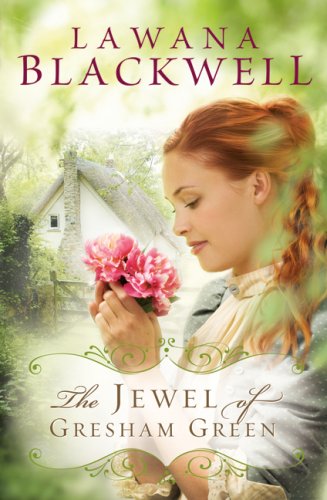
the Jewel of Gresham Green by Lawana Blackwell

publisher: Bethany House
rating: ***1/2

I love Lawana Blackwell. I love every sentence she writes. The first trilogy in the Gresham Chronicles: the Widow of Larkspur Inn; The Courtship of the Vicar's Daughter and The Dowry of Miss Lydia Clark were, combined, the perfect antidote to a blustery, long Toronto winter.


Many a chilled evening found me snuggled in a coffee shop near a fireplace, tea and scone at the ready, completely lost in the delightful Elizabeth Gaskell world of Vicar Phelps( curate of a parish infiltrated by squires and good-hearted cheesemakers, farmers and teachers and the like), and his elegant Julia Hollis ( the owner of the Larkspur Inn: a coaching house turned hub for eccentric boarders: gardeners, melancholy actors and spinster writers). Like Cranford or Lark Rise to Candleford, Blackwell's strength is in weaving charm, humour and,at times, pathos into a series of episodic vignettes which perfectly portray daily life in rural 19th Century England.


I just finished the Jewel of Gresham Green:

As is the case with all Blackwell's novels, there are one or two main strands ( this one featuring a widowed mother and her adorable daughter fleeing the harmful potential of a rakish London landlord for the safety of the Gresham parish ) and plenty of subplots to colour in the sidelines. My favourite plot in the novel involves the jubilant writer Aleda and her friendship with storyteller Gabriel Patterson. The last time we saw Aleda and Gabriel they were substantially younger and I love what they have grown up to be. Aleda ducks conventions, lives in a writing cottage where she doesn't feel the need to have a water closet ( because Shakespeare didn't have one) and has a Jo March-esque tendency to write pot-boilers about pirates eaten by komodo dragons. Blackwell's inserted snippets from Aleda's magazine serials and moments showing Aleda plotting the next portion of the novel are to die for!


I really love how funny and fresh Blackwell's prose is. She captures the time period perfectly and throws in tidbits of every day life that balance the charming action of the novel with plausible historical fact.


Blackwell's novels are the perfect modern specimens of Victoriana. You will find no writer stronger-in either Christian or secular publishing-who better understands 19th Century wit, dialogue, grace and every-day life.

Blackwell takes you back a hundred years or so, drops you off and lets you float as an outsider amidst some of the most compelling and dimensional characters I have ever had the privilege of meeting.

Thursday, April 16, 2009

christian fiction pick of the week

I often head over to Christianbook.com to see what is new and hot but also to check out their pick of the week. This week it is Robert Whitlow ( who I love ).

check it out.

Wednesday, April 15, 2009

blog recommendation: Tamera Alexander


I am currently reading Beyond This Moment by Tamera Alexander. I read the first in the series From a Distance and really enjoyed a taste of the frontier life in the years following the Civil War.


Beyond This Moment features some of the characters from the previous novel but can be read as a standalone. I enjoy the fact that the heroine has a doctorate in romantic languages and linguistics: no easy feat for a woman of her time period. Like all of Alexander's heroes, Sheriff James McPherson ( at least so far ) is blue-eyed, wide-smiled and winsome.

While I keep reading through the twists and sparks of their romantic plot, I will send you over to Tamera Alexander's blog where she promotes the best Christian books and authors she is reading and tells us about what's going on in her world.

I avidly follow My Friend Amy's blog and here she describes itching to get her hands on Beyond This Moment

Thursday, April 09, 2009

Passover

Passover started last night and I was fortunate enough to be invited to celebrate with my landlady and her family for some delicious food and tradition.

I had never celebrated Passover before and, like most Christians, knew the story well but did not recognize the various ingredients that go into making this meal a holy one of solemn remembrance.


I figured that the best place to consult in preparation is the awesome blog of Bodie and Brock Thoene: proudly Jewish and Christian, these two often offer insight into celebrations and traditions whilst keeping them firmly rooted in Christian trajectory and scripture.

After all, they know this period intimately due to their work on the A.D. Chronicles and various turning points in modern Jewish history.


I subscribe to their mailing list and received this affirming message yesterday:

Tonight is the first night of Passover!
This is the night when we rememberhow the Strong Arm of the Lord delivered the Hebrew slavesf rom bondage! This is the night we rememberhow Yeshua, Messiah and Savior,delivered us from the bondage of sin and death! Jesus is indeed the Passover Lamb! Jesus is the Lamb of God who takes away the sinof the World! Read Exodus 12-13 tonight! Then read Matthew 26-27!Everything means Jesus!The moment of our EXODUS is near! Shalom and blessings!Happy Passover!

I knew I could count on them to give a bit of insight into this popular festivity.

They are not only my blog recommendation for the day, they are two of my favourite Christian novelists. I strongly encourage voracious readers of historical fiction to dive into their exceptionally researched novels (esp. Vienna Prelude--- one of my favourite novels of all time)


DISCLAIMER: As long as an opinion is well-written, I will venture into writing whose beliefs differ from my own--- to keep a healthy open mind and a pulse on current perspectives. I find that the Thoenes express a, for lack of a better term, rather “right wing” viewpoint which I do not always share. This being said, they are always able to couple their opinions with research, scripture and fact and, more often than not, lace them with interesting anecdotes from their writing. It is their inspiring devotionals and stories of bringing history to the page that I most enjoy.

Wednesday, April 08, 2009

A Flickering Light by Jane Kirkpatrick


rating: ***1/2

publisher: WaterBrook


Jessie Gaebele loves photography. Her mind frames potential images everywhere she looks in her Minnesota town. Jessie is fortunate enough to find a placement at FJ Bauer’s photography studio where she burgeons into a working and professional woman whose hand at portraits and talent for putting “sitting” clients at ease prove her a natural.


I enjoyed this turn- of -the -century tale about a spunky woman who has the rare chance to make something independent of her self: regardless of the social constrictions of her time and circumstance.

Kirkpatrick does a notable job of creating the dark room world of Jessie, her friend Voe and the imitable FJ Bauer. Likewise, the portraits of domesticity: whether at Jessie’s home with her stern parents and challenged brother or at the Bauer residence: which, when unveiled, is a formidable look at a crumbling marriage guised by poise and outward appearance.

I often felt I was walking down a street with Jessie, peering above the wrought iron gates to mansard roofs and wafting lace curtains to gaslights and cozy hearths. Kirkpatrick does a remarkable job of painting life as it was. In fact, as is often my highest compliment as an imaginative reader, she made me nostalgiac for a time period I never lived in.


You will recognize from previous entries that the insertion of ephemera rarely inspires me in fiction, but Kirkpatrick uses it well. As this is a fictionalized biography of her grandmother, Kirkpatrick has numerous photos Jessie took or posed for and these loan an interesting and unusual physicality to the plot. Your imagination is somewhat stopped by virtue of the fact that you know what Jessie looks like: a plain, proper, probably well-mannered woman of her time.


I very much enjoyed learning about the dissonant opinions treating photography as art and commercialism. This tied well to my previous read, Cramer’s Summer of Light.

As a Christian novel, this book is rather lightweight evangelically. Kirkpatrick is more interested in spinning the yarn of her grandmother’s youth as a developing photographer and this is not the soap box from which she will preach fire and damnation. That being said, there is a calm and subtle symbolism of light that Kirkpatrick uses deftly: especially in a sermon preached a Christmas Eve candlelight service.


At the heart of this unique romance is the attraction between the young Jessie and her employer, FJ Bauer: who is some twenty-odd years her senior.

This coming of age tale evokes the awkward emotional development of a girl who is confused by the feelings racing through her. I applaud Kirkpatrick on her ability to take the reader through the whirlwind of susceptible Jessie’s emotions ---also, through the returned infatuation of her married employer who loves his family but is starved of affection and often the slightest touch.


This was an engaging read and I look forward to reading more of the series.

Tuesday, April 07, 2009

blog recommendation: Liz Johnson

I have not had a moment to myself it seems to chalk up a couple of reviews from some very well-deserving novels. The publishing business is extremely busy at this time of year and my work keeps me hopping!


Instead, I am going to offer another blog recommendation:


As exciting as it is to follow establish authors, I also enjoy reading about the writing and publishing process from the perspective of a first-time novelist.

Liz Johnson, a stellar publicist at a leading Christian publishing house and the author of the upcoming Kidnapping of Kenzie Thorn (Steeple Hill, 2009) loans her snappy wit and interesting perspectives on things Christian and non ( pop-culture, books, life, the excitement of having a book published, the all-too-familiar saga of a lost library book ).

Liz is funny and down-to-earth and I sincerely wish her upcoming novel all of the very best.

I follow her daily and hope you will too!


Upcoming Reviews:


Chasing Fireflies by Charles William
A Flickering Light by Jane Kirkpatrick

Monday, April 06, 2009

blog recommendation: Beth Pattillo


I was meandering through Chapters today ( Canada's answer to Barnes and Noble ) and stumbled upon a Beth Pattillo novel I had not read!


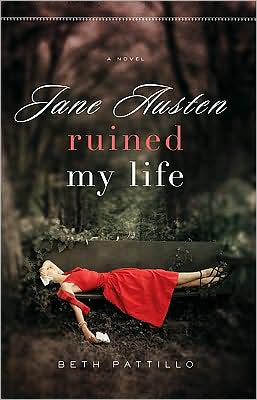
Shocking because it's called Jane Austen Ruined My Life.

A
Beth Pattillo Jane Austen novel that I missed? Shame on me!


I love Betsy Blessing and the Sweetgum Knit Lit Society so how could I pass on this?

....well, my book budget dictated that I momentarily stock it in the "to be purchased after you have read the mountain of books on your TO BE READ SHELF and not before" --- but, await fair reader, I shall be picking this little gem up before long!
Especially as I anticipate the second Knit Lit book this summer! In honour of my discovering unchartered Pattillo territory, let today's blog recommendation be her's ( well, in the guise of Betsy Blessing).


Sunday, April 05, 2009

the upper room


A while back, Canada's most prominent Christian bookchain, Mitchell's, went bankrupt. With its departure, my vast metropolis was surprisingly stripped of a Christian book hub. Sure, there are the seminary bookstores and the theological bookstores but nothing quite like Mitchell's: a favourite escape laden with wingback chairs and a chance for a snuggle with a good book and a cup of coffee; friendly staff and a welcoming ambience.


Because I love to support "brick and mortar" franchises, I try hard to purchase as many books as possible at bookstores. Mitchells' demise has left me bereft somewhat and I have had to resort to online purchasing....

Luckily, I find myself in London, Ontario occasionally and a guest at The Upper Room: a midsized bookstore with friendly staff and a glance of what is new and hot in the fiction world.

Sure, they capitalize on the popularity of whatever is the latest buzz with large pyramids of "The Shack", but it is nice to walk into a bookstore wholly devoted to Christian books.

I went yesterday and was lucky to strike up a conversation with a salesperson whose tastes were very similar to my own.

We talked Cramer and Austin and when she told me about Charles Martin I was immediately intrigued. I had read in an interview that Dale Cramer reads Martin and thought he might be worth a peek ---- I am always looking for great fiction in the contemporary vein.

Unfortunately, due to some poor marketing which drills out his books looking like they stepped out of the Nicholas Sparks' cover factory, I had skipped him. Sometimes a savvy reader DOES judge a book by its cover: if the cover clearly defines the author as a comparative style to another ( like that guy whose books look like Tuesdays with Morrie .... cannot remember his name...another Christian....Dinner with a Perfect Stranger... or something like that).


I mentioned this to salesperson who assured me that Martin has scintillating prose. I purchased Chasing Fireflies and am about two-hundred pages and my whole heart and soul in. The writing is gorgeous! the characters are leaping off the page and each chapter- end wedges a lump in my throat.


You cannot always trust a bookseller: some will lead you off on mazes and trajectories that in no way, shape or form bear resemblance to what you crave.... but when you find a good one, strike up a conversation! --- make sure they know your likes and dislikes and allow them the credit of narrowing down a large and harrowing field to find your next favourite author.


p.s. I checked out Charles Martin and fortunately for my burgeoning infatuation, he has a wide backlist!

Thursday, April 02, 2009

blog recommendation: Jane Kirkpatrick


I am currently savouring A Flickering Light by Jane Kirkpatrick. I know I will have lots of questions for Jane once I finish the last half of this sumptuous fictionalized biography of Jane's photographer grandmother.

This story pulls you in immediately and I have been tasting its ambience: streetlights, candles peering through windows, the stiff aura of the darkroom, the smell of woolen socks drying on a radiator these past few days.

I was meandering through Jane's blog and thought I would direct interested readers here.

I am always elated about entries outlining the writing process and Jane's perspective is interesting as it is informed by her real-life subject matter.


Enjoy.

Wednesday, April 01, 2009

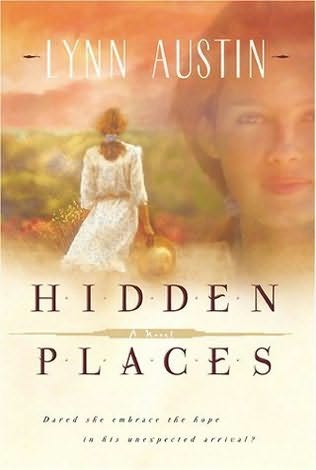
Christy Awards: Hidden Places by Lynn Austin


rating:****
publisher: Bethany House

I have decided to read a selection of past winners of the Christy Awards in anticipation for the 2009 ceremony in July.

I started with Lynn Austin's well-deserving Hidden Places.


In Hidden Places, Lynn Austin has crafted a near-perfect novel. I am surprised I had not read this before now because, as you are well aware, I am a fan of Austin's and I recognize this as a modern classic of the genre.

Eliza Wyatt is hit hard by the Depression, especially after her husband and her father-in-law pass on leaving Eliza and her children with the vast responsibility of maintaining Wyatt Orchards and its on-property homestead.

Just when it seems that her faith(already on tinterhooks) is going to droop completely, Eliza is sent an angel( well he might as well be an angel). In human form, he is Gabriel Harper: an enigmatic presence who vows he is a journalist riding the rails capturing the stories of out-of-work, hard-on-luck nomads. He knows everything about farming and the Wyatt Orchards and may be the answer to the prayers Eliza is reticent will ever be heard. ( Note: this "angel" figure put me in mind of Cramer's Sutter's Cross)

But, there is something familiar about the "angel" Gabriel---something that Eliza cannot put her finger on. It could be that he is the elusive Matthew Wyatt: the rightful owner of Wyatt Orchards who can, at any moment, remove Eliza and take ownership of the land.


Although the aforementioned plot is at the core of this exceptionally-structured novel, we are given leave to open the dusty curtains and delve into the past of Wyatt Orchards and the people who have seen it through hardship and prosperity; war and peace; abuse and love.


One major component of the story focuses on the eccentric Betsy: now christened Aunt Batty a bookish old woman and an epoch of faith who, due to an unfortunate storm, finds herself nestled in a family-in-embryo with Eliza, Eliza's children and Gabriel.


Batty's story, for me, was the most poignant and exceptional testament of Austin's resounding faith. Like W. Dale Cramer, Austin need not rely on evangelizing us --- rather she uses her gift of prose to slowly unfurl a gripping family saga with roots in Charity, Hope and Love.


There are certain authors whose works so transplant you there is an immediate connection: a kinship that makes you feel that the author is speaking directly to you---sitting across from you---treating you as a confidante ---voice rushing so quickly in utter need to reveal every detail that the turning of pages cannot keep pace.


Austin is an author whose words spill lucidly. She restores my faith in everything: colours seem brighter after reading her, nature is more noticeable and I walk around giddily replaying some of "gasp!" moments she imparts on her readership.

From a literary perspective, Hidden Places is far more than a Hallmark escape into romance and love. Though the heroes of Lynn Austin novels always see heroines as more than they see themselves, the real love of the novel is founded in an acceptance of God's purporse. Austin weaves this deftly, yet its impact is powerful

Batty's faith is the most resonant in it solidity: "God didn't have to make apple trees and peach trees burst into flower and fragrance", she explains jubilantly, "But God just loves to splurge. He gives us all this magnificence and, if that isn't enough, He provides fruit from such extravaganze!"

Her warm heart and brainy mind are well-suited to Walter: the bookish and sickly man she recalls marrying. "Don't ever settle for any other life except the one for which God created you." Walter insists of her.


Lynn Austin allows her characters to be splayed flawed and humane on each page. We are supposed to take note and example from their successes in Christ as well as recognize the common threads that link us to them: just another way Austin pulls us into her world and confides in us as if we were a part of the drama unfolding.


Hidden Places could refer to the family secrets deeply rooted in the orchard and burrowed on each page; to a scripture verse quoted; to Batty's money hidden in her vast library; to a clue from Gabe's rucksack as to his true identity; to what the erudite Walter sees in the self-proclaimed homely and awkward Batty; to the secret furrowing Eliza's brow with guilt and shame.


For me, the title was most resonant when little gems of phrase or humour or literary reference were spilled onto pages unexpectedly---Like the time when Batty pretends she has been reading Les Miserables to charade her sadness over a seeming rift with Walter.


I have a feeling each reader will glean something unique from this exceptional novel.


I highly recommend it and hope to bring more Christy Award winners to light as we approach the 2009 event this July.

the thinking girl's guide to eric metaxas

Last night, the annual President’s Dinner at Tyndale Seminary here in Toronto featured renowned debater, lecturer and author Eric Metaxas as its key note speaker.

A humourist and intellectual, Metaxas’ CV ranges from writing and voicing Veggie Tales to hosting the prestigious monthly philosophy forums, Socrates in the City in Manhattan.


My primary interest in Metaxas is his role as a biographer: of abolitionist William Wilberforce (the subject of the British film, Amazing Grace) and the upcoming life of Dietrich Bonhoeffer ( HarperOne, September 2009).


Eric Metaxas was a dream speaker: rapier-witted, erudite and literary. The motif of his talk was Christian Heroes and this provided an easy platform for delving into the tenets of the Wilberforce story not explored in the film. Metaxas’ subject is obviously one of effusive passion for him and this translated well: captivating the audiences from the get go.


Metaxas brought Wilberfore to light in a way often overshadowed by his great abolitionist work and his position as protégé to the hymnist John Newton. Metaxas’ research argues that Wilbeforce single-handedly infused a sense of moral and social conscience that not only tail-ended the “Vanity Fair” of the luminous and decadent 18th Century but propelled the way for the social platform that was the Victorian Era (aptly ushered in near the end of Wilbeforce’s life ---he died in 1833). With his tireless brand of Christianity in action, Wilberforce coupled the zealous Methodism of George Whitfield with a Christ-appointed drive for moral change and his efforts resulted in shaking the very infrastructure of Britain’s morality (or lack thereof).

If Metaxas is correct (and his argument coupled with history….especially Wilbeforce’s participation in organizations like the Clapham society….is more than convincing),Wilberforce paved the way for the literary period to which I have ascribed more than half of my 27 years of existence: the Victorian period. Dickens, Eliot and Hugo are three authors who used their pen to battle moral injustice: a long cry from the complacency and disregard of morality Wilberforce was battling in the previous century. If indeed William Wilberforce was the moral force to be reckoned with: this 5”2 man with a genius for oratory and politics is certainly one of history’s most pronounced Christian ambassadors. He realigned the fibers of a decrepit infrastructure that dictated the actions of, at that time, the most powerful Empire in the world. In doing so, he proved that one fallible human can propel actions that will ripple through a century and onward in a humble yet incendiary motion far more vast than his initial spark of light.


More Metaxas?

@ WaterBrook press

Interview ( at the Wittenburg Door)

Socrates in the City

Amazing Grace

Monday, March 30, 2009

Summer of Light by W. Dale Cramer


rating: ****
publisher: Bethany House


Reading Lynn Austin and W. Dale Cramer in the same week reaffirms my long-standing opinion that they are the two strongest writers in the Christian marketplace. I fell in love with Cramer’s prose when I read Bad Ground and then subsequently with the rest of if his novels. Cramer once mentioned in an interview that some of his greatest influences were Faulkner and Steinbeck. Reading his thoughtful, well-embroidered yarns you can easily detect this influence. Though Summer of Light is a bit of a more breezy read without the seeming emotional or thematic depth of Bad Ground and Levi’s Will, it is still an exceptional novel... And, when held up against other contemporary Christian novels manages to pack quite the punch.

Mick Brannigan is a tough iron worker with set views that a man’s place is as the breadwinner. Though Mick loves his kids and his paralegal working wife, he is steadfast in his beliefs that he should be out of the home and on the job. After an unfortunate accident, Mick is forced to leave the working world and care for his three children: Toad, Ben and the sometimes challenging Dylan.

More than a “Mr. Mom” story, Summer of the Light is a novel of perspectives cast by differing shards of light. The search for the perfect light and the challenge to capture the perfect light is a resounding theme in the novel. Mick’s talent for photography, his upscale neighbour Aubrey’s coaching and the homeless man-with-no-hands’ classic opinion help Mick thrive in an element foreign to him: one of art and light borne of seemingly commonplace circumstance. This light, as embodied in photography, in the stainglass of a monastery, in a sunrise over a ramshackle barn was ( to this reader) the manifestation of God in human places.

Mick sees most clearly when things are reflected in a certain light. This ironworker/ photographer has an almost preternatural reverence for light at angles and the perspective these angles give him. The reader is given the same perspective as Mick as he is the character driving the novel.

From a monastery, to an empty barn to a homeless sector beneath the bridges, Mick’s photographic eye snaps everything: Hope, Charity, Emptiness, Faith …. People, his kids and a zillion different reflections.

Cramer is magnificent with symbolism and theme. Some if his descriptive prose is quite breathtaking and he does well in using photography and an artist’s eye to capture the exceptionalities of what Mick once found commonplace.


Tolkien once mentioned that his Lord of the Rings novels were a type of “pre-evangelum”: stories with symbols and archetypes which bordered on the metaphysical--- prodding readers to contemplate rather than receive a forced conceptualization of theology. I feel that Cramer uses this same practice. Though his characters ( especially the Preacher) are recognizable symbols of Faith, there is nothing explicity or exploitatively “Christianese.” Instead, Cramer infuses Christianity through practice rather than words. Any Christianity is embodied through actions. Cramer mentions something along the Francis of Assisi line “ preach the Gospel, if necessary use words” ( my paraphrase) when Mick realizes that Dylan will mirror his actions rather than internalize his words. Cramer doesn’t bludgeon you over the head with the Gospel, rather he credits the thinking reader with enough dots to be connected: parables to be chewed over and aligned with resonant Faith.


My only Cramer complaint is that the Christian reading populous has heard nothing of him since this publication two years back ( I just read it now. I was saving it for a rainy day). I wish he would come out of hiding because the Christian book publishing prospect of 2009 is rather empty without him.


More W. Dale Cramer? He will completely overhaul any preconceptions you had of Christian fiction


...and hold on. I will get to Hidden Places! I am just savouring a re-read. I always go through a fantastic book and re-read my favourite bits to pick up any thread I missed.


Wednesday, March 25, 2009

A new take on TOP FIVE

My friend Courtney tagged me in a meme which asked me to write about five things that I love.


I thought I would tweak it to reflect the subject matter of this blog.

Thus, I give you ( and ever so delightedly) five leading men I love from Christian novels.

These are my top five, so to speak and I hope you enjoy reading about them ....and will be inspired to hunt down the excellent books they live in.


1.) Neil MacNeill from Christy (Catherine Marshall)

has this book EVER been published with a good cover?

Dr. Neil MacNeill is a fiery Scotsman who sacrificed a prestigious city medical career to serve his mountain people in Cutter Gap ( the small populus ensconced in the Great Smokies of Tennessee).

Neil is a little bit different than numerous Christian heroes because he begins the book as an agnostic. He has a lineage tracing back to Bonnie Prince Charlie and a fiery temper to match his heritage. He is a skilled and brilliant doctor who is seemingly well ahead of the game dappling with groundbreaking cures ( for diseases like trachoma) while having some of the most rudimentary resources at his disposal. It is funny to see him as a suitable match for the coming-of-age schoolteacher Christy Huddleston, but they share a similar passion for the people and a desire to see more in the region than anyone in the "outside" world ever will. This not only solidifies their relationship ( even if it is interspersed with some incredibly verbal battles), it helps Christy grow into the strong and independent woman she is to become...all the while turning Neil back to faith.

(note: they made a rather horrific family television series which diluded all of the serious subject matter of the powerful book. But they did one thing right. They gave Neil MacNeill a pension for opera and flyfishing. I thought this was a poignant touch and very much in character: delineating him from the mountain people he was descended from while sewing a common thread to Christy's cultural background in upscale Ashville).


2.) John Murphy Vienna Prelude (Bodie Thoene)

I think I can safely say that John Murphy was my first fictional crush. I had turned 12 when I read Vienna Prelude for the first time ( I have read it every year since at Christmas time) and I immediately fell under the spell of this brash, quick-witted New York Times reporter. I first fell for him when he was saving Theo Lindheim and his beautiful violinist daughter from a Nazi interrogation at a Berlin train station. Murphy snappingly responded to a mousy Gestapo's "Heil Hitler" with a quick "Twenty Three Skidoo". Some things just don't translate.

Not a spineless, mopey lover, Murphy pursues Elisa doggedly---even accepts her proposal of an arranged marriage , crashes a Kosher Zionist party with ham as a gift, and buys a multitude of symphony tickets in a seat and row which directly align with her chair in the orchestra section. In later novels in the series (The Zion Covenant) , Thoene tells us that John Murphy resembles Jimmy Stewart. Sign me up! Like Neil MacNeill, Murphy does not begin the novel as a Christian allowing the reader to be ministered through those who minister and challenge him.


3.) Silas McClure A Proper Pursuit (Lynn Austin)

I'm reticent to reveal the delicious secret surrounding Silas in case you have yet to read the novel ( please go get it now ). Suffice it to say, Silas is one of my all time favourite leading men. Sort of Harold Hill ( think the charm of the Music Man) without the sly ulterior motives. Silas is an elixir salesman: a drummer clad in saddle shoes and bright suits with stunning blue eyes and a candleabra smile. Silas is light-hearted, adventurous and funny with a fire crackery "gee whillicker" boyish charm. He provides heroine Violet Hayes with a taste of the penny novel adventures she longs for, takes her up Mr. Ferris' Wheel at the Chicago World's Fair and engages in bouts of a "would you rather" game." He is also one half of the most tingly, joyous kissing scenes I have ever read.

One thing I am learning as I read more Austin is that her best heroes have a tendency to see more in the heroines than they do in themselves. This has always been a romantic trait for me. Well-done Silas! And he's a Christian! Praise the Lord. I wish I could bring him home to meet my mother.


4.) Phineas Snowe All the Tea in China (Jane Orcutt)


What I like most about Phineas is that he is part of the reason Orcutt's novel strays from falling into convention. He is sneaky and not always truthful but he treats sword-wielding wordsmith Isabella as an equal. Phineas doesn't shy away from teaching Isabella the finest of Chinese combat and legend and martial arts. Further, he engages in many a match of witty repartee with Isabella which adds to the novel's sheer brilliant, diamondy dialogue. He's not who he seems but he is a lot of fun and gives a fresh and unexpected twist to a taut and tantalizing Regency adventure.


I think I knew from the first scene ( which plays like something out of a Jane Austen drawing room with a careful match of well-strung words) that he and Isabella would provide me with hours... meaning pages... of blissful entertainment.


5.)Wynn Delaney The Canadian West series (Janette Oke)

Who doesn't love a man in uniform? Face it, these books may have as much depth as a tea spoon but they are classic. In a wonderful twist relating to her subject matter, Oke is very much a pioneer in the genre: paving the way for other Christian novelists as Wynn and Elizabeth were part of the mass settlement in the Canadian West.

Well, I AM biased. As a Canadian, I have a soft spot for the tales about a gorgeous, steadfast mountie of impeccable character whisking a courageous and refined schoolteacher to a remote post in the Canadian West. The scenery is beautiful ( and not just Wynn in scarlet) and the episodic events create inspiring terrain for Christian values and morals. I also really enjoy the close proximity of the Delaneys to the First Nations. We learn a lot about a rich and beautiful cultural heritage.


Honourable mention:

John Falconer Heirs of Acadia series (T.Davis Bunn)

I read the entire series for this former slavetrader whose dark, redemptive journey challenged and compelled me. I think Falconer is one of the most dimensional Christian heroes in years. I strongly recommend these books for those who hanker after solid character pieces.

Christy Awards

Named after one of the greatest Christian fiction novels ever written, The Christy finalists are announced.

Interesting catagories and some excellent shortlists this year.

See here

and yes, Lynn Austin is nominated.

Tuesday, March 24, 2009

Well-played Lynn Austin


I am currently reading Hidden Places and, as per usual, am blown away by Austin's prose. She paints images with words I would never think of stringing together.

Pending a review of the sumptuous book ( I cannot get enough of it ...I am reading some paragraphs over again so I don't miss one well-situated word or phrase), I thought I would dedicate a whole entry to Lynn Austin.


I think I mentioned previously that even in the novels without strong starts ( I had trouble sinking into Until we Reach Home) she always wins me over with a moment I was never, ever expecting.

Here, they start at the beginning.


Here is Lynn Austin's website. Just buy the lot of her work. She has such a wide range and she is an incredibly beautiful writer.


p.s. Apparently they made a television film adaptation of Hidden Places with Shirley Jones (!!!) however, a synopsis assured me it strayed too far from the novel for my liking.

Sunday, March 22, 2009

"The Cubicle Next Door" by Siri Mitchell


rating: ***
publisher: Harvest House


Jackie works for the US Air Force. She has been there for ten years, is extremely proficient and has her own office.

But, not for long.


The powers-that-be squeeze a divider between Jackie and a new pilot/history teacher named Joe and office space becomes a little more crammed.


Even more so because Joe immediately likes Jackie and spends the rest of their working relationship pulling her out of her comfort zone (vis-a-vis a cubicle) and on to the rest of her life.


The metaphor of the cubicle closing someone in to a space: trapped and somewhat ignored is a prevalent one in Mitchell's breezy chicklit.

Jackie narrates that story with precision and a fresh sarcasm/realism that few first person narratives can pull off.


Joe is an engaging, funny and downright adorable pilot ( with dimples *cough*) who endears us (and Jackie) by seeing more in her than she ever does in herself.


While this is a strong contender in the realm of Christian chicklit, I cannot help but think that Mitchell was somehow reigning in what could have been an even more daring and delectable novel.

This could be because her most recent foray into the genre, A Constant Heart is more than one of the best of its kind.


The Cubicle Next Door refers to an eponymous blog wherein Jackie informs a wide readership of her confused and mixed feelings toward Joe. She also shares some kernels of wisdom and a delightful vulnerability.

This being said, the blog itself is the weakest part of the novel. For a writer like Mitchell, crafty blogs should be a cinch but I could not figure out why this blog enticed upward of 20 000 hits a day. Moreover, why it would be the subject of a television news segment ....the very one that lures Joe into reading it daily----unaware of its author.


The premise is catchy and the characters well-drawn ( I love Oliver: Grandmother's British love interest and the ladies Joe helps switch from Bridge to Poker).

This is a light and page-turning read that I devoured in a sitting. Joe IS wonderful and the tenacity and patience in his pursuit of Jackie will restore a reader's faith in romance.

I particularly enjoyed the setting of Colorado Springs and area as that is a familiar territory for me because one of my closest friends lives there. It made me feel inadvertently at home.


I would definitely consider reading A Constant Heart if you can choose but one Mitchell title. However, you cannot go wrong with this slightly lesser fare. Mitchell has a knack for words and stories that translates well into any genre.


More Mitchell? I recommend here highly.... see here

Friday, March 20, 2009

A Proper Pursuit by Lynn Austin


Rating:****

Publisher: Bethany House


A Proper Pursuit by Lynn Austin is one of my favourite Christian novels of the past year. It is sweet confection and tugs your heartstrings while catching you in a dizzy whirl of romance and fun.

Violet Hayes is ecstatic to leave her stepmother and her usual high-society existence for the adventure and mystery she is sure await her at the Chicago World’s Fair. Violet knows that staying with her eccentric aunts and society-hungry grandmother are an easy trade for the chance of finding the mother she recently learned abandoned her….while soaking up the intrigue she has read about in dime novels and Sherlock Holmes stories.

Violet is an imaginative and engaging young woman who is always at the ready to snap up romance and danger. She is winning, endearing and brightly created.
As mentioned, Austin is one of the most capable novelists in the genre. Her structure is always one of her strongest suits. Here is no exception. Violet is courted by four very different suitors and both Violet and the reader are able to dissect each potential relationship though a telling trip to the World’s Fair.

One of Violet’s suitors, the enigmatic “drummer” Silas McClure is like Harold Hill meets Gilbert Blythe. It is hard to characterize Silas’ open charm. He is one of my favourite leading men in all of Christian fiction. He is surprising and mysterious and perfect for Violet…also for me. The two banter and play rounds of “would you rather” as well as exorcise their need for a bit of danger with trips to the beautifully-described Mr. Ferris’ wheel: one of many wonders of the Fair.

Austin has captured the period perfectly. Her characters, wit and dialogue shine. While, surfacely this novel seems to traipse at a more sunny and simplistic gait than the sterner subject of other works, it has serious undercurrents touching on abandonment, cultural and social discordance, loss, and the rights and roles of women in a subservient era.

And, on a superficial level, the novel has one of the most perfect kissing scenes I have ever read. Think of all of the hyperbole given “the kiss” in Goldman’s “Princess Bride” and top it by ten. This scene is electric.

Shove away the early Spring shivers with a warm and inviting novel that will send jolts of happiness up your arms and tingle your fingers with giddy joy.

I LOVE this book.


I recommend this novel heartily to readers Christian and non.

Tuesday, March 03, 2009

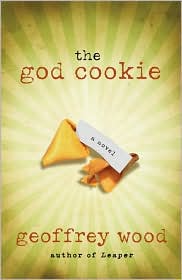
The God Cookie by Geoffrey Wood


rating:****
publisher: WaterBrook


Geoffrey "Leaper" Wood has more than exceeded my expectations with his jaw-droppingly well-written sophomore book.

In fact, The God Cookie should propel Wood into the large readership he deserves. I knew that the Christian reading populus had something special on their hands when we were gifted with Leaper's sparkly dialogue, fly-highing premise and thunderbolt of fresh creativity....and now this! All of the ingredients which made Leaper so giddily defy the norms of the genre have been healthily dolloped into the God Cookie....tenfold.


The God Cookie is not your grandma's yellowed Grace Livingston Hill novel; nor is it the broadly coloured collection of riff raf circa 1970 with a cover seemingly stolen from the movie poster of Funny Girl you would find in a church rummage sale. Instead, the God Cookie belongs in the Christian literary elite. Geoffrey Wood, I hope, has a long career in the industry because he will not conform. Take his gutsy plot---young barista who has copious world views on golfing and salt shakers but cannot wrap his head around the metaphysical, follows a holy trail spun from a vague interpretation of a fortune cookie he interprets as God's divine will. Through a caffeine-induced high and not withstanding the mockery of his coffee shop pals and the greater world's cocking of a sceptical is he for real? eyebrow, John Parrish is ready to listen. He scrapes by on a thread: following blindly a commandment to "take the corner."

"The Corner" holsters a discombobulated melange of bench-sitters---some seemingly waiting for a bus (or Godot?) which might never come. This mix leads John and his new pal Audra along a trail of redemption, life lessons and gritty, every-day Grace.


What I like most about Wood is that he meets everyone where they are at. Not all of the characters infiltrating this Christian novel are believers and, let's face it, by the end of the novel, there will be no mass-conversion and looping of arms in joyful song. There are no super-powered (well, there was one literally in Leaper....) molds of perfect spirtuality. John continually questions God in the way he questions his underworked employees Mason and Duncan about where the duct tape went.

Wood is a dynamite story teller who is funny, saucy, conversational and invitational: you feel like you are being invited as a privileged fly- on-the- wall witness to something outstanding. The realism surging each page makes this experience plausible and keeps the pages flipping.

Wood is heavy on dialogue ( especially in the first third of the novel) but he has a knack for it and each character has such a distinctive voice that were you to detract any notation of speaker, I have a feeling I would still be able to figure it out. This is a rare gift indeed. One, I think, which might derive from his extensive background in theatre.


As a coffee lover, I enjoyed long, frothy odes to the beverage as well as the tirades on the monotony of tea ( the anti-coffee).


As for the structure of the novel, it is almost genius: life changing, climactic events of pseudo-Biblical proportion unfold in the course of a week. In this span, numerous people ( making a big web, say), are changed and interconnected.


Poetry is apparently ( according to my grade ten teacher, at least) "the perfect words in the perfect order" and our friend Wood is apparently a poet. Example: a scene thawing a frigid urban February:

...blue touched blue and they became background for streaks and wisps of cloud. Sunlight, rays of it, gave a brightness like spring, a direct and golden-yellow brightness unlike the trapped, refracted glow of winter's day, and to that homogeneous cityscape that lay so inert and wide and flat, just a few spring rays of sunshine gave a sudden depth of dimension to everything. Individual things came alive, as if each stood brightly before you, each with its own story.


There are also whispers of unpreachy symbolism and comparison prompting the thinking reader to stop and pause. And, everything has meaning: Fritter Johns: the eponymous coffee shop derived ( very inadvertently ) from Robin Hood (a book John and his rag tag trio can "get behind") and John Parrish's name: which boasts a religiousity lending well to a discourse on the "everyman" or "parish":while still putting us in mind of one of Jesus' ultimate followers.


Geoff Wood went out on a limb ( again ) and succeeded. The vulnerability of his characters seems almost ironic when housed in such a stern, confident and strong novel. I like guts in my Christian fiction. This guy has guts.

Most importantly, however, beyond the pitch-perfect phrasing, the well-executed tale and the characters who spark and fly, is the message encapsulated in each page. A message of: 'we're not there yet, how can we possibly be? but, let's keep trying and searching; learning and listening, following redemptive strands that might lead to nowhere, rejoicing in hope and hats and snow....'


A cop tells John that he expects God on earth would find out the lonely places...rather than the over-crowded congregations. Wood reminds us that God meets us where we are at, if we give a little: no matter how flawed.....

I believe, most heartily, that He has found His way between the covers of a Geoffrey Wood novel and it would be an absolute shame to miss what He has to say.


More Geoffrey Wood: read interview here

Sunday, March 01, 2009

reviews

Hello, I have written several reviews recently over on my Christian fiction blog:

I have a love/hate relationship with this genre which will be apparent when you read my reviews. I am always truthful and I hope never biased.


mantra: Just because its Christian, doesn't mean its good.

Saturday, February 28, 2009

A Woman's Place by Lynn Austin


rating:***1/2
publisher: Bethany House


I am a huge Lynn Austin fan. I think she is one of the best novelists in the market and this is yet more evidence that she has strength and conviction as a faith-based writer.


A Woman's Place follows four women: Helen, Jean, Rosa and Ginnie --- all working Rosie-the-Riveter jobs in Northern Michigan during the Second World War. Each represents a different type likewise a different strength of woman: Rose is a fiery new wife of Italian origin who leaves Brooklyn to settle with her strict inlaws when her husband is shipped overseas; Helen is a middle-aged teacher and heir to a large fortune ---the only lasting member of a large family. Her past love life is explored and carries more than one surprise. If Rosa is the free-spirit, Helen is, at first glance, the stick-in-the-mud. Jean is a fresh-faced woman--- just 18 at the start of the novel, who yearns to go to college against the wishes of her All-American jock boyfriend. Her friendship with Earl the foreman at her ship-building factory job is the highlight of the novel; Ginnie is a stay-at-home mom whose war-time employment she hides from her keeping-up-with-the-Jones's huband. Ginnie yearns to discover that her value lay outside the conformity of a housewife ensconced in appearances of domestic norms. At one point, she is assured that the dog is the only member of the household who holds any affection for her.


The novel begins with a snapshot of the quartet in their respective pre-war lives nicely developing characters who will grow into dear friends as the pages progress. When the attack at Pearl Harbour hits, their lives are uprooted and the narrative continually rotates to each perspective of women-at-war.

The novel is at times funny, heartbreaking and warm. A scene where Rosa accidentaly spikes the punch bowl with vodka intoxicating her mother-in-law's church women's group had me in stitches.

The structure of the novel also works extremely well. More and more I learn that structure is one of many of Austin's strong suits.

Structure and the development of complex themes and issues. The first, in this novel, being racial prejudice. Though an inadvertent victim of prejudice herself, Helen is quick to judge a German POW begging for her acceptance.... driving the consequence of bigotry close to home.

Earl and his factory workers become victim to acts of racial persecution when they stand up for a black female engineer and Jean discovers that hatred is sometimes harboured not a stone's throw from your front porch.


Above all, Austin tackles the established role of women: at home, at work and through a Christian lens.

Austin empowers women while allowing them to thrive in a domestic role. Her housewife, Ginnie, is not "tame", her middle-aged teacher is not silent and submissive and Rosa and Jean are in turn intellectual, passionate and strong: women who carve their own path----for whom life as a wife and mother is a result of choice and not standard trajectory.

I especially felt that Austin did not favour one type of woman; nor champion one choice. Instead she realistically provided four examples and let her readers discover the universal spark in each... no matter profession, ideal, family sitatuation....

With this, I expect every reader will discover a bit of each of this well-drawn quarted is housed in themselves.

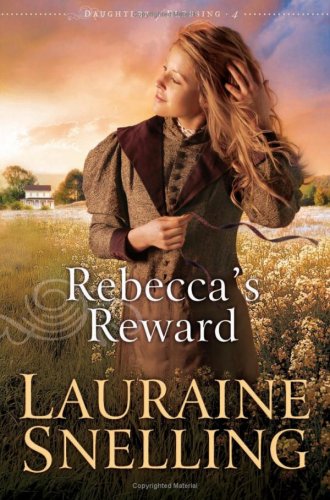
Rebecca's Reward by Lauraine Snelling


rating:*1/2
publisher: Bethany House


Rebecca's Reward by Lauraine Snelling is a light ( almost juvenile at times ) historical about a young woman who has experienced countless sorrows---through which she picks herself up never abandoning her dream of opening an ice cream shop in Bismarck.

I have not actively read Snelling since I was in high school and she has stayed in her niche ----women of nordic origin: pioneering, struggling, finding love and deepening faith.

Snelling would do well to abandon the choppy, distracting dialect which plagues so many Christian novelists. She more than introduces the origins of her characters and this weak link detracts from her dialogue....

That being said, Snelling does have a good handle on dialogue: considering she uses full pages of it at a time ( most prominently in a scene between Rebecca and her female friends.... the eponymous "Daughters of Blessing" ).


I also really liked Gerald: Rebecca's romantic lead in a relationship is at first shrouded in friendship while Rebecca learns to believe in its ability to foster sterner connection.


One thing that particularly irks me about Christian historicals is the propensity to add extraneous birth or death scenes.... Rebecca's Reward is not an exception: a scratchy, whirlwind delivery scene is scrunched in by p. 60. I am also not fond of italicized prayers provided over-zealously. This novel boasts a few too many.


This is not Snelling's best. She is a competent writer, she just never quite hit the mark here.