Showing posts with label jane austen. Show all posts

Wednesday, March 20, 2013

Danny/Darcy: the Austen archetype in the 21st Century


You love Mr. Darcy. You may not know you do; but you do. If you watch a romantic comedy or even buy into the long-building romance between two characters on your television screen, you are likely encountering facets of Darcy perhaps even without knowing.


The Darcy archetype has been alive and well and thriving for years. For centuries, to be exact and while many people know of Austen and her seminal work Pride and Prejudice many may not recognize that it has infiltrated so much of our popular culture.


A male friend asked me last year about Darcy and to give an example of a modern Mr. Darcy he might know about in modern culture. Off the top of my head I mentioned Nick Miller from New Girl. Not the best example, granted, but a surly, somewhat misunderstood and aloof character who harbours obvious chemistry and fondness for the heroine even though they meet at a cross-roads now and then. This dynamic has changed greatly in latter episodes; leading me to believe that their bond is one of repressed physical and sexual attraction and somewhat diminishes my initial comparison--but, there you are.

Lately, I have sought and found 21st Century Darcy elsewhere....
I am a huge fan of Mindy Kaling. She unabashedly champions the single every-woman, has a smart and sassy sense of humour, is sharp as a tack and speaks openly about her obsession with romantic comedies. Indeed, her creative brainchild The Mindy Project proudly flounces and brandishes so many lovely cliches of the rom-coms she loves. They are an unofficial guide for her as she navigates modern life and relationships. Unlike so many clumsy and stereotypical rom com heroes, Mindy is a genuine article, a bonafide smarty who has her professional life figured out (for the most part) as a talented OB/GYN; but who lacks the ability to separate romantic ideals from real life in her personal spheres.

Tell me that you don't relate to this, oh bookish, romantic, dreamy reader friend of mine.

Often, she cites how romantic comedies have provided life lessons she lives by---- or strives to live by. The line between fictional Mindy on screen and the Mindy we meet in her hilarious memoir is ironically as blurred as on-screen Mindy's disability to detract from the rom coms of her youth.


Mindy's favourite romantic comedy in the tv series is You've Got Mail --- an archetypal romantic comedy of letters and epistolary flair that, itself, is an homage to a play (Parfumerie), a musical (In the Good Ol' Summertime) and a Lubitsch piece The Shop Around the Corner). It is also a Pride and Prejudice re-telling before the far more obvious Bridget Jones' Diary. So blatant is the comparison, writer Nora Ephron has both of her characters reading and mentioning the piece unaware that their story greatly mirrors the triumphs and challenges of their literary counterparts Lizzie and Darcy.


In the New Yorker last year, Kaling wrote the following: " But what I’d really like to write is a romantic comedy. This is my favourite kind of movie. I feel almost embarrassed revealing this, because the genre has been so degraded in the past twenty years that saying you like romantic comedies is essentially an admission of mild stupidity. But that has not stopped me from enjoying them. 
I like watching people fall in love onscreen so much that I can suspend my disbelief in the contrived situations that occur only in the heightened world of romantic comedies."

She buys into the pretences, the contrived cliches, and she admits to loving them. In her series The Mindy Project which she developed, created and often scripts, she bombasts her audience with a parade of these lovely tropes and conventions. Never more obvious than in Mindy's on-screen Darcy-esque counterpart, Danny Castillano.


It is easy for people to misread any love/hate relationship as one reflecting the Lizzie and Darcy mould. Yes, theirs has its antagonistic moments; but the greater the depth of the building relationship the greater the intellect behind the creator and the creation. I argue that since Mindy Kaling has self-deprecatingly asserted her love for this archetype that she buys into it in the best, most grounded way possible. Danny is a modern-day Darcy.  One of the best examples, it turns out, to give a friend you're out for beers with who asks "What's a Darcy today? Who is a 21st Century Darcy?"  Hear me out: 
This will never happen again, I caution you, but I'd like to start with an unlikely source for further evidence. Read how Danny is described in The Mindy Project wiki (I can't believe I am sourcing a wiki): He has a very strong, intense personality capable of running over weaker, less assertive personalities; it is best tempered by someone who has an equally strong, assertive character. He is very vocal in his opinions (especially when it comes to  Mindy) and often comes across as a jerk. Despite this, he cares deeply for the people around him and is very loyal and dependable. His respect is hard-won, but once won, it is also hard to lose.

Correct me if I'm wrong; but the latter part of this contributor's perspective smacks of a chapter 11 conversation between Lizzie and Darcy in which the latter admits that his "good opinion once lost is lost forever." 

I may be pulling at strings; but I do think that there is propensity for modern writers to draw on literary predecessors from the well of perfect heroes. Pride and Prejudice is one of the original romantic comedies, not unlike Shakespeare's Much Ado About Nothing . Human nature doesn't change, at least in its core, over time and neither does love. Sure, it takes on different forms and freedoms and is not labelled as easily as it once was, but at its centre, the experience of two people meeting and the obstacles they overcome to be together are very much the same.

One of the reasons I am attracted to Danny as the modern-day Darcy archetype (Darchetype? tee hee) is that he really is good-hearted when it counts--- Not unlike Darcy is forced into action to reveal Wickham's wrong-doings and traipse through London trying to recover Lydia before she can make it to Gretna Green. He thinks Mindy is ridiculous (much as Darcy thinks Elizabeth's family is ridiculous); but respects her nonetheless.  He shows up at her Christmas party and acts as saviour when she learns that her current beau is a cheat and a liar and comforts her thereafter. More still, he takes the Christmas speech she has written in her bouncy, loquacious way and reads it himself: completely out of persona. He even brings a Gingerbread House (tell me you didn't just die. you did. you died. he brought a Gingerbread House)


When an old flame from camp shows up in New York on leave from the army, it is Danny who picks up the pieces when Mindy's almost-love must leave for duty. In his gruff, typical way, Danny cajoles Mindy; but stays with her nonetheless.  I couldn't help thinking in this moment of a helpless Darcy encountering Elizabeth who has just learned of Lydia's misfortune. He feels a tad awkward, more than a little helpless, but he stays.  Danny also stays, incidentally, with Mindy when she is in the midst of a crying jag when she breaks up with her boyfriend . He is awkward, yes,  but he is there. 

The qualities that make Darcy....well... Darcy are not the affable ones that we find in a Bingley (a modern counterpart to Bingley might be Jim from the Office, per se, a show that, coincidentally, Mindy Kaling wrote several episodes of); but in the deep-seeded gold and fibre that force him to act in moments of goodwill. Often surly, often misunderstood, he's not at his best with crowds or with people; but the right person and circumstance can draw him out. 

I'm not lining one against the other in comparative certainty, inasmuch as I am proudly adhering to a nod: a slight nod to source material.  Kaling buys into the tropes of romantic comedies and promenades them for the world to see.  In doing so, she essentially tips her cap at a master, at Austen, who created dishy, dark and swoon-worthy heroines, who are at their best when just a little out-of-reach.

The one comparative certainty I can state without hesitation is that in both cases the reader/viewer is more enticed when these two characters are in the room together, their chemistry so palpable you want to shake them and ask them to stay awake and pay attention.  Women revisit 6 hours of the BBC Pride and Prejudice for those lovely, listless, dreamful moments between Lizzie and Darcy: even from their misguided early start). In the same way, I come alive when Mindy and Danny are in the same scene; much like the way the volume on my television somehow gets louder during a commercial.  I am alive for them. I am rooting for them. I want my 21st Century smart and sassy Lizzie to get her surly, "handsome jerk" ( as Mindy  describes Danny) Darcy and I want them to live happily-ever-after ( but off-screen. After the end of the show. The build-up is so much more fun than the resolution ).


Side note: Not unsurprisingly, Chris Messina, the actor who plays our Danny/Darcy, has a few romantic comedies under his belt: two of them Ephron films ( he was a bookseller at Fox Books in You've Got Mail--- how perfect! and he was the modern love-interest in Julie and Julia. More recently, he starred opposite Jenna Fischer in The Giant Mechanical Man: a quirky film that I LOVED)


Tuesday, June 12, 2012

A Walk with Jane Austen: A Journey into Adventure, Love and Faith by Lori Smith


“It’s a difficult, romantic thing to be a dreamer” admits Lori Smith in one of many, many quotes I would love to appropriate and cross-stitch and frame and hang on my walls as the story of my life.

A Walk with Jane Austen: A journey into Adventure, Love andFaith should rightly be called the Difficult Musings of a Romantic Dreamer for the book is, at its core, Lori Smith’s relatable reflections as she stumbles through singlehood, depression and faith.

There are certain books that tug your heart strings and catch your throat and make you squeal aloud at every moment where you realize that the author has taken words and thoughts out of your mouth and heart and slapped them on a page. A Walk with Jane Austen is very much A Walk into Rachel’s Psyche.  It is Smith’s blatant and commendable honesty, her frustratingly poignant stream-of-consciousness and her willingness to spill her thoughts and pangs like a tipped-over inkpot that make this story the most poignant caption of a literary infused life I think I have ever read.


It speaks to those of us who love Austen, certainly, as Smith weaves her way through the English tapestry: beguiled at Bath, cloistered in an abbey, bewildered at Lyme as she traces through her beloved’s footsteps. Mostly, however, this book speaks to a specific type of Austenian: those of us romantic sorts who are blessed and cursed by a passionate devotion to Christianity in our single thirties.  Cursed, you ask? Yes. Smith realizes, as so many of us do, that the limited dating pool and strict moral requirements of what a Christian match should be can make the odds seemingly impossible.  Add to that a passion and heart for romance and a God-given desire to seek that which is beautiful, fantastical, witty and light and you are caught with Lori Smith in a modern web: where educated women feel at a loss--- so likely are they to cherish their post-feminist independence while guiltily admitting contradiction as they ache for an Austenian match. It’s a difficult, romantic thing to be a dreamer, yes; but to be cursed as a Christian with a romantic, dreamer’s mind? Even worse.  Like lapping water out of a sinking boat with a plastic pail.

Readers of this blog know that I was on work leave for 5 months recently with debilitating anxiety.  As someone who has struggled with a mental disorder her entire life ( one that was only recently given a name), I fell in love with Smith’s vulnerability as a depression sufferer plagued with a malady that is not christened until near the end of the novel.  Some might find the dark, smoky edges of this romantic Walk to be a tad over-bearing; but that is what makes it special.  Smith does not shy away from using her plight as a balm.  She admits to being smack in the middle of a life-long dream ( traipsing through Austen-land) while still admitting moments of defeat.  Just because you are chasing Darcy-coloured rainbows, doesn’t mean that the curses of real life will fail to set in.  To add to this, Smith writes eloquently about Christian lamentation: and a modern weakness inducting believers into a world of radiance and light while scorning natural human lamentation.  From the book of Job to her flitting, irreplaceable thoughts, Smith guides us through the happy and the sad: the rainbow-tinted and the melancholia.

 If you are a single Christian woman, this book will speak to you so strongly, you’ll look up and be surprised that a best friend is not spilling all deliciously confusing details across from you over a glass of wine.  Lori Smith GETS it: she gets that “…the other skill that single women possess is overanalyzing every conversation” and that “Of course, a single woman who wants to be married has, ironically, no sharper skill than that which rules out potential suitors before fully understanding their character.”   Smith provides a delightful paradox:  she re-imagines Austen’s tone and timbre while inserting the quite different dilemmas plaguing single Christian females.  Certainly we do not have the constrictions of sex nor of money or patriarchy in Austen’s society; but Smith works that we have the same obstacles, we crave the same matches, we trip over ourselves in the pursuit of love: bewildered, shamed, uninhibited.    To add to the perilous puzzle, Smith “gets” the evangelical cadences of an upbringing so familiar to all of us: “She didn’t have to deal with the evangelical culture I was raised in---“, she explains, “the one in which Christian things are separate from other normal (or as the church sometimes describes them “worldly” ) things.”

Further, she understands the scathing imp at the back of our minds which brings to forefront our questioning of our path.  For a contingent of women taught to pray for their future husbands and families in children’s church and through youth group to the same sect of women in their 30s, she understands that making sense of the nonsensical is part and parcel of the plight.   “He’ll be normal”, she hopes, “Someone I could actually introduce to my non-Christian friends without cringing.”  If you are in the datingsphere as a Christian single woman and you have not thought this; then you are either lying to yourself or are much more decent at heart than I am.   Smith is an automatic ally who understands how difficult it is to seek God’s path and timing when our impatient human nature forces us to explore the great world beyond: “Our conversations range from incisive devotional thoughts to solving poverty to the creepy, ogling married guys buying us drinks downtown.”  Like she says of Jane Austen, Smith is able to engage with the world around her. She fully epitomizes the contradictory nature of modern Single Christian females: those who are cursedly frustrated at God’s ridiculous timing while steering into moment of secularism in order to discover if there is light and love and passion available. Those who worry that one does not have the luxury of standards when there are so few male believers left to choose from (many marry young; there are twice as many single Christian males as females in North America).  She IS NORMAL.  Further, she muses, on the seeming unavailability and awkward friendship nature of connections with Christian men over a certain age: “It is a truth universally acknowledged among single Christian women that single Christian guys beyond a certain age are weird.”  Harsh, perhaps, and most likely not universal; but, again, she mirrors Austen-- bringing the peripheral subject of her thesis to forefront and honestly revealing a thought that actually got published in the Christian market (God bless you, WaterBrook).   “ I still want it so much”, she says of marriage as her 33 year old self traces Austenian heritage, “And if that sounds crazy to some, since I’m currently thirty-three and still very marryable, it may help to know the expectations in the conservative Christian world in which I was raised. Girls were supposed to grow up, go to college, and get married. “  To put that into further context and to heighten the stress and significance, I will echo that the first time I had the thought that I was abnormal for being single and pursuing an education and wanting a career was at 18.  There are zillions of readers who will not understand  the moments of vacuous inadequacy one feels as an aging single Christian woman; but they are there.  In a world where we are supposed to be supportive of differences, to seek God’s will and to find God outside of human expectations, to realize you are someone not quite like the rest of the flock is a constant sting. Moreover, to be an intelligent someone out of the flock who seemingly chose education and career outside of early marriage (I’m talking 18-25 here, the average Christian marrying age), further removes one from the idealized domestic sphere.  

Smith quotes writer Sue Monk Kidd’s talk about the defining choice every woman makes between love and independence.  Smith further investigates its ramifications and contextualizes it in the Christian sphere. But, as an independent woman on an independent excursion, she allows room for ruminations on love: realized and mentally constructed. There are a few major relationships in the book which make up the “love” component of the subtitle.  One being Jack: the odd, Christian friend-sorta-date who occupies Smith’s time at Oxford 
( and her thoughts long after), one being Smith’s reconciling her love for herself and God against moments of shadow and Smith’s love for Austen: what Austen stood for, what she wrote, how she was ahead of her time, how she provides a metric against which we should all attempt to live and love. She also speaks to the relationship she longs to have. A beautiful one with adored looks, not unlike the one Darcy gives to piano-playing Elizabeth during a scene in the 1995 BBC miniseries.


Smith, like me, believes herself to have been inherently compliant: to want to please her parents, her God, her church, the expectations told and untold and with this heavy weight she loses herself, if momentarily, and often just as reality comes  galloping back in, in the world of Jane Austen.  I realize that I spoke far more to the personal resonances of this book than to the Austen-centric mold of this Walk; but that is because that is not what hit be so hard about this reading experience.  I know a lot about Jane Austen and I have read dozens of books and studied thoroughly in University so, truth be told, I don’t need a literary travelogue
 ( though this one is so much appreciated); but I do need an author who understands me. I do need someone who is brave enough to spurt out on page what wrestles so acutely in my heart and mind but has rarely found a voice.  Smith, in the guise of a beautiful homage to a great female writer, speaks up for those who cannot speak for themselves and in this case, she speaks up for me and my ilk: we trusty, conflicted band of Christian single females intelligent and contradictory: wanting love and independence, sitting over coffee wondering why he said this or who he is or why we are attracted to guys outside of the fold and what it is to be equally or unequally yoked and why can’t EVERYONE BE MR.FRAKKIN’ DARCY --- she speaks for us.   And while she is speaking for us she takes us on a rollicking rural journey through the mind and thoughts and, yes, heart of the greatest female writer of all time.

Tuesday, May 22, 2012

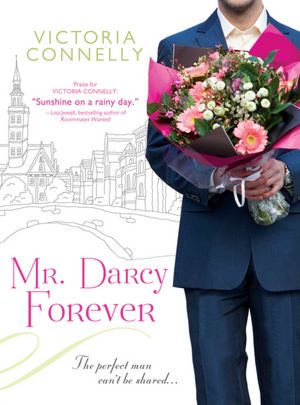
Author Interview: Victoria Connelly

I am so thrilled that Victoria Connelly, author of Mr. Darcy Forever took the time to answer a few questions for me :)


Rachel:

First off, this is a statement rather than a question; but I LOVE this quote: “Why is life a constant disappointment?”
“Because we read fiction.” Mia said

V.C.
- Glad you like it – it reflects how I feel sometimes!

 Rachel:
Q.)I was really impressed with the narrative structure of the novel and how it seamlessly transitioned between three years back and forth: what inspired this creative direction and how did it influence your writing process?

V.C.
- I think writers should always push themselves to try different things.  I’ve always wanted to write a dual narrative and this seemed like the book to try it with.  I knew that something had come between these two sisters and that they would meet in Bath at the Jane Austen festival and I wanted to ‘drip feed’ their back story using flashbacks.  I actually wrote it pretty much as it appears in the book and I found that the dual narrative really added pace to the story.  It was challenging but really enjoyable.

 Rachel:
Q.)Mia loves jogging and the fresh outdoors: Marianne Dashwood and Elizabeth Bennett also enjoyed exercise: do you think that this says something about their disregard of social precaution and a certain deviance to societal norms of their era?

V.C.
- I do.  These were women who knew what they liked and weren’t afraid to be themselves.  I really admire them for that.  They are strong and independent and didn’t have time for people who hid behind social conventions.

 Rachel:
Q.)There is obviously a plethora of Jane Austen references in the novel and throughout the Festival our heroines attend in Bath. Which is your personal favourite of Austen’s work?

V.C.
- It’s got to be Pride and Prejudice for its warmth, its wit and its love story.  Not only does it have the best hero and heroine ever but there’s a cast of fantastic ‘love to hate’ characters too.  Mr Collins and Lady Catherine have got to be two of literature’s greatest creations!

 Rachel:
Q.)This is the second Jane Austen novel I have read this year dealing with mental disorder and Austen (the first being Compulsively Mr. Darcy). Sarah, who suffers from OCD, becomes somewhat of an Elinor counterpart: do you think Elinor showed some of these tendencies in Sense and Sensibility  thus informing your decision?

V.C.
- I do.  Elinor Dashwood was very in control of herself, her family and her environment and I wouldn’t be a bit surprised if she was a list maker.  I kept wondering what a modern-day Elinor would be like and I thought she might well suffer from OCD.  I played around with the idea for a while and really thought it fitted her character.

 Rachel
Q.) Mia and Sarah and Shelley love watching Jane Austen adaptations. Which is your personal favourite?

V.C.
- I think it has to be the 1995 BBC adaptation of Pride and Prejudice because Colin Firth and Jennifer Ehle give such wonderful performances as Mr Darcy and Elizabeth and there are some magical moments like Mr Darcy watching Elizabeth when she is at the piano; the moment he helps her into the carriage and their hands touch; and Elizabeth’s mortification when she bumps into him at Pemberley when she thought he was away from home.

Rachel
Q.) Mia and Shelley both confess to liking the “bad boy” Willoughby despite the heartbreak he brings Marianne.  Why do you think women keep falling for these charming rascals…. Even in Jane Austen where gentlemanly conduct and honour reigns supreme?

V.C.
- I think women will always be drawn to the bad boy – it’s that element of danger that’s so attractive.  I also think that women believe that they’ll be the ones to tame them.

Rachel:
Q.)This is not your first Jane Austen-inspired tale and you are obviously very comfortable in jubilantly painting women and men inspired by Austen in the contemporary world. Is there another author you are equally as passionate about?

V.C. 
HE Bates is my favourite author of all time.  I adore The Darling Buds of May quintet and happily quote him in my everyday life.  He creates characters that are so real and his style of writing is warm and funny.  I’ve just named three hens after his characters: Mariette, Primrose and Florence!

You can find Mr. Darcy Forever and other Austen-esque yarns by Victoria Connelly on amazon
Visit Victoria Connelly on the web to read her blog and learn about her other novels 

My thanks to Sourcebooks for the review copy and to Victoria Connelly for stopping by the blog 

Sunday, February 05, 2012

Author Interview: Nina Benneton, "Compulsively Mr. Darcy"

Hello Readers!

I am so thrilled to have my first ever author interview here on this old blog. Nina Benneton, author of the fresh and sassy new take on the Pride and Prejudice story, Compulsively Mr. Darcy published by Sourcebooks. I don't want to give too much of the plot away here because I think it will be as a delightful surprise to you other P and P lovers as it was to me. Part of the delight was seeing how Nina Benneton took a tale as old as time and oft re-told in numerous settings, eras and cultures and made it wholly her own. I was so pleased that Nina took the time to speak to some of my thoughts on this exciting new addition to the genre. Scroll down to read some of Nina's insights into the writing process and why she was able to transplant our beloved characters into a completely new fictional sphere due to her passion for the source material and her penchant for fresh characterization!


Rachel:
There seems to be an enduring universal passion when it comes to revisiting the world of Pride and Prejudice in both Historical fiction and Contemporary re-tellings like yours. Why do you think this particular Austen novel is the most popular when it comes to re-imagination?

Nina Benneton:
Mr. Darcy and Elizabeth Bennet. Both are flawed yet relatable characters. Flawed because both have varying degrees of pride and prejudice in them. Relatable because these are the two flaws we like the least in ourselves, yet we know they're there inside us. If one considers Pride and Prejudice as simply a Literary novel, then the deep navel-contemplation by the characters about their flaws throughout the novel satisfies. If one considers this novel purely a Women's Fiction, then Elizabeth truly grew at the end to see how wrong she was to judge a bad man favorable by a pleasant countenance and gentleman-like manners, and a good man unfavorable because he appeared proud and haughty. If one considers it a Romance, what makes it so satisfying for a romance reader is how both hero and heroine overcame and grew through their pride and prejudice to a gratifying, believable happily ever after.

A writer in any one of these three genre examples (I'm certain others can come up with more genres) can undertake the re-telling in any way they wish because these character flaws are so great to tap into as seeds for character development.

In many ways, of all Jane Austen's novels, Persuasion comes closest to my definition as a romance. I feel Wentworth's letter to Anne was one of the most romantic thing that Jane Austen ever wrote. But Anne and Wentworth's flaws—whatever they are— are not as easily accessible or relatable to me as a writer. She's a bit of a saint, and his only fault is that his heart was still too-broken years later. (Even after more than a couple of decades of reading, that's still my shallow impression). Personally, I'd rather have Anne and Wentworth as neighbors and close friends than Darcy and Elizabeth, but I don't choose my friends for their flaws. On the other hand, as a writer, I choose my characters for their flaws.

So, to answer your question as to why Pride and Prejudice is the most popular when it comes to re-imagination, I believe it's because readers and writers relate very well to Elizabeth's and Darcy's flaws.

Rachel:
There are several ways to re-tell Darcy and Elizabeth's story and I have to admit, Compulsively Mr. Darcy was the most original I have read thus far ( and I have read many, fan that I am!) What led you to explore the characters in this particular way?

Nina Benneton:
Oooh. A fellow fanatic! How lovely.

'Most original'? Thank you.

I started with Darcy characterization. From my reading of many of these retellings, there's a consistent motif of our hero's characterization: that he is haughty, arrogant and prideful, and then he learns his lesson at strong Elizabeth's feet and becomes a better man. As a reader, I love this faithful and familiar theme of growth in a hero. Take the haughty and arrogant man down to his knees. Yeah! How satisfying.

As a writer, I needed more. I wasn't interested in traveling down that well-trodden path where other writers, writers with more skills than I, have beautifully and masterfully explored.

I asked 'why' was he like that? Why was he haughty, arrogant, prideful? I reread and reread Pride and Prejudice.

Darcy's a man who liked to be in control.Control of himself and of others. Hmm. So what? Nothing wrong with that. All romance heroes, the alpha kind, need to be in control.

My mind brainstormed. What if his control issue is really from a neurotic need to have it be so? A neurotic with obsessive-compulsive-disorder (OCD) who needs to have it be so. An OCD who needs it to be so because otherwise he'd feel unsafe? Yes!This was an original enough twist that I knew it would work to keep my interest as a writer.

Elizabeth's characterization was harder to tap into. She's usually depicted in re-tellings as a strong, take-no-prison heroine, and, again, as a reader, I love this portrayal.
I wanted something in this vein, yet with some original twist. I reread and reread Pride and Prejudice, and what stood out for me was her tendency to make snap judgment of people based on the exterior. She wasn't a shallow person, but she's so convinced she's right in her initial impression of people that it's a turning point for her to acknowledge she's not as insightful as she thinks she is.

Brainstorm time. What if my heroine Elizabeth's snap judgment comes from an inborn impulsivity? Since I knew I wanted her hometown to be Berkeley, California, I made her a liberal, Berkeley granola girl who simply wants to save the world—in that wonderful, audacious way that Berkeley-born-and-raised natives are reared to feel empowered to do.

Don Quixote is one of my favorite novels and a novel I reread often. I infused humor into Elizabeth by making her an impulsive, quixotic Berkeley native bent on saving the world. Like Don Quixote, she wants to charge at windmills. Perfect. It's this quixotic quality in her that cracks my hero Darcy's shell and effects a change in him.

Now, I have a unique pair that I could work with.

Rachel:
It is obvious that you are as passionate about Pride and Prejudice as the rest of us! What was your first experience with the novel and has it influenced your writing beyond Compulsively Mr. Darcy?

Nina Benneton:
My first experience with Pride and Prejudice was in school. As a fourteen-year-old girl, I was enthralled with how funny Mrs. Bennet was with her theatrics and how much she resembled many of the women in my family. I thought Elizabeth should have ended up with Wickham (aghast!) or Bingley, because Mr. Darcy was just too much work. Blech. Who'd want a boyfriend that complex. He didn't seem to be a bundle of joy to be mated with for life.
Maturity and wisdom came years later, after I've gone through a few Wickhams and Bingleys in my life and was bored. Simply bored. When I stumbled into some re-imaginings and re-tellings of Pride and Prejudice, I began to look at the novel differently. It became a romance for me.

My shallow impression of the novel as a young girl influences my writing now. I, like Elizabeth, learned that I'm not always as smart as I think I am. I'm often wrong about people. Yet, I love that. I love discovering different aspects, hidden depths, strange quirks in people whom I've stereotyped in a blink of an eye.

A reviewer recently wrote in her review blog that, on reading the description of Darcy as an OCD, she was leery of the affliction ruling him, and the story would not be romantic. She was happy she was wrong. He is a man with OCD, but he is not defined by it. I love that. I love to surprise readers. Give them something unexpected between the pages. From the word OCD—one might make a snap judgment that it would be a dark portrayal of a hero's neurosis, but it's not. It's a very human and tender and funny portrayal of a man who just happens to be afflicted with OCD.

People are so much more than their afflictions.

Rachel:
The Vietnamese setting of the novel ---and the well-researched action at the orphanage and the hospital, as well as the local flavour, is a spicy, sassy, exotic and throughly unique setting when held up against other Jane Austen "pastiches." What inspired you to set the novel here?

Nina Benneton:
The exotic setting came to me because I was reading some old tabloid issues where Brad and Angelina had just adopted a Vietnamese orphan. I had some familiarity with Vietnam and adoption, and it tickled my funny bone. I had very good idea how the locals would have reacted to Brad and Angelina —a la Mrs. Bennet upon hearing Netherfield being leased by Bingley. Da Nang, Vietnam as Hertfordshire. Perfect.

This setting was original enough to start the novel and to challenge me as a writer.
Yet, I didn't want it to be a travelogue story. I wanted the setting to be organic to the story line but not overtake it. What worked in my favor was it had been some years since I last visited Da Nang, so all that was left in my memory was an emotional geography of the place, but not the guidebook details. I actually had to hit travel books and read some descriptions for research, but quite honestly, I had a migraine headache almost the entire visit (Darcy suffers from migraines in the story) so the landscape, where things were located etc… were all a blur. My weakness is that I'm the kind of person who has to be alerted to the mountain range right in front of me, for I'm always too busy trying to listen to conversations around me. In the end, I focused more on the cultural aspects of the setting.

Though Compulsively Mr. Darcy isn't about cultural clash, you might say the inherent humor when cultures collide appeals to me as a writer. The second novel I wrote after this one was about an South Asian Indian grandmother and her struggle to accept her orphan granddaughter's love for a blue-eyed American cattle rancher and a recycling magnate (both untouchable jobs).

Rachel:
The initial misunderstanding between Elizabeth and Darcy strays far beyond the first impressions of behavior and attitude we find in the book. Can you speak to your decision to have Elizabeth perceive Darcy's relationship with Bingley as she does?

Nina Benneton:
An irreverent story needs to have a bit of a farce to it, I think, and thus the comic potential of such a misunderstanding appealed to me. Though, at first, I did hesitate to use this angle, for I was fearful of being perceived as unPC. But, you can't write 'honest and funny' if you're fearful.

Elizabeth is a Berkeley native. I spent years at Berkeley, and this is where my heart is, always. And because I love it, I want/need to make fun of its quirks. To a liberal Berkeley girl, it's just a normal thing for two guys to show up together and to immediately peg them as a gay couple.

Though I made fun of every one of my characters, main or secondary, I really didn't have an agenda to put forth. That would be authorial intrusion. I simply wanted to entertain my readers for a few hours of reading the book. Yet, I was sensitive to the fact that what's funny to me may not be perceived as such. I chose as my trusted readers people from a wide range of interests and philosophies and bent, especially those with different viewpoints than mine, to hold me accountable and check me if they feel I'd intruded myself into the story in some way.

Rachel:
Your Dr. Elizabeth Bennet is the prototype of a modern literary heroine: intellectual, independent and very much a career woman. How do you think the original Elizabeth Bennet set the stage for her fictional descendants?

Nina Benneton:
I think the original Elizabeth Bennet did what many of us might not do—turn down a proposal from a rich man and a life of ease, when, at that time, marrying well was the only viable option for a woman of her genteel means.
At fourteen, when I first read Pride and Prejudice, I was coming from a place in life where I was feeling acutely the lack of material comfort, and, honestly, I thought Elizabeth was a bit of a fool to turn down an estate full of servants. (Remember, I didn't think much of Mr. Darcy, then). Teenagers tend to be very materialistic, and I was no exception.

The deeper I research the mores of Regency time, the more I'm in awe of Jane Austen's Elizabeth Bennet. She refused his marriage proposal because she wanted to respect her partner, and vice versa. Denial on principal is something that we all think we would do, but we often very humanly fall short.

By that refusal of Darcy's first marriage proposal, she set the stage for heroines ever since. How heady is it to turn down a man with ten thousand pounds and Pemberley on principal?

Rachel:
In preparing to tell Elizabeth and Darcy's story in a modern context, did you refer to any other re-tellings of the book; or strictly to the source material?
Nina Benneton:
If I'd relied strictly on source material, I think I would not have been so bold in my attempt to write a modern myself. I'm not that talented or audacious.

I enjoyed Sara Angelini's The Trials of Honorable F. Darcy interpretation, and the fact that she didn't faithfully follow the original in the plot or minutia made me see it's possible.
When you write a modern retelling, it's very freeing in many ways because you have more leeway in character interpretations and plot. Two hundred years ought to have effected some changes. Darcy and Elizabeth and company should have evolved to fit their modern time, though still retain enough of the essentials of the originals to resonate with readers.
Yet, in many ways, it's very hard because you now do not have a rigid set of Regency rules and boundaries to keep you contained as a writer. You have to world-build and create a believable modern imitation, and that can be a daunting challenge.

Rachel:
Can we anticipate other revisions of Jane Austen stories penned by you in the future? What other book would you like to find a modern home for?

Nina Benneton:
I'm editing a Pride and Prejdudice Regency Romantic Suspense novel that I've completed six months ago. (Simply because I wanted to explore Regency boundaries and then break them.)

I'm letting rest a non-Jane Austen contemporary romantic comedy I've finished two months ago before I tackle revision in a couple of months.
I'm currently writing a time travel, haven't decided whether it would be a Jane Austen or not, since…ahem…I tend to tackle strange twists to characterizations and plots, and I may hit it too much out of the Jane Austen realm.

As to modern home for other Jane Austen books (this is from the top of my head!)

I'd love to tackle a modern Mansfield Park. Fanny as a foster child to the Bertram family. Think of the fun we could have with a modern Mrs. Norris and Dr. Grant. I love Jane Austen's secondary characters.
Northanger Abbey. Catherine Moreland as a girl from the project invited to an exclusive gated community called Northanger Abbey.
Emma as a stagemom-handler to a young actress Harriet Smith.


AUTHOR BIO: Nina Benneton was on her way to save the world and earn a Nobel Prize in something, anything, when her own Mr. Darcy and a bevy of beautiful children interrupted her plans. She woke up one day and saw she was too obsessive about alphabetizing her spices and searching for stray Barbie shoes. She turned to writing. Her debut novel, Compulsively Mr. Darcy, earned a Best Book review from Long and Short Review, 'Hands down…a must read for lovers and fans of classic romance.' Fresh Fiction Review called it a 'tenderly written novel.' Publishers Weekly wrote, 'Die-hard fans of everything Austen will enjoy this update of her classic tale.'

There are several ways to connect with Nina on the 'Net!

Find her on her website/blog
Find her on facebook
Find her on twitter


This Valentine's Day, why not treat yourself to the ULTIMATE romance?--grab a copy of Compulsively Mr. Darcy:

Goodreads
Barnes and Noble


I would like to thank Sourcebooks for the review copy and for the opportunity to interview this exciting author!

Sunday, September 11, 2011

Venetia by Georgette Heyer


Venetia is a lovely story and it just smacks of LM Montgomery.  So many times I think that Maud would’ve loved Heyer should she have lived to experience the author at the height of her Regency-writing powers.

The opening scene in Venetia is memorable to fans of romance: an ultimate “meet cute.” Venetia, having strayed from her languid, opulent property to search for berries at the deserted property adjacent (its owner known to spend little time at the estate) runs into a rakish rogue who, seeing her bonnet askew, her cheeks rosy, her figure a pinnacle health, plants his eager lips on her unexpected ones.

From this chance encounter springs one of the freshest connections of intellectual equals in all of historical fiction.  Jasper, Lord Damerel, has been thwarted in love and while maintains a large fortune, languishes his time beguiled by the “orgies” of the ton.  Enamoured by nothing and no one, his is a second-hand, vapid existence until the entrance of Venetia and her sickly, scholarly brother, Aubrey.

Venetia is sequestered in her family homestead having been given no introduction to society. At over five and twenty, she is very much a green girl: shelved in a rambling mansion, caring solely for her brother without the slightest prospects of travel, culture or true romance.  Two local men fight for her affections; but neither is up to her speed.  With great solitude, we learn, Venetia has garnered a great capacity for the written word.  Paired with her swift mind and biting tongue, Venetia is very much the thinking girl’s heroine.

Venetia is well-met with Jasper Damerel and beguiled by his worldly adventures.   A happenstance wherein her beloved brother his laid up at Damerel’s estate requires Venetia to often be by Damerel’s side. He is immediately smitten with her beauty, erudite nature and her rapid-like brain and to see true devotion and love blossom between two “kindred spirits”, best friends, is a mature and favourite type of romantic story.

Damerel’s past, however, and is now acute adoration of Venetia dictates that he spends hours worrying about how his reputation might sully hers.  Thus, Heyer winds us on a bramble and briar path of mis-encounters, family secrets and words unspoken. Readers, it is HEART BREAKING when Damerel sacrifices for Venetia’s best interest.  He cannot bear to live without her, he loves her to “the end of madness”; but he worships her so much he cannot bear to think that he would mar her reputation and her chance at a wonderfully wholesome future.

The repartee between Venetia and Jasper just heightens the reader’s pleasure in excavating a perfectly adult love affair. The end scene is TO DIE FOR and Jasper and Venetia’s final 
( expected ) declarations are some of the best Heyer ever wrote.

This is very Jane Austen with a dash of roguishness and a love so intense it recalls the preternatural cry across the moors when Rochester, in despair, hankers for Jane. If you have even the slightest romantic bone in your body and the slightest respect for a woman who certainly knew how to spin a Regency yarn then do yourself the pleasure of dipping into my favourite Heyer novel so far. There are some moments when I prefer Heyer to Jane Austen. Dictated by her time and sensibility, Austen’s romances could be rather reserved in exposition where as the gap of a century or so renders Heyer’s more modern infusion of romance into Regency fare is welcome, impassioned and sparkly.

Tuesday, August 16, 2011

Sourcebooks Blog Tour: Bath Tangle (and Happy Birthday to Georgette Heyer)


Georgette Heyer was designed for you if….


…it’s raining and you have the “mean reds”

…you want to steal into a land of gossamer and lace where men wear top hats and breeches

…you can taste the salt smell of the Bath waters while dreaming of a high tea at a nearby shop (perhaps stealing in for a dry spell after a stint in the rain)

…you miss the days when men were men and kissed ladies’ hands and knew the rigmarole of whist games and quadrilles

…you know the difference between a morning dress and a day dress

…you want to breakfast late and call the house staff by their surnames

…you think that “felicity” and “thither” really are the greatest words in the dictionary

…if, like me, you have read your Jane Austen canon to shreds since you began at the tender age of 14.


Georgette Heyer is pure, sparkly, cupcake-iced joy. Her heroines are winsome and beguiling, her heroes have just enough rogue to be tamed by the careful attention and craftily-won heart of a fair maiden. The “drawing room” manners and social graces of the “ton” whirl in a maze of winding, twining roads making the obstacles securing an inevitable happy ending worth the trip to the altar. Celebrating Georgette Heyer’s Birthday ( today) is a good excuse to spend the day perusing through Sourcebooks’ exceptional catalogue (they have done an incredible job at making her beloved titles easily accessible for the hungry masses)

Take Bath Tangle….


{italicized from the publisher}:


A Delightful Tangle of Affairs…The Earl of Spenborough had always been noted for his eccentricity. Leaving a widow younger than his own daughter Serena was one thing, but leaving his fortune to the trusteeship of the Marquis of Rotherham – the one man the same daughter had jilted – was quite another.When Serena and her lovely young stepmother Fanny decide to move to Bath, Serena makes an odd new friend and discovers an old love. Before long, they’re all entangled in a clutter of marriage and manners the likes of which even Regency Bath has rarely seen.


Serena is a lovely heroine: spirited and sly and smart and, like the best Heyer heroines, unwilling to be rescued by a dashing gent; rather willing to be accepting of his offer on her own terms and in her own way. A feisty red head with a temper to boot, she is near bested by a reduced family circumstance that throws her in the path of a suitor she jilted years before. Will he enjoy sweet revenge on her behalf …and to her utter ruin? Or does the spark of a first love still linger like an ember beneath flashes of anger, duels of wit and conversation that will keep readers giggling?


If you liked Persuasion, then Bath Tangle will delight you.


Heyer is indubitably the best Regency writer since Austen and in sea of Austen-inspired prequels, updates, sequels, epistolary fiction, diaries, graphic novels, parodies, pastiches and horror stories, she will rescue you. She is in a class of her own. What differentiates her from the usual Austenitis continually sweeping the publishing world and fulfilling our insatiable craving for more, is her verisimilitude, understanding of Regency culture, feels for dialogue and character and fresh plots and romances. She doesn’t hype on the laurels of Jane Austen; nor does she create new stories for characters already developed. Rather, she springboards from a popular motif and makes it her own. She is renowned as one of the most timeless Historical novelists of any age and you must, must read her. You must. It’s the law.


+To celebrate Georgette Heyer's birthday, make sure you visit Austenprose --where they are celebrating with a giveaway!


+Jane Austen's World featured a scintillating look at the Many Faces of Georgette Heyer


+Sourcebooks is celebrating Heyer's 109th by offering e-books at as little as 1.99. Honestly, they are so worth it. Buy all your Heyer here. Consider my two favourites, Venetia and Black Sheep alongside a purchase of Bath Tangle


My thanks to Sourcebooks for making her titles widely available and for sending me the copy of Bath Tangle to add to my happily growing Heyer collection.

Sunday, May 15, 2011

The Classics Circuit: Austen Vs. Dickens


I am defending Great Expectations on The Classics Circuit today! In the Austen Vs. Dickens Challenge

I have to tell you that these classics competitions are really tough for me. In some ways, it feels like picking a favourite friend… or favourite kind of ice cream.

Sure, sometimes I want peanut butter chocolate; other times I want cookies and cream--- both are equally worthy and wonderful.

I love me some Jane Austen---don’t get me wrong…. And I love me some all-of-Dickens: so much so that when people would ask me what my favourite Dickens’ novel was, for years, I couldn’t pinpoint. Sometimes it was Tale of Two Cities, often it was Our Mutual Friend, and Great Expectations always held a more-than-special place in my heart.

Forced to confront the fact that at some point I really should pick one, I decided to go with the one that reaches me on the deepest level. All have stories chock-full of brilliant characterization, sparkling sentimentality, wonderful wit and breathtaking materializations of London in all of its gritty glory--- all are like sinking into a favourite easy chair, re-visiting comforting friends, tea in hand.

But, Great Expectations brings to mind the most palpable of reading experiences. I feel greatly when I read Great Expectations, and I glean something different from between its pages upon every visit and am consistently fascinated by the style and the undercurrents of themes enforcing something more than Dickens’ pen-to-page brilliance.

At the forefront, Great Expectations is a relatively simple story. In fact, it is in this seeming simplicity that the reader is tricked into something more complex.

Philip “Pip” Pirrip stares at the headstones of his dead parents on the haunting marshes of the early 19th Century. (Yes, this is one of Dickens’ rare forays into historical fiction, as it is set years before its publication.) There, he is confronted by a veritable bogey-man: an escaped convict of the marshes who intimidates young Pip into near-jelly.

It is this fleeting instance that will shape Pip’s destiny.

Several of the tenets of Great Expectations are well-known to the greater populous: the unlucky-in-love Miss Havisham who wilts amidst the debris of her rotting, unforgotten jilt-at- the-altar; her ward, the icy Estella, well-raised in the art of scorning men and twisting them beneath her lily white finger, the kindly blacksmith Joe and his domineering wife, Mrs. Joe; the mysterious Magwitch; the troubling Mr. Jaggers and the extremely likeable Herbert Pocket.

Daring escapes, plot twists and family mysteries are uncovered at the backdrop of this keen bildungsroman. At the crux, Pip learns the downfalls of wealth and greed and awakens to the realization that with his great expectations a great price is exacted.

It is a bubbling and readable book and certainly one of Dickens’ shortest and most accessible. I think some of its resonance ( as one of the most beloved and adapted works of literature ) is its study in disillusionment and grace. Pip falls deeply into a trap of believing that which will make him whole is largely outside of himself and his meager upbringings. This is a commonality of the ages: a young man bred with good morals ( at least from the salt-of-the-earth blacksmith Joe) is tantalized by the prospect of something greater and holds no qualms at shirking his past, viewing his hometown as wreckage and turning into a veritable snob. What is heartbreaking is how those true to Pip are reluctant to dismiss him (even though, believe me, he can be, at times, the most absolute wretch).

It is these scenes: these confrontations between the now-gentlemanly (at least in form, if not in deed) Pip and the life he left behind as emblemized by Joe ,that wrench my heart.

This is a novel I grew up with and a novel that inspired me to face ugly truths about all of humanity and, on a searing micro level, about myself. We all fall into Pip’s trap when something shiny is dangled affront us; we would all rather believe that our benefactor will lead us to our heart’s desire, not regale us with a past twisted into treachery and mire. We all want to believe we were born for something more, greater than our circumstance, deserving of everything the wealthiest people have attained.

With that stirring of pride and that callous and complacent turning of our disdainful heads comes a stark and powerful realization: that humanity at its pulse is frail, that society ---gilded and obtuse--- exists to spin us into a web of our undoing…. That the greatest force in our life is redemptive love---acts of limitless grace---binding us back to a place where we belong. Where people love unconditionally. Where the mistakes made in youth are wiped clean of a slate by the gnarled hands of honest work and the belief in Love, God’s Will and Redemption.

Tuesday, May 03, 2011

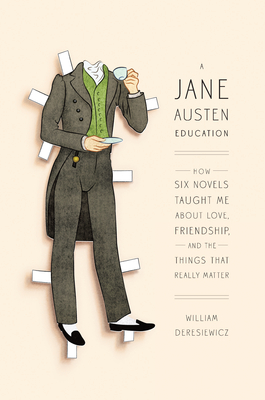
TLC BLOG TOUR: A Jane Austen Education by William Deresiewicz


A Jane Austen Education is one of the most delightful books I have read this year and an essential compendium to any extensive Jane Austen Collection of works and criticism ( such as my own). It extolls all of the virtues of Jane Austen in a way we don’t often view them: as tantamount to the greatest life lessons. Walking us through Jane Austen’s six novels in a literary memoir, noted critic and renowned professor William Deresiewicz breathes fresh life into an author whose works I have read to shreds.

Reading Jane Austen for the first time ( as a bitter modernist with a penchant for coffee and sunglasses, apathy and modernism),Deresiewicz mocked the mundane world of Emma: the seeming non-happenstances that threaded through a novel with no overtly bold statements, no visceral truths at forefront, no gripping plot. But, then the book changed, it ( like the best books of literature we peel back like a leaf) become all-to-clear for our author and informed his life and formative academic years in a way that not only propelled him to sink into Austen’s entire canon; but shifted his world view.

His relationships, his view of love, the way he treated people and the lens through which he viewed literature was reformed and hi-jacked by a growing fascination with Austen: who said the extraordinary and catapulted universal truths into the wide sphere of her readership with the ordinary.

From his crush on Elizabeth Bennett to his learning to love in the same way Catherine Morland learned to love a hyacinth at the urging of Miss Tilney, a Jane Austen Education is an ABSOLUTE MUST for those who love her novels.

You will want to think back on your first reading experience, you will identify with the author’s feelings on one portion of the novel while rally against views on another and you will be forced to contemplate how Jane Austen has subverted herself into your psyche, whether or not you knew she was doing so.

Austen’s place in the cultural consciousness as well as her lasting place in media is another thread of the book.

Favourite moments include:

Deresiewicz referring to the New York Dating Scene as “an endless maze of stupid conversations”

His run-down of the films good and bad

The fact that he tries to gloriously extricate every splendid moment of the novel without spoiling the plot for new readers

His unabashed crush on Elizabeth Bennet and his willingness to defend her from any criticism: warranted or unwarranted

His treatise on novels as “practice life” and his exposition on the life of a reader whose novel reading informs make-up: morally, ethically, in love, reason and decision

His absolute joy in the Ang Lee adaptation of Sense and Sensibility: casting light on a dark plot

Most importantly, his recognition that the power of the best literary novels is one that takes residence in your brain and being and changes your life.


View the guest blog by William Deresiewicz at The Huffington Post

Visit the TLC tour

Tuesday, December 28, 2010

Head in the Clouds by Karen Witemeyer


This is how ridiculous I am: I purchased this because I liked the shoes the girl was wearing in the cover photo.

Well... that and I had heard good things about Karen Witemeyer as an up-and-coming historical novelist.

I have yet to read her first novel, A Tailor-Made Bride; but I am going to assume it is as pleasant as Head in the Clouds, which I easily finished in one sitting.

Adelaide Proctor is desperate to find a romance and subsequent family of her own. She spends her days literally with her head in the clouds, day-dreaming of the heroes in the stories she reads by the Bronte sisters and Jane Austen. When a knight-in-shining-armor turns out to be a rake in disguise, Adelaide throws caution to the wind and applies for a job as a governess to new rancher ( and British ex-pat) Gideon Westcott and his mute daughter.

Back story reveals that in true Valjean-Fantine tradition, Gideon is not Isabella's biological father; rather a stranger who promised to take her into his care upon the untimely death of her mother. Adelaide begins to fall madly for both of them and a happy ending can only be secured when dangers from Isabella's past and a hovering uncle bent on securing his niece's massive fortune is halted.


The story is very formulaic and will be very comfortable for those who enjoy this genre. There aren't any real surprises and it follows in the tradition of the Bethany House Historical Romance line. That aspect of the book, I found, to be a little too safe for me. I would love if Witemeyer had shaken and spiced the genre a bit; but I realize that my viewpoint and marketable interest are two very different things. Thus, for an offering in this often-frustrating genre, I found it to be above-average in execution and style.

I enjoyed the constant references into the actual literary world of Jane Eyre and the comparison of Jane's plight to Adelaide's own.

Readers who hanker after a great Romantic hero will be smitten with Gideon. Not only does he have dimples and a roguish sense of humour, Witemeyer does well to make him equal-parts rugged sheep herder and classic British gentleman. By day, he wears work clothes and rustles in the field; brandishing a gun at times, riding a horse and basically appealing to a girl who loves a cowboy. By night, the golden cufflinks are polished, the manners tamed and a starched white handkerchief dabs at his masculine jawline. Gideon's concern for his ward, Isabella, is a charming addition to the romantic plot between he and his governess.


The governess-master plot has seen a real renaissance in recent Christian Historicals and Witemeyer does well in a genre already well-established with a topic that, unfortunately, is becoming a bit too familiar and bordering on the verge of cliche.


I look forward to checking out more of her writing in the future.


Readers of Deeanne Gist and Cathy Mary Hake will feel right at home!

Wednesday, December 15, 2010

Georgette Heyer: April Lady


Like A Civil Contract, April Lady revolves around a marriage of convenience. But, while the hero and heroine of A Civil Contract resolve to live in a mutual admiration and respect, the already married hero and heroine of our tale are madly in love with each other.

Viscount Giles Cardross has been in love with Nell ( his now wife) since he first set eyes on her. Made to think that it was a marriage of convenience by her mother, Nell is coached to hide her overflowing affection for her husband lest he find her too clingy.

Somewhat contented to be the tropy-wife, all the while assured that her beloved Giles may, at one point, turn to other female companionship, Nell spends her days with Giles’ half-sister Letty, buys extravagant dresses, rides a marvelous carriage ‘round the fashionable park and wiles her nights away at the most extravagant events of the season.


Giles loves Nell; Nell loves Giles, half-sister Letty loves the poor army- secretary, Jeremy Allandale and Jeremy Allandale loves Letty.

The entire plot is a mixed array of crossed paths, misunderstandings and love very passionate and squelched unknown.

Like the adorable Kitten in Friday’s Child, Nell’s modest circumstances in her youth have made her a poor fit for the excessive ton. Indeed, she is more often than not in scrapes involving over-expenditures she is sure will awake her husband’s wrath.

Desperate to conceal her folly and deeply ashamed at her innocence, Nell and Giles spend most of the book completely unaware of the other’s feelings.

The forbidden, cross-class romance of Letty and Jeremy Allandale complements the frustrating maze of Nell and Giles’ hidden emotions.


You know when you open a Georgette Heyer novel that you can bask in the certainty that all will end well. It’s like a Jane Austen novel, in that respect, it is a guaranteed certainty that all will tie with a neat little bow. But, like the most delicious romances, it is the topsy-turvey paths and cross-purposes leading you to the ultimate gold-at-the-end-of-the-rainbow that propel you onward.

April Lady is chock-full of frustrating “But you love Rhett, not Ashley!” moments and exceptional snapshots of the glorious ton at the height of its gilded Regency brilliance.

Another fabulous read from Georgette Heyer.

Wednesday, October 14, 2009

Jess and Rachel Talk Books: the Classics Edition


Hey kids, hello from BLUSTERY windy and rainy St. John's Newfoundland where I am at a conference for work and surrounded by dozens of delicious books.

I also found a fantastic used bookstore here: complete with a Michael Crummey display. Yes, Newfoundland is proud of Mr. Crummey, as well they should be.


note ( on a very superficial level which rescinds any dwindling respectability I might have had): I think Michael Crummey is Canada's cutest author. The end.


Remember when Jess and I talked Horatio Lyle and how much fun that was?

Well everyone's favourite Coloradonian ( is that even a word) and yours truly are going to talk CLASSICS! Look for me in italics and Jess in bold ( for she is boldly beautiful )....


Jess, what is your favourite “Classic” book? ( from any era, just one widely-regarded as “classic”)

I’m going to give you two. I’m a cheater like that.

As a kid, one of my favorite books was Matilda by Roald Dahl. I can’t even begin to tell you how many times I read that book. It’s been a while since I re-visited it, but I look forward to my chance to sit down with it again someday soon and experience the magic and delight.

Okay, I’m going to cheat even more and give you three, because I also read The Island of the Blue Dolphins by Scott O’Dell about 8 billion times as a girl. What I loved about both of these books was the strong, smart girl protagonists who have to take care of themselves – and do. Matilda is smarter than pretty much everyone everywhere, and manages to defeat the evil adults so that she can live with her beloved teacher, Miss Honey. Also, she’s telekinetic. Which is just awesome. Karana lives on the island all by herself for years, finding food, hiding from hunters. Her story is sad and lonely, but she finds peace and contentment in her life, and isn’t so much rescued as much as she chooses to leave.

I now feel the overwhelming need to re-read both of these.

My “grown-up” favorite classic novel is Rebecca by Daphne du Maurier. I read this for the first time in high school, and it’s the book that truly sparked my love for literature. Because if Rebecca was this awesome, how good must most of the other previously-considered-boring classic novels be? Rebecca is a gothic mystery that’s as close as one can come to a ghost story without actually having any ghosts. The narrator never tells us her first name, and no one ever uses it. She is simply Mrs. de Winter, living always in shadow of the previous Mrs. de Winter, the beautiful, beloved Rebecca. Rebecca haunts the narrator, making her miserable, as she knows she can never measure up. But then she starts to discover the truth about Rebecca, and with it, the truth about herself. It’s creepy and atmospheric, and it’s been far too long since I read it. October’s a good month for gothic, isn’t it?


Like you, I love “autumny” books which make me think of sitting in my cozy living room in orillia, staring out at the street: the tarmac all slick and sparkly under the streetlamps from a chilled fall rain, the leaves rustling and everything shadows. I LOVE THE FALL.

It’s funny that your connection with Rebecca prompted you to seek further classics because that is the story I associate with Les Miserables: the book that propelled my love of literature. I threw down my copy of whatever generic Fear Street book I was reading deciding that I already knew how it was going to end, asked my dad to take me to our Coles store and picked up Les Miserables. I was 13. I loved it! Every moment. It’s a gargantuan book but it is made up of so many different infinitesimal worlds. You can almost go through and just pick a strand of story: a sort of choose-your-own-adventure.


(Brief interruption: Fear Street books! Ha! I think I read three of those and then gave up. Ah, memories. Also, I have never read Les Miserables because I am the saddest excuse for an English major there is.)

I cannot say I ever enjoyed Roald Dahl because I found him rather creepy and depressing. I read Island of the Blue Dolphins, though, and I concur: it has strong female protagonists. And, when you think about the state of YA and teen fiction published ‘round O’Dell’s time and the limitations of genre, it is rather remarkable that that book was so daring and unique. There is far more published now for the demographic and I hope that classics like that don’t get squandered by PARANORMAL URBAN FANTASY!

I love Rebecca. I think it has one of the most haunting opening lines I have ever heard. I also really liked the Hitchcock film. Rebecca is so much more than your typical gothic romance. It really speaks to a woman usurped by her husband’s status, who is nothing more than wife, who is victim to narrate a story that is another woman’s and not quite her own. Mrs. DeWinter. The females prey to Max’s charm subsequently are reduced to no more than a name stemming from his identity.

This is why you’re the one with the book blog. You talk about this things so much more eloquently than I. I’m just sitting over here shouting, “Yes! YES!” to everything you’ve said.

That is a very haunting book. Makes me think of Jane Eyre.

Funny, your classic books are 20th Century: two YA books and a mid-20th Century classic whereas mine are Victorian. Because, my developing mind was circumferenced by the 19th Century: there were no classics before or after, or so thought my 15 year old brain. So, classics included Les Miserables, Great Expectations and Villette by Charlotte Bronte. As well as the Sherlock Holmes books. From there, of course, I expanded, starting with the A’s ( for Austen, notably) and moving forward.

Thoroughly Modern Millie. That’s me.

What classic do you loathe?

Wuthering Heights! Urg. I do not understand how Heathcliff and Cathy have become these great romantic characters. They’re awful. I hated them.

Robinson Crusoe and The Last of the Mohicans were both torturously dull. Never again will I read Daniel Defoe or James Fenimore Cooper. Though, I will read Mark Twain making fun of James Fenimore Cooper anytime.