Thursday, March 08, 2012

Happy International Women's Day

Happy International Women's Day ---to celebrate, I thought I would feature a woman who inspires me daily: my sister Leah.

Leah making some new friends
Leah is a professor at Tyndale University with a phd in Global Governance. She has dedicated much of her adult life to campaigning for education as a universal right.  She is so well-beloved in Africa, a continent she has traversed across doing research, working for CIDA and infiltrating with her passion for its culture and people, she has been affectionately known as Mama Africa.  Leah speaks Swahili and makes friends everywhere---with everyone. I have never met anyone with such a genuine love and zest for humanitarianism than Leah. She evokes Gandhi's immortal statement that we must be the change we wish to see in the world.

Recently, Leah was in Senegal under a taut political climate and there she was able to meet and befriend a Sengalese boy. She articulately recounted this experience.  Why Leah's experiences always stand out is that she goes expecting to be changed and allows it to happen. She does not approach a culture believing that she will be the change or inference it needs; rather, she becomes a vessel ready to be filled by the experience. If you go somewhere expecting to leave and indelible print, the result can be forced and can contradict the purest forms of  International Relationships in a developing world. If instead, you approach the situation as a blank, open page hoping to be intercepted by life-altering moments, then both parties will be positively effected by the ramification.

AMADOU  printed with permission by Leah McMillan
Yesterday I met Morninga on the street - a Senegalese man about my age who makes a living selling paintings, wood carvings, and various other artifacts.  His shop is directly across from the guesthouse where I'm staying, meaning that I was able to hang out in his shop for quite a while last night knowing that I could simply run back to my room when manifestations broke out (yes, it's more 'when' rather than 'if' right now).


Yes, he wants a white wife, but beyond that little barrier to our friendship, I really learned a lot from our chat.
Like all Senegalese at the moment, his shop was tuned into the radio.  It was blasting in Wolof (interspersed with the soundtrack from Chariots of Fire - no joke!) and he was able to translate for me the current tensions in the country.

In Senegalese culture, if you're talking with someone or a group of people for a while, you must take 'taya', small little cups of traditional tea.  So, as we were chatting away, his brother, about 12 years of age, came into the shop and offered me and Morninga the taya.  His brother, Amadou, only speaks Wolof, but I was able to say the few small words I now know.
He laughed at my butchering of his language, we became friends, and he left Morninga and I to continue our chatting.

This morning, Amadou was on the street and again I chatted with him - small greetings ('salaams') to start the day.

About an hour and a half ago, I was coming home when I ran into Morninga and Amadou again.  I entered Morninga's shop and again we began to chat, as I learned more about the political tensions in the country.
So, again, Amadou left and came back with the taya.

As I was getting ready to leave, Amadou began to say something to his brother in Wolof.  Morninga immediately began taking a painting off display and rolling it.  "Amadou wants to give this to you as a gift."
I quickly replied, " No, no, it's too much."  This painting was a fairly large size and could honestly get him quite a profit, especially living across from a guesthouse with so many tourists.

Morninga quickly interjected that this was a very special moment because it was the first painting Amadou had ever made.

In Senegalese culture it is rude to refuse a gift, but I felt very embarrassed, so I inquired further.
Why was he giving me such an honour with this special gift?!

Amadou, through Morninga's translation, began to explain that normally tourists simply walk by without greeting or stopping.  Amadou liked that I was kind to him, that I took time for the taya, and that I remembered him even the next day in the morning.  He saw me on the street playing soccer with other kids and talking to everyone and he could tell I had a kind heart that didn't care about the difference between black and white people.  I was so kind he wanted to do something special for me.  All this out of the mouth of a 12 year-old! 

Obviously I began to tear in the shop.
Then Amadou, a Muslim boy who has never in his life touched a woman outside his immediate family gave me another special honour - I got a hug :)  It was a VERY awkward hug...but a hug nonetheless.
I told Amadou that I will hang his painting in a special place in my home so I remember to pray for him everyday.

I'm not writing this story to brag about myself.  There are so many times when I rush through life too quickly, when I don't take time to greet people, to smile, to really get to know every person I meet.
But I do write this story to share with you about a little boy named Amadou.
A little boy who was wearing the same ratty t-shirt (labelled 'Burberry') two days in a row.  A little boy who probably owns nothing else to wear.

A little boy who found it in his heart to give me one of his most precious possessions - the very first painting he ever made.
Coming from an artisan family, this is probably his life's profession, especially given that he speaks only Wolof and no French (an indication that he doesn't go to school).  And I have the privilege of hanging his first painting in my home.

And you know what he wanted in return?  Nothing.  Absolutely nothing.
He didn't ask for money.  He didn't as for "un petit cadeau".  He didn't ask for a visa.  He didn't even ask for me to marry his brother.

I dropped down on this country for merely a week, taking away so much, and giving back so little.
If you read the media out of Senegal right now, you'd think that this was a chaotic country, with thousands of angry, conflict-causing, rioters.  Boistrous.  Hateful.  Violent.

But in the short time I've been here, the Senegal I know is the one displayed by Amadou.  Caring.  Generous.  Thoughtful.
As I hear of teargas and grenades, as I hold onto the backseat while my car departs from the burning wreckage of protester barricades, as I run from stones thrown by protesters...

As the media makes sure that all of the above is the only story out of Africa...

I clutch my painting, I tear over dinner, and I remember...
Africa is not just politics, war, famine or hardship.
Africa, in its purest form, at its very heart, is Amadou.

Wednesday, March 07, 2012

A Menu for Romance and A Case for Love by Kaye Dacus


TWO ! TWO BOOK REVIEWS FOR THE PRICE OF ONE!

So, I think you all remember I bought a 3-1 Brides of Bonneterre set at a Christian bookstore about a month ago and I read Stand-in Groom right away.

Well, I just finished Menu for Romance and A Case for Love: featuring friends and family to the Guidry family: a prominent aspect of the mythical town of Bonneterre, Louisiana. Indeed, Bonneterre becomes a character of its own: a Cajun-laced spicy sphere of historic buildings, Southern charm, delectable dishes, sticky heat, sprawling plantations and a plentitude of events and weddings to be planned, by Anne Laurence nee Hawthorne (of Stand-in Groom) and Meredith Guidry and Major O’Hara, planner and chef alike.

I really enjoyed spending time in the world of these characters. The plots of each novel in the trilogy were easily usurped by the friendly nature of the characters. At more than one point in each tale, I was surprised not to look up and find myself sitting across from one of them over a glass of sweet tea.

 A Menu for Romance softly etches the slow-blooming love story between Chef Major O’Hara and event planner Meredith Guidry. Unbeknownst to both of them, they have each harboured a mutual flame for 8 years; however Major’s complicated family life and Meredith’s certainty that Major is attracted to the beautiful news reporter, Alaine Delacroix, keep their paths from crossing until much, much later in the story.  Like all good romances, you know before the characters do what will bring their eventual happiness and you wait, on baited hook, for them to catch up. Elements I appreciated about this story include the amount of knowledge Dacus displays about culinary arts and cooking shows.  I found all of these scenes in Major’s world to be authentic. Further, Major’s mother suffers from Schizophrenia and the compassionate scenes involving her care at a supervised facility, Major’s terms with his mother and their mutual love of John Wayne movies was a treat to read.

A Case for Love finds beautiful Alaine Delacroix at odds with charming lawyer Forbes Guidry when she understands that the Guidry enterprise might be over-taking her family business, she tries desperately to quell her developing interest in the charming lawyer in order to secure her family business and name. Several misguided turns, misunderstandings and a few ballroom dancing lessons help pave the way to eventual happiness. The strongest element of this novel is the characterization of Forbes. I must confess when I first “met” him in Stand-in Groom, he rubbed me the wrong way. I think this was intentional on Dacus’ part and she carefully fleshed him out into a fully-realized sympathetic character in the third novel. While he didn’t capture my heart to the extent Major O’Hara and George Laurence did (perhaps, like his romantic counterpart Alaine, because they both seem to physically represent the “traditional” movie-star couple), I did enjoy reading his ups and downs in the dating world. In fact, the dating world is explored more closely here than in the previous two novels due to one of Forbes’ successful enterprises: an online dating site called Let’s Do Coffee.

I really enjoyed the ballroom dancing sequences and the careful way Dacus coupled dance skills with the talkative and sometimes clashing relationship of Forbes and Alaine.

I am now working through the last two novels in the Ransomeseries: so Dacus will pop up on this blog again soon!

Happy reading all!

Saturday, March 03, 2012

The Merchant's Daughter by Melanie Dickerson

Over a year ago, I was thrilled to read and review The Healer's Apprentice by what I found to be an essential voice for the Christian teen market. I will be the first to say that the Christian market is decidedly lacking in strong fiction for teenagers; but Dickerson is changing that and she is a welcome voice. Like The Healer's Apprentice and its soft re-telling of the Sleeping Beauty tale, The Merchant's Daughter re-positions the Beauty and the Beast story in feudal England. The titular merchant's daughter, Annabel, becomes conscripted servant to Lord Ranulf le Wyse,  a harsh, enigmatic master to whom she is indentured to serve to pay a family debt. 


Ranulf le Wyse is a very Byronic figure who immediately put me in mind of Edward Rochester.  Due to an accident years earlier, his hand is disfigured, his face blighted with a scar and his blinded eye hidden behind a patch. Ranulf is the beast figure in the story: a worthy and brash counterpart to the beautifully-spirited Annabel.


This is a delicious love story; but not only because it believably metes out the growing attraction between the lord of the manor and his fair servant. Dickerson does well at infusing the novel with the Christianity which would have been prevalent to residents of this era and sphere. For example, the Holy Writ is available only through the Latin Vulgate. The denomination is completely Catholic and women are scorned for reading: especiall scripture. Annabel, having been once a wealthy merchant's daughter speaks and reads numerous languages and, as part of her servitude to Lord le Wyse, reads daily to him from his own treasured copy of the Bible. 

Often characterized in several of the re-tellings of this tale, is the role of an enchantress or seductress who serves at the initial fall of the Beast figure. Here, we learn that Ranulf is a widower once seduced by the beauty of one who did not love him; rather his station and monetary value.  To further emphasize the temptress motif, Dickerson does well at reminding the reader of the garish view of women during these primitive times.  Women, as preached by the priest at the pulpit, were seen to be the fall of man, seen to be deceptive forces, even more so if blessed with the beauty of one such as Annabel. Ranulf muses: "Beautiful women weren't to be trusted or allowed into a man's heart when that man was less than perfect. He'd learned that lesson well." At one point the priest explains how dangerous reading is to a woman: "I am not sure your motives are pure. A woman reading the Word of God? Are you able to interpret the Scriptures? You aren't even dedicated to God. Never said your vows. Nay. You are to rely upon your priest to give you the interpretation  of God's Word. I will tell you what you need to know."  As you can see, Annabel is victim of a patriarchal word where men were not only to be the studious conveyers of the scripture, they were in charge of interpreting it for women and the common public.  This is years before Luther and years before the veil was torn to allow for a public personification of the Holy Word. Annabel's desire to draw closer to the faith that has been represented to her in her minimal encounters with the Bible is often thwarted by the separation marring her to her position and her sex. 

Indeed, the greatest beauty found in the story is the pure-hearted nature of Annabel and it is this, rather than the physical grace of her movement and countenance that ultimately wins the hand of the Lord. Their relationship becomes further secured when they share the Holy Word together: Annabel thirsty to learn more about Christ in writing (so much so that she considers entering a nunnery just to be near it).

The research in this writing is wonderful and you really do feel like you peel back centuries to step into Annabel and Lord Le Wyse's time. I also found the descriptive writing and imagery to be a beautifully-woven tapestry; an apt canvas for Dickerson's renewal of a fairy tale.... like this sentence: "...she once again caught sight of the sky, which had bruised blue and purple with clouds and threatened rain"  or "...his shoulders swayed, like a hewn tree just before it collapses."

The faith in this book is well met with the time period, as mentioned. But, is rather inspiring as well. "How wonderful to know that Jesus didn't condemn women like the priest did. Even with a sinful woman, He didn't rant about how evil she was."  Nearing the end of the novel, Ranulf and Annabel discuss my favourite portion of the Bible, found in Romans 8:1 and the the theme of condemnation and Christ's atoning grace intercepts again.

For those who are familiar with the Disneyfied portrayal of the story: there is a rose, there is the sacrifice of Ranulf to put his love for Annabel before his own desire to keep her.... it goes on and on in a colourful carousel and the pages will rapidly slip between your fingers.

I found this to be even stronger than The Healer's Apprentice and I cannot WAIT until Dickerson's next tale.

Go read her blog
Buy the book

ORILLIAN books in the NEWS

While I have lived in Toronto for over a decade,  my hometown is Orillia, ON. where my parents still live.


Excitingly, a young up-and-coming author with Harper Collins Canada is also from Orillia.  I remember meeting Matt in passing and I wish him all of the greatest success on his new book.

I plan to read The Carpenter when my review schedule dies down a little bit and will let you all know if, indeed, it elicits the comparison to Mystic River, so boasted by the enthusiastic editor.

GO ORILLIA!  ...and fiction that shows apt shadier sides of Leacock's Sunshine City.

Read about The Carpenter in The National Post
Purchase on Amazon
Take a closer look at the Harper Collins Canada page

Wednesday, February 29, 2012

In which....well.... just 'White Collar', y'know?

oh NEAL! oh PETER!
Dear World,

Sometimes I spend my off-time reading clever books and watching clever films and filling my brain with all sorts of deep goodies which I then impart on you, fair public....

Other times, I just watch a heck of a lot of White Collar because USA Network has the best American television there is .... most of it doesn't air in my country; but, we do what we can (and purchase a lot of dvds)

So, season three came to an end and, as per their usual DELIGHTFULLY AWESOME CLIFFHANGER season finales, I was left going....asdjfkla;d fjkald jakl;dj kl;a jdskfl; jaklsd; jfl;ajdsk fajsdklf jaskdl; jkasd jifaioe ui ahui gfiuasd!!!!!!! ( or something like that.... with more question marks)

that's right. smooch it up. i love BOTH OF YOU!

Tuesday, February 28, 2012

The Swiss Courier and Chasing Mona Lisa by Tricia Goyer and Mike Yorkey

TWO! TWO book reviews for the price of one!


When I received Chasing Mona Lisa from Graf Martin Communications (on behalf of Revell), I was inspired to immediately purchase its predecessor The Swiss Courier by the same authors, Tricia Goyer and Mike Yorkey.

The strongest element of both books is their fast-paced timelines, deft characterization, skill for WWII-era history and aura of suspense and espionage. Indeed, readers of Bodie and Brock Thoene’s The Zion Covenant Series will feel strongly about the depth and competence of the research and fans of Sarah Sundin and the Allie Fortune Series will immediately feel at home with the time period.

In both novels, intrepid Swiss OSS agents Gabi Mueller and Eric Hofstadler race against time from their neutral Switzerland to perform daring operations which could turn the tide of the Allies’ integration in the war.  The Swiss Courier finds Gabi charged with rescuing a German physicist working on the deadly atomic bomb.  Chasing Mona Lisa sees Eric and Gabi attempting to keep Da Vinci’s masterpiece from falling into enemy hands.

The former begins with the events dramatized in the movie Valkyrie and makes careful note of theologian Dietrich Bonhoeffer and his careful spiritual work to undermine and overthrow Hitler.  In both books, the research is well-plotted out and Yorkey and Goyer’s grasp of the German language and Swiss-German dialect is plausible. I mentioned to a friend how much I appreciated their infusion of German terms and phraseology without immediate translation. It feels like Yorkey and Goyer have eluded the tendency in the Christian market for talking down to the readers: their plots are swift and complicated, there are a myriad of characters to keep pace with in both offerings and there is a saturation of interesting and noteworthy information we are expected to take in stride. While some readers may initially find the twists and skips from one plot setting to another to be convoluted, you soon fall into ease and become accustomed to how fast the pages turn and how you are spirited from one scenario to the next.  While Chasing Mona Lisa did not keep my attention to the same degree as The Swiss Courier, I very much enjoyed meeting Gabi and Eric and look forward to more of their adventures in the future.

Visit Mike Yorkey and Tricia Goyer on the web
The webpage for The Swiss Courier

I received Chasing Mona Lisa for review from Graf-Martin Communications on behalf of Revell, a division of Baker Publishing. I purchased The Swiss Courier in conjunction

Monday, February 27, 2012

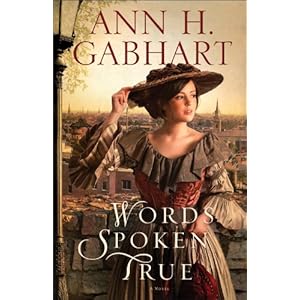
Words Spoken True by Ann H. Gabhart

Words Spoken True is a well-researched look into the world of newspaper reporting in mid-19th Century Louisville, Kentucky.  Tensions in American politics are high: especially when it comes to the ever-present recognition of a growing immigrant populous.  Adriane Darcy, raised in her father's newspaper offices, is determined to find a story no matter the cost. Her fierce competitor, Blake Garrett, has a controversial new style of reporting which requires him to work in and amongst those most dangerous in order to excavate a scoop.  From high social parties to trailing a Jack-the-Ripper like murderer, Gabhart keeps the tension taut and strong as she peppers her well-developed world with information about this mounting medium.

Adriane Darcy is exactly the type of heroine I seek in my historical Christian fiction: somewhat bound by the norms of proper society ( and in Adriane's case even bound to a loveless engagement) who breaks free from the structure of her time to pursue her heart's desire and calling. I was quite fond of Adriane who read like a flesh-and-blood heroine and not remotely like a cardboard cut-out or usual archetype of this ilk of fiction.  I especially loved her interactions with Beck, her father's pressman.  Their mutual care and banter kept the pages turning. Moreover, I enjoyed Adriane's dedication to thwarting the suit of the boring, but proper Stanley Jimson.

Blake Garrett is a dashing, be-moustached 19th Century hero and in the few encounters that Blake and Adriane experience with each other early on, the chemistry is palpable and the sparks fly. Indeed, it is interesting to pit these two against each other because regardless of their differences and well-balanced competitive nature, their similarities include a passion for reporting and exposing stories.

This is a prime bit of Americana with enough carefully plotted historical and political research to entice those who are looking for a story in the genre that relays a slightly less-explored area of US history with mounting regional and national tensions.

While this is a galloping romance with some heart-wrenching scenes of distant and formative love, it is also a well-knitted suspense and most atmospheric when our intrepid reporters are in the face of danger while pursuing this faceless killer.

My friend Ruth also reviewed this book last week and I invite you to visit her blog and read what she thought!

This book was received from Graf-Martin Communications for review and I thank them for the opportunity to explore this exciting new Revell title

Visit Ann H. Gabhart on the web
Purchase Words Spoken True on amazon

Thursday, February 23, 2012

Chateau of Echoes by Siri Mitchell


Chateau of Echoes is my first “keeper” book of 2012.  The first book that makes me want to leaf through it again in search of all of the treasures and snippets and revelatory moments which may have evaded me during my inaugural reading.  Siri Mitchell, alongside Lynn Austin and Dale Cramer, is my favourite Christian novelist.I have adored her previous work and her strong literary elements and thematic devices. In fact, I was thrilled to be an INSPYs judge when She Walks in Beauty received the well-deserved award for Best Historical Novel of the year.


Chateau of Echoes is a thesis on passion: passion for stories, passion for legend, passion for research and passion for history--- social history----food, wine, dancing, exploration, myths and stories. In fact, excavation runs as an apt undercurrent throughout the text.   Widowed Freddie owns a chateau in Brittany, France.  Here, she is pursued by the many readers and lovers of the history of a young medieval diarist named Alix: whose grasp of English and languages is remarkable and rare considering the station of women in her age.

 The writing is beyond what is usually housed in the Christian fiction genre. If you are an avid Christian fiction reader like myself, who also has a penchant for sleek literary merit then this is a book you can unashamedly thrust at your non-Christian friends. The themes of God and acceptance are grappled with in a natural and stormy way. Indeed, like so many of Mitchell’s heroines, Freddie’s coming-to-terms with Faith and Grace is a tumultuous journey which requires some semblance of self-sacrifice and the giving of one’s way to a Higher Power.   We learn that Freddie’s deceased husband was an atheist and the guilt that has accrued from his passing keeps Freddie at a distance from her Creator.  One Christmas returning to church after a long drought, she explains: “Looking back on those years, I realized I had missed the wonder of Christmas and the contemplation of the divine. I missed meditating on the sacred moment when God reached down and touched the earth. Peter viewed Christmas as an opportunity to ease the collective guilt our culture had accumulated throughout the year.”  And further: 
“Neither of us understood a word; but the liturgy was so familiar it seemed as if no one was there to actually hear it, but to experience it. To enter a stone country church lit by candlelight on the holiest evening of the year.”  The mystery and mystic nuances of the celebrated Season help broaden the theme of legend and spun tale. For example, the teenage diarist Alix, so followed in the tale and such an object of affection for a visiting phd student and the brash Robert Cranwell: author of numerous celebrated novels now only coming to terms with his desire to write something of greater substance, spends the ilk of a season penning a great mystery play.

 The relationships between men and women past and present is not easily dissolved when taken in great, galloping gulps as this novel affords. In the past we have Alix and her relationship,  as of yet unconsummated by her husband, Awen.  Her struggle to come to grips with the man who approaches her bedchamber only to weave a tapestry of narrative ( not unlike a Scheherazadean tale) each night echoes the modern day presence of Cranwell, the competent writer who invades Freddie’s life and chateau for months.  Yet, to mull on the idea of male and female voice one must also consider the great pains given to make each voice heard across the ages: sure, Awen spins the nightly tales (painstakingly researched legends and fables collected by Mitchell); but it is Alix who is modern in her ability to read and write many languages and script a Mystery play that her husband will ultimately take credit for.  In present, it is Robert Cranwell who will pen Alix’s story for the world to hear; but the narrative voice belongs to Freddie.

The presence of Guinevere, of the story of the Holy Grail, of King Arthur and his Knights and of Joseph of Arimathea and the history of the grail are all prominent here and so well infused you feel as if they are sparking off the page and you are a guest at the Chateau in a similar manner to Cranwell.

Mitchell is an ardent traveler and her details as to French culture and food ( even on a sojourn Freddie takes to Italy) are so well-penned you are gifted a sort of travelogue within in a novel. I know for certain that I want to hunt out all of the magical portions of France painted in this tale. Her passion becomes even more acute when paired with the amount of detail provided at the end of the novel: recipes, Breton History, even a Medieval calendar to guide readers through the inserted passages of Alix’s diary.

The balance between the past and the present and the seamless weaving of their thoughts on love, doubt, faith and redemption are so well-balanced: like a carefully-tipped literary see-saw.

I was remarkably impressed by Mitchell’s fresh narrative style in A Constant Heart and more still when she penned Love’s Pursuit: what is destined to be a modern Christian classic.  Chateau of Echoes should NOT be limited just to the faith-reader public. It is far too exceptional and far too beautifully written.  Yes, there are elements of faith; but they are sprinkled to highlight constant doubt in the presence and the structure of history.

If you are in a book club you NEED to pick this book as a future read.  There are some thought-provoking discussion questions included ( and not the usual range of “what colour of heroine’s hair would you most like to have” and trash like that)

I cannot believe this book has not found a larger publishing house or bigger reading base.


The Rose of Winslow Street by Elizabeth Camden


While reading the Rose of Winslow Street I was reminded of Dickens’ Bleak House and of The Apothecary’s Daughter by Julie Klassen.

Stay with me here: the former because it involves a piece of property that two parties desperately want and lay claim to and a strong-willed legal battle: the latter because Liberty Sawyer’s investment and knowledge of botany rivals The Apothecary’s Daughter regency-infused methods of pharmaceuticals.  A stronger offering than Camden’s inaugural novel, TheLady of Bolton Hill, Camden has applied her penchant for strong research and bold, non-flowery writing to write of the struggles and triumphs of a young Romanian immigrant and his two sons and a young woman whose lifelong shame of illiteracy has forced her to build an invisible wall. It will take a crisis of faith and the unravelling of years of secrets to bring these two together and sever the barrier between them.

I was impressed by this novel on two fronts: the first in Camden’s natural flow and ease of storytelling and her insertion of knowledge without infusing a sense of overladen fact-dropping; secondly by the slow and easy and quite believable depth of characterization: from initial remonstrance through kind and gentle understanding.  Camden paints quite a different portrait in the trials and travails of Michael Dobrescu, the swarthy strapping ex-soldier, his two sons and his compatriots. Moreover, she dallies with the fragments that will sew together the larger revelation, pulling the reader along with finesse.  She is a fine storyteller and her strong talent and ease of verisimilitude helps stretch a bright canvas of late 19th Century New England life.

I really enjoyed her attention to historical detail: from the flow with which she expels descriptions of botany and the perfumes and illustrations of soaps of the day, to a monumental eclipse, through the prejudicial slighting of Michael and his family and more still to the over-arching legal battle over ownership of the house on Winslow Street. There is also dichotomy to the eponymous rose and readers will soon grasp the many symbolic inferences of the flower to the characters and their growth.

This book was provided courtesy of Baker Publishing Group and Graf-Martin Communications, Inc.
From Bethany House, a division of Baker Publishing Group 

Buy it at Amazon

Visit Elizabeth Camden on the web

Wednesday, February 22, 2012

LILI, 1953 dir., Charles Walters

Also known as: The best time that Mel Ferrer played a brooding, drunken ex-dancer/soldier-turned-puppeteer-with-a-self-pity-problem-to-rival-Sydney-Carton


You may think I am making this up; but I'm not. A trailer to prove it:

Guys, have you seen Lili?  Oh well, you have to.  It’s a 1953 Leslie Caron vehicle (before Gigi) and works toward securing her as the best waif-elvin-french-girl-to-star-as-titular-heroines-with-cute-two-syllable-diminuitives.
Lili’s dad is dead and so she wanders the provincial French streets hoping to find a job.  But, she doesn’t.  The baker she was going to work for (an old friend of her father’s) is dead. She heads next door to see if she can help a tailor; but he is a douche... Such a douche that she is happy to be interrupted by a hot Carnival performer who is obviously the world’s slimiest guy. But, he has curly hair and an accent. Le voila!

And there be DANCING

So, she follows him around and meets up with his other two circus friends: one is pudgy, the other is Mel Ferrer(who is tortured and brooding and angry).
Lili tries her hand at waitressing for the carnival;  but keeps getting distracted by the hot slimy carnival magician.  Even though he’s a douche and obviously in a steamy relationship with Zsa Zsa Gabor.  So, she does what any self-respecting French teenager stuck at the Carnival with No Money would do: she decides to commit suicide. She starts climbing up, up, up, up this tall pole-thing when a voice beckons her calling her name and calling her back.


The voice comes from a puppet.  It’s Carrot Top, a rascally little red-head of the era of Howdy Doody. It’s a scary little thing.  Then all the other puppets at the puppet stand burst through the curtain and talk to her: Reynardo the Fox, Golo the goofy giant, Marguerite the vain and pretty woman.
Lili is enchanted and interacts with the puppets genuinely.  She doesn’t seem to recognize that they are actually controlled by Mel Ferrer’s Paul the Puppeteer. Soon, they inadvertently draw a crowd and Lili sings a cute song with the puppets and the whole world is beguiled.  I mean, come on! Leslie Caron dancing with a puppet!

So, you see, I am actually ALL THE PUPPETS!

Cool.
So, we learn that Mel Ferrer’s puppeteer--- all war-ravaged and injured and broken from being reduced to puppetry after having been a promising dancer--- is all googly-eyed for Lili. Big time. Sydney Carton. But, he drinks too much wine and his way too gruff and doesn’t know how to explain that I HATE WHEN YOU TALK TO THAT DOUCHEBAG MAGICIAN---- not because I hate you; but because I WORRY for your VIRTUE, you pristine little pure-as-a-bell wait elf!

Lili is hired to perform with the puppets every night.  It is LE CHARMING!  She doesn’t ever seem to recognize that they are puppets and, as it is the one time that Mel Ferrer can be gentle with her, he asks her her private thoughts and uses the puppets to woo her in the way he wishes he could in “real” life.  As soon as you can say Cyrano  de Bergerac, Mel Ferrer is following Lili around with eyes so enraptured with love and devotion that your heart will break.

And yet, fair readers, he is of the TORTURED, BROODING sort.  But, heck! He can do a voice….

So the puppet thing goes on and these big wigs offer Mel Ferrer a puppet job away from the Carnival because he is so good and the Douchebag Magician is leaving the Carnival and Lili learns that Zsa Zsa is actuellement his wife! Zut alors!

So Mel Ferrer sees Lili talking to DBM and misinterprets it as VIRTUE HAVING BEEN COMPROMISED so SLAPS HER (!!!?????!) and she decides to leave the carnival and the puppet team.  But, before she does: Carrot Top and Marguerite and all of her puppet friends beseech her to stay. She has a tearful farewell with them and just as she hugs them, she notices that they are trembling: well, the hands holding them and propelling them are trembling and then LILI finally realizes that MEL FERRER is the guy she has been talking to all along. … telling her deepest secrets and desires through the PUPPETS actually controlled by him! And she is conflicted and he is all, like, I AM THE PUPPETS: I, like every man, embody their perplexing personalities and characteristics and the viewer is all, like: DUDE! That’s some sort of metaphor!

But, Lili still leaves the Carnival…. And she walks down a warm, musty grey road ONLY to dream a puppet dance sequence (!!!!!!!!!!!!!!!!!)   Every time she dances with one of the puppets (now life-sized) they imaginatively fade into their creator…. And Lili is like DUDE! MEL FERRER is ACTUALLY HOT and he ACTUALLY LOVES ME!

So…. She runs back to the carnival and THEY MAKE OUT and have one of those awkward 1950s-era neck-tilt kisses and the PUPPETS clap from the puppet stand ( although who is making the puppets move is beyond me because Mel “puppetmaster” Ferrer is getting busy with Lili….

WHO IS MANNING THE PUPPETS?

But, ANYWAYS… it is the best movie ever. Also, Mel Ferrer was something else because, for a time, he was AUDREY HEPBURN'S HUSBAND! Also, Mel is short for Melchor. True Story.

TLC Book Tours: The Garden Intrigue by Lauren Willig


Lauren Willig’s enchanting Pink Carnation series is basically Georgette Heyer meets The Scarlet Pimpernel with a bit of Bridget Jones.  If ever I were to paste the term “something for everyone”, I would use it as a label for this fresh series. Fresh, still, and uncannily, seeing as it is on its 9th book!

But the plot-within-a-plot structure, coupled with Willig’s devotion to the time period and her fervor for splendid and sparkly research provide readers with another glimpse into the world of romance, danger and espionage: this time, featuring the newest in the network of the Pink Carnation, the beautifully named Augustus Whittlesby and the  New York born Emma Morris Delagardie.
 
Sparks fly, intrigue ensues and it is up to the American student Eloise and her erstwhile love interest Colin Selwick to excavate once more some of the most endearing, endangering, sexy and suave history of the British Empire.I especially enjoyed Augustus Whittlesby’s penchant for bad poetry. Of all of Willig’s incredible captivating regency heroes, this one proved to be the closest descendant of Sir Percy Blakeney, that indomitable and elusive Pimpernel.

I realize that my thoughts here are rather over-arching and not as specific to this particular novel and that is because, after looking through my blog, I don’t think that I have ever written about this series previously and I want readers to pursue the entire series. ALL OF IT! I have enjoyed all 9 books immensely and crave many, many more and I would heartily recommend starting at the very beginning ( especially for the well-worthwhile introduction to the Pink Carnation ring and to Eloise and Colin and their charming exploits around a beautiful old English manor: said to house the greatest secrets of the scheming carnation and her floral-power counterparts …)

I mostly enjoy Willig’s work because her passion for the period and for romance and for the tongue-in-cheek reverence that follows is so deftly acute. It infuses every one of her books and makes for rip-roaring fun.
Even though her research loans pitch-perfect verisimilitude to each of her endeavours, it is her sparkly wit and the devilish fun that hops off of every page.  Willig is more than a competent writer: her pen was MADE for this era. She will throw in enough laughs, enough tawdry villainry, enough steamy romance and enough wit and sparkle and denouement to thaw even the most reluctant of historical readers.

I heartily recommend The Garden Intrigue, yes; but strongly advise the entire series for optimal enjoyment.

Just see if you don’t fall for dashing Augustus and his dastardly couplets, verses and rhymes

-Visit Lauren Willig 


-Find the sequence of the Pink Carnation series here 

-Buy the Garden Intrigue on Amazon 

-My thanks to TLC for allowing me to host the most recent book by one of my favourite contemporary writers.

Saturday, February 18, 2012

The Fastest Book Reviews You'll EVER READ!

I read a ton of books and due to having a real job and time constraints and a social life, I cannot possible devote the time that is necessary to give them each a well-deserving (or perhaps not-so-well-deserving ) blog post. So, instead, I shall just note them here and you guys can go and read them ....

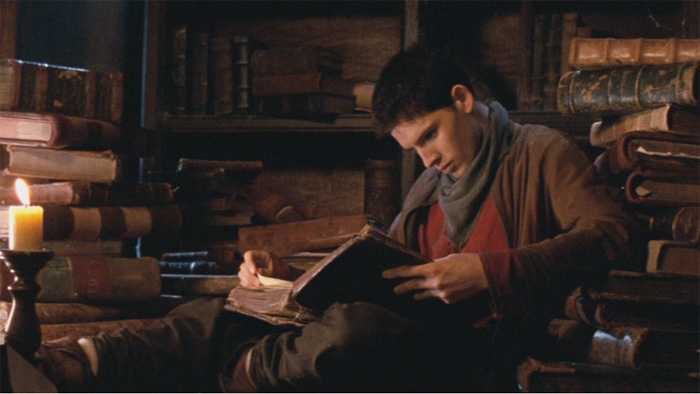
Merlin reading surrounded by lovely BOOKS


Thursday, February 16, 2012

more shameless Arthur Slade promotion

You guys know I love me some Canadian lit, right?

I happen to really like Arthur Slade. He's a swell guy.  He keeps releasing ( and tracking ) e-book sales with, like, scientifically coloured graphs and stuff.  So, you should, like, see what he's been up to: READ THIS

Also, according to this blog post, Buy a Book and Save a Butterfly ( true story)

Also, follow him on twitter: (@arthurslade)

Also, read Jolted

Wednesday, February 15, 2012

In Which I pull a few BBC miniseries out of my vast collection....

This past weekend I re-visited two BBC miniseries from the Golden Age of adaptation: the mid-1990s

The first, Martin Chuzzlewit, was in honour of Dickens’ bi-centenary.  The second, Middlemarch, was a borne of an impulse to revisit the complicated whir of industrial events spinning the cogs in the lives of Dorothea Brooke and Tertius Lydgate.

Martin Chuzzlewit has never been a favourite Dickens novel of mine.  I do appreciate its thesis on avarice, selfishness and the slow, tormented descent into sheer villainess; but its peripheral characters far outshine the main characters and the love story of the younger Martin Chuzzlewit and the almost possibly good Mary Graham pale when I compare them to, say, Lucie and Sydney Carton or Amy Dorrit and Arthur Clennam. Nevertheless, the secondary characters are divinely, colourfully Dickensian: including the stalwart Tom Pinch, the greedy and horrifyingly abusive and murderous Jonas Chuzzlewit and the dastardly Pecksniff.


Montague Tig and Mrs. Gamp as well as the refined old gent Chuffey help round out a myriad of some of Dickens’ most eccentric oddities.  Merry and Cherry Pecksniff are deliciously silly and frivolous and the adorable Mark Tapley revives some of the dragging scenes with his fresh zest and optimism.

Martin Chuzzlewit is known for painting a primitively dirty America to instill a sense of new world dread in its English readers. Certainly the scenes in the series which find Mark and Martin in supposed Eden (rather a malaria-ridden swamp) are as well-painted here as in the novel.   The moments where the lovely and good-hearted and golden Tom Pinch looks up from the organ where he practices at the cathedral to feast on the angelic countenance of Mary Graham captures you with the same sense of devotedly unrequited romance as bespeaks Tom’s journey in between the pages of the novel.

The casting of the series is excellent. Paul Scofield provides a WONDERFUL Martin Chuzzlewit, Tom Wilkinson and Keith Allen (Sheriff of Nottingham in ROBIN HOOD!!!) are both equally horrifying villains as Pecksniff and Jonas Chuzzlewit respectively, Pete Postlethwaite is inspired as Montague Tigue …and John Mills makes a sweet Chuffey. I cannot recommend the casting highly enough.  The character depth and realization is multi-dimensional here and no one is static: each revolves, evolves and changes due to circumstance and plot developments and it really is a wonderful to behold how they have transferred something so intuitively Dickens and painted it on screen.


Middlemarch remains one of my all-time favourite BBC series because it does well at capturing the essence of a remarkably complicated and twirling novel. Whenever I have talked to readers intimidated by beginning what has been called the definitive and finest Victorian novel, I tell them just to think of it as three different strands braided together: Dorothea Brooke and her untimely and loveless marriage to the wretchedly possessive scholar Edward Casaubon and later love of the romantic artist Will Ladislaw. Idealistic doctor Tertius Lydgate and his passion for research and reform: squelched by the vanity and social-assumption and spoiled nature of his beautiful wife, Rosamund Vincy.The good-hearted; but unlucky and wayward Fred Vincy and his pursuit for Mary Garth. Inasmuch as these three stories propel the themes of social reform, industrial change and growth in a small, middling community, all action revolves around/or is witnessed by these three sets.

Andrew Davies (one of the finest screenwriters and adaptors of all time) does well in focusing his attention to great detail when it comes to painting the definition of each of these three threaded storylines. Equal weight is given and enough backstory and character development ensues.  Viewing Middlemarch is, at base, an enriching experience: the frosting is the eccentric population supporting these three sects: the wonderfully noble yet prone to gambling chaplain Mr. Farebrother, the tediously loquacious Arthur Brooke, the conniving Mr. Bulstrode who cannot leave his past behind him….  Plate this against the Great Reform Bill and the expansion of the railroad, and you have a wonderfully historical portrayal of life in a provincial community.


Like Les Miserables by Hugo and Hard Times by Dickens ( well, a lot of Dickens, at that); Middlemarch was written under the grain of social activism and the detailing of Brooke’s life in politics, Will Ladislaw’s dappling in the newspaper and Dorothea’s passion for her cottages  and benevolently providing a better way of life for her land tenants give us a superb snapshot of the issues of the day. The casting is, as always, perfect and Dorothea is the perfect angel imprisoned by her ill-fated marriage, Tertius Lydgate is heart-wrenching as the doctor doomed to a life of remonstrance at the ill-advised expenditures of his clueless wife.


If you are a fan of BBC period pieces and you have not seen either of these, I heartily recommend them.  Moreover, seek out their source material and bask in the multi-layered, heavily caricatured tapestry of Victorian Literature’s greatest.

Ransome's Honour by Kaye Dacus


Ransome’s Honour is like Horatio Hornblower meets Jane Austen for CHRISTIANS


I can’t tell you how much I enjoyed the strong period setting, the pitch perfect dialogue of the era and the perfectly infused historical details regarding the glorious Age of Sail. Dacus never dumps information, rather strings it into each sentence with fervor and aplomb. The result? One of the strongest historical voices in Christian fiction.

Julia Witherington stands to inherit a large dowry upon her 30th birthday. One young man, destitute from gambling debt, vies for her hand and the promised fortune. Another is the dashing William Ransome: a Captain beloved by Julia and her father who turned her suit away years ago. Now, back in her life and as daringly close as ever, Julia proposes that they marry, that he secure her fortune, that she use his means in the navy to secure passage back to her native Jamaica.

The Portsmouth and subsequent sea setting of the novel are so well-coloured you believe that Dacus has lived and worked there in the time in which this novel is set: the golden cusp of the Napoleonic World ---when England turned from War to downing pirates and lusty privateers. Yet, it is rather (according to some searching on her blog) a love affair with a type of thinking person’s fan fiction that wrought this captivating tale. You know from the get-go if you, like me, have devoted hours of your life to the reading of Patrick O'Brian and watching of films like Master and Commander and the excellent ITV Hornblower series that Dacus is a kindred spirit. A sprinkling of drawing room manners loans the author’s penchant for Jane Austen and the inclusion of nautical figures provide the chivalrous spark. Many characters emulate doubles from the Hornblower series specifically: especially Bosun Matthews and Ransome’s eager servant. The righteous and brusque Admiral Witherington is so very much like the indomitable Pellew of the Hornblower series (lesser portrayed in the books; but still widely mentioned).

I have often mentioned that part of the reason I enjoy reading Dacus’ fiction is she features a unique type of Christian heroine: a single woman amidst a bevy of married women who is very much trying to find her place. It is interesting that to a degree Dacus is able to transplant this part of her ongoing thesis into Ransome’s Honour. Julia is very much “on the shelf” at almost 30 and well beyond marriageable age. Her wit, intelligence and refusal to comply to societal niceties and norms; and, further, the adventurous spirit that will catapult her into Ransome’s path and to Jamaica set her apart from the usual Regency era dolls with careful curls and docile dispositions.
It was quite a different experience reading this novel in conjunction with Dacus’ modern-day romances. I really REALLY liked this book and quite look forward to the next two in the series.

Tuesday, February 14, 2012

Paris, My Sweet by Amy Thomas

Warning: If you do not have chocolate nearby, do not read this book. Under any circumstance.In fact, make sure you BUY chocolate ahead of time. Or a cupcake and read it alongside.

This book reminded me a little bit of Chocolat  by Joanne Harris and a little bit of Petite Anglaise by Catherine Sanderson. The former, because of the passionate, undying love for all things sweet; the latter because it speaks to a young woman rediscovering her life in the City of Light.

Amy Thomas was always obsessed with the French. She loved pastries and chocolate and writing and, when offered a job to write ad copy for Louis Vuitton, she leaves her gorgeously decorated condo and the plethora of NYC cupcake shoppes she loves and heads for the Champs-Elysees.

The best part of Paris, My Sweet is Thomas' love affair with all things Parisienne. It is so whole-hearted, consuming and genuine. You can just feel in your fingertips that this, THIS is her dream city; rather like Vienna is mine. It was also refreshing, in a world of books where women feel they must restrain their sweet tooth in order to accomplish a societal ideal, to read of a woman's passionate love-affair with food. Dieting be damned! Thomas bikes everywhere and, like the (now immortal?) words of actress Emma Stone, believes that "life is short. You only live once. So eat the damn red velvet cupcake" (paraphrase).

"The first time I bit into one of Rachel's truffles", Thomas recalls, "I was instantly smitten." This Valentine's Day, I propose rediscovering Romance in its artistically liberal forms.  It was, long before the Hallmark Card industry, a term reserved for implying all sorts of artistic merit and unrestricted beauty: passion and fervently immeasurable beauty: in music, art, theatre, literature: colouring outside the lines, discovering passion and sensuality in themes, images, ideas.  Thomas reclaims Romance in this sense by offering us a succinct world of delicate deliciousness.  This is a sensual exploration of one woman's passion for pastries and the smells and sights and senses that lead her on a remarkable journey around the City of Love.

Think of this as the chocolate-lover's travelogue: interspersed, Thomas includes Sweet Spots on the Map which weave a chocolate-lover through some of the most delectable spots in her world. The index at the back of the book is a lovely list of bakeries: in Manhattan and in Paris where those who share an affinity for all things sweet can retrace Amy Thomas' footsteps.

The only complaint I have in regard to this frothy and fun story ( which I, smartly, decided to read with a decaf latte and pastry near-hand) is the dialogue intermixed. I recognize that Thomas needed to provide a narrative credibility and flow to her story by paraphrasing dialogue which would help transport the reader to the times and locales of her memoir; but I found this aspect rather weak.

If you are looking for a love affair with chocolate, vanilla, cupcakes, brioches, cinnamon, croissants, macaroons, petite fours and icing, then LOOK NO FURTHER!

This was a fun, frivolous and frosty maze through a city renowned for its unabashed delight in all things sweet.

My thanks to Sourcebooks for the opportunity to read this book and review it on the blog.

Read Amy Thomas' aptly named blog: God, I love Paris
Buy the book at Amazon

Happy Valentine's Day

get the girl
feel a tingle
listen to mozart
take a walk around a moonlit neighbourhood
squint up at streetlights
skip down the stairs
kiss a lady on the hand; a gent on the cheek
hold open the door
eat your weight in cinnamon hearts
lick the icing off of a cupcake
smile twice as big
watch the last five minutes of your favourite BBC miniseries: the part where, after 6 hours and numerous conflicts, the characters share an ecstacy of kiss
feel enraptured
tap music only you can hear on a table top
remember those little cut-out hearts in red construction paper
taste a snowflake on your tongue
remember all the colours of the rainbow
taste cherry lipgloss
paint your world with sparkle
believe in magic and light
love can be found in all corners, under tipped chairs or over seemingly unbeatable odds
chivalry is everywhere: at starbucks, on the subway
romance is a philosophical feeling: of liberated art, music and song
find a loved one
hum the Carpenters ---loudly
swing your arms
feel the world.

Monday, February 13, 2012

BOOKS in the NEWS!


-Remember how much I love Catherine Webb? Yah, we all do. Anyhow, I found this lovely podcast interview of her answering questions of adorable students. I had never heard her speak before (although I, of course, read her often and follow her well-written blog

-To celebrate the 100th anniversary of Stephen Leacock's Sunshine Sketches of a Little Town set in the fictional Mariposa (a stand-in for my hometown of Orillia), the CBC made a really boring tv movie filmed in Gravenhurst. I watched about 23 minutes. Leacock was rather like Canada's Mark Twain in ways. Shame that this had to happen to him.

-I love the Classic Trash series at The Awl. I especially liked this write-up of that Golden Book of WTF-ery, The Thorn Birds: made into an equally creepy TV movie starring Richard Chamberlain (who spends more time eye-snogging with Christopher Plummer than actually acting on his forbidden lust for Rachel Ward).  Anyways, funny-as-heck book written in a funny-as-heck article.

Sunday, February 12, 2012

Mortimer and Eugene, a Study in Friendship

Hey friends,

Gina was kind enough to post my rambles about Mortimer and Eugene from Our Mutual Friend over at dickensblog today.

Read it here. I'm sure you'll agree that Mortimer needs some love at the end of the story too!

Friday, February 10, 2012

little known fact

....i try to wear a bit of animal print every day: whether in jewellery, scarf form (like here), dresses, shawls, purses, bags, rings..... i love to differentiate myself with animal print ----and, fortunately, it is easy to find at value village and goodwill.....

what heroines do you think would be best suited in leopard print? i like to imagine that a modern lily bart would dapple in le print....

"artsy" self-portrait from mac photobooth taken for linked-in profile

In Which, I TWEET


I used to update a regular Twitter account; but dissolved it over a year ago.  However, I missed connecting with booklovers, publishers, authors and bloggers.... so....

FOLLOW ME: @rachkmc