Wednesday, June 27, 2012

Jessica Strider's 5 Canadian Fantasy/SF Authors you should read....

Happy Canada Day week all! As you've noticed, this week is ALL about Canada on the blog.

 Jessica Strider is a long-time friend and former bookseller colleague and one of my favourite readers on the planet. As well as being a gifted writer, she is well-respected as one of the major voices on quality Sci Fi and Fantasy in Toronto.  Authors know her, agents know her.... conferences and book-signing events know her! You are all in for a treat!  If she says that the book is good---then go read and buy it now!


Jessica Strider's 5 Canadian Fantasy/SF Authors You Should Read

Looking for strong male and female characters in your fantasy? Then give Violette Malan a try. Her prose is crisp and her female characters are calm, competent women. She has two fantasy series, the first, Mirror Prince (with a sequel coming out this fall), deals with a fairy guardian exiled to Earth (Toronto), now called back after 1000 years. The second series, Dhulyn and Parno, starts with The Sleeping God and deals with a pair of mercenaries who get into all sorts of scraps while trying to complete their contracts.


If you want more 'literary' fantasy, then try Guy Gavriel Kay. His prose is lyrical, almost poetic, his plots involved and his characters complex. Under Heaven is a great novel to start with. The plot centers around Shen Tai, the son of a famous General, who spends two years burying the dead of a battle that happened twenty years ago. In return for his selfless service, the enemy nation gifts him with 250 of the best horses ever bred. This is a gift fit for an emperor, and puts Tai's life in danger.


Want fantasy with more romance and fun? Then look to Moira Moore. Her Heroes series (starting with Resenting the Hero) pairs the serious Shield Lee with the one Source she can't abide, the flamboyant and famous Taro. Together Sources and Shields can control the weather that keeps the world stable, but Lee fears that the fame of her Source will stop her from doing the work she's best suited for. As the series continues, their romance heats up. But the real fun of the book is Lee's humorous descriptions and critiques of Taro's behaviour.


Not a fantasy fan? Like stories that scare the life out of you? Then try David Nickle. If the cover of his short story collection, Monstrous Affections, doesn't give you nightmares, the stories will. His first novel, Eutopia, deals with the eugenics movement in the US. And while the monsters in the book are scary, the humans are even scarier. He recently released his second novel, Rasputin's Bastards, dealing with the cold war and supernatural affairs.


So far these have all been authors who do branches of fantasy. So it's time for some SF. Nalo Hopkinson writes general fiction with SF fixings. Her novel, Brown Girl in the Ring is set in a collapsed Toronto. Those with money live in walled cities, and harvest the poor for body parts. The story really deals with a young woman learning more about her grandmother and her magical roots.


Bonus author: OK, even that last book had fantasy elements (magic). So here's a military SF author for you. Karin Lowachee wrote three science fiction novels that have a real focus on character development. The best of these (in my opinion), Burndive, tells the story of a rich young man who's taken on his father's star cruiser to keep him safe from the dangers on the station where he lives and to get him away from the drugs he's ruining his life with. There's language and adult situational material (though no sex), as it takes place on a military ship, but seeing the teen become a man willing to take responsibility for himself is a wonderful journey.

Hope you give one or more of these fantastic authors a try.

Jessica Strider works once a week in the SF/F section of a major bookstore in Toronto. She posts author interviews, themed reading lists, book reviews and more on her blog 


Tuesday, June 26, 2012

Love in Disguise by Carol Cox


Disguises, love, intrigue, suspense, enigma…..

Ellie Moore never anticipates what will pepper her life after she loses her job to a prominent Chicago actress; but as soon as you can say, oh, I don’t know, something Shakespearian, she is utilizing her crafty wardrobe of wigs, cosmetics and disguises, joining the Pinkertons and fleeing to Pickford, Arizona to help solve the mystery of silver shipments stolen from the local miners.


The Pinkerton Agency wanted two women to pose as an aging, demure aunt and her beguiling niece and, lucky for Ellie, she can play both with great aplomb.  Sure, the dream of trailing to London to follow in her employer’s stage career has fallen to pieces; but she is able to transplant that dream to Arizona territory: using her knack for eavesdropping, her nose for danger and the heart palpitations which take on frequency whenever miner Steven Pierce is near to spring her into action.

There is one catch: Steven is smitten with young, fresh, dazzling Jessie Monroe.  Likewise, he views her aunt Lavinia Stewart as a moral compass and confidante.  While Ellie falls head over heels for Steven, she cannot reveal the parts she is playing: for neither is actually her---especially not Jessie: the attractive young woman seemingly blessed with all of the  poise that Ellie lacks.

There were several wonderful things about Love in Disguise:  first, it started off with a bang.  Ellie stands looking over a pretend audience, propelled into dreamlike state as she imagines a prosperous career as Juliet!  Cox obviously has a capable working knowledge of Shakespeare and 19th Century theatrics and it works well.  Next, the Pinkerton agency. We've seen Pinkertons in A Proper Pursuit and in the Confidential Life of Eugenia Cooper and now here.  I really enjoy these romance historicals when laced with a bit of well-written intrigue.  

Contrary to so many heroines in the Christian historical realm, Ellie does not begin the book as a church-going Christian ( this may not seem like a big deal to those who are not initiated with this genre; but egads! It is mind-blowingly fresh ).  Ellie actually runs into more than one problem when her life as a non-believer clashes with the role she is trying to play. While Lavinia Stewart would indubitably be able to sing out all of the words to “We’re Marching to Zion” aside Steven Pierce’s baritone, Ellie-as-Lavinia has no hopes of doing so. She doesn’t know the words.

Anyone reading this review can eke out the moral construction of the tale: as it deals with identity and being true to yourself.  In many cases, it is easy for Ellie to hide because she houses such deeply ingrained insecurities when she is acting as, well, herself.  She finds determined solace as she elicits the moral backbone of Lavinia and the grace and wit of Jessie: little realizing that these are just two  facets of herself --- the best combinations of a person who, though shrouded with a hidden appearance, is indeed at the heart of the mystery and love story.  It is not Ellie’s trained skill; rather her intuition and ability to read people which make her such a competent Pinkerton.

This is a light summer read that I would highly recommend to those who want a nice, thoughtful Christian historical that is mindful of its trappings into the typical Christian construct; without falling too greatly into some of the less-scintillating norms of the genre ( for example, I did my usual finger-flip through all pages at the beginning to spot italics and found very, very, few! )

There’s a cute love story and some embarrassing moments when Ellie almost gets caught and she is a normal, conflicted heroine. Most importantly, she is one to cheer for. 


Ruth also reviewed it

Learn more about Carol Cox and check out her backlist


I received this book for review from Graf-Martin Communications on behalf of Baker Publishing Group 

Mountie Day!


Happy Canada Day week all!

As promised, I am featuring lots of lovely Canadian things on ye olde blog! Be sure to check out my post for the Hey Canada!  blog tour ! and our little kick-off post (featuring a few videos!)

When people think CANADA! They think, well, all sorts of awesome things... one of those things is our unofficial National emblem: The red-coated Royal Canadian Mounted Police! 

Mounties are cool!  My dad ( who is ALSO cool) houses one of the largest collections of RCMP memorabilia and history in Canada. I grew up surrounded by heirlooms and paintings and plates and plaques and uniforms remnant of numerous eras of "the Force" and, most importantly, surrounded by the written recollection of the Mounties' history and formation as a stabilizing force in Canada.

My first Mountie-related book was Mrs. Mike  I also really enjoyed Janette Oke's Canadian West series (remember Winn the mountie?)

Dad is  a chaplain for the RCMP (passion now manifest) and gets to do lots of cool things ( and even has his own AWESOME RCMP chaplain's uniform! cool! )

To help us find the BEST books on the history of the Mounties, their heroes (such as Sir Samuel Benfield Steele ), their legends ( the Mad Trapper of Red River), their horses, and the ones who are famous for being heirs of famous Victorian authors ---hello Dickens!, we went to the source: DAD!

So, these are some of Dad's favourite books about and written by the RCMP!


Mounties are cool. They always get their man. They have awesome uniforms. They ride horses to music .

Like most Canadians, they also know most of American history and how to diffuse a bomb and drop their heart-rates:


Monday, June 25, 2012

Hey Canada! by Vivien Bowers (Illustrated by Milan Pavlovic)

This book ROCKS (True Story!)
This is "An amazing journey of discovery across Canada" and oh my! is it ever!  Its format is one of a traditional picture book with a sweet, family-centric story: Gran is taking nine-year-old Alice and eight-year-old Cal on a road trip across Canada. Starting in St. John's, Newfoundland and spanning every colourful, glorious province, this literary road trip ends in Nunavut with a great trek up to Iqaluit.

As well as providing young readers with a wonderful geographical and cultural snapshot of the great land, "Hey Canada!" will immediately instil a sense of pride for our diverse terrain and our even more diverse culture and heritage.  Like the best picture books, "Hey Canada!" does well at remaining current and speaking to current mediums such as tweets; but it doesn't do away with history altogether.  As well as introducing children to the landscape, heritage, landmarks and wildlife of each province (a collection of photographs and illustrations make the book come alive), it also inserts an acute sense of continuing history: whether through snippets and tales (such as a paragraph about the Privateers' Warehouse in Halifax Harbour) or a comic book (such as one recounting life at the Fortress of Louisbourg in Cape Breton circa 1745 and a recap of the Battle of the Plains of Abraham).

"Hey Canada!" is also funny: the author has a wonderfully silly sense of humour which makes the road trip as enjoyable for Cal and Alice as it will be for young readers and even includes "Hamster Updates": a continual check-in on Cal's rapscallion and furry friend.

There is a perfect balance of fact, dialogue and illustration (or photograph) on each page to keep children enticed and interested.  If I were a school teacher I would have a heyday incorporating this into a geography, social studies or history curriculum: for not only does it provide ample opportunities for segway into numerous multi-disciplinary conversations, it also allows students to speak passionately about their history and heritage.  As they traipse through Canada with Cal and Alice, I am sure their personal history, their family ties and heritage and even memories of similar road trips will abound.

A few favourite moments:
Also, the Plains of Abraham segment is HILARIOUS!  Last year, a few friends and I were in Quebec on May 2-4 weekend (how Canadian is THAT sentence) and we spotted people engaging with history the same way Gran and Cal and Alice are: namely seeing a ton of gophers, eating picnics and, well, not quite remembering that the entirety of the Battle which formed our nation took little more than a few moments.  Further, I loved Cal's Tweet from PEI: because I did not actually know that PEI (famous for its potatoes) housed more than 70 different kinds of spuds! (who'da thunk? )  In the Newfoundland and Labrador section ( featuring one of my favourite provinces and travel spots in Canada), I was all tickled pink with the "Find It!" section ( kids will notice this feature throughout the book).   Here, Cal, Gran and Alice figure they can't leave the Rock until they've seen AT LEAST The following: Cod, Moose, Atlantic Ocean, Iceberg, Puffins! Awesome.
I'm learning history through COMICS? AAaammmaaazing!

I can say, quite assuredly, that this is the best book of its kind I have seen.  It houses it all: it would be a PERFECT gift for a boy or girl living in another country ( and perhaps planning a first time trip to the Great White North), it would be a great book to take with you if your family (like mine ) spent hours in a car traveling through the badlands and beyond ( we did 16 hour trips in our van!  Sorry, Saskatchewan, you weren't AS interesting ---well, your fields of wheat sure weren't---by hour 10) making historical stops along the way.  It features an easy index, a colourful map reminding kids of some of the symbols of each province they have seen( cleverly without including the Provincial name so that hopefully they can recount what they've learned in their tour and name each Province from East to West and back), and it includes a page on the Flags of Canada.  "Hey Canada!" is one of those rare books that is equally educational and fun. It doesn't take itself too seriously, it realizes that our country is one of quirky and colourful heritage and it revels in the beauty of our landscape and the diversity of our culture.

I have been fortunate enough to travel quite extensively in our great country and I say, quite often, that Canadians make a grand mistake by trekking off to other places (I'm looking at you, Florida) before seeing what we have in store. After a romp through this exceptionally visual and entertaining book, I wouldn't be surprised if kids tugged at their parents' sleeves to see if their next family vacation could be to something nationally awesome like the Dinosaur Parks in Southern Alberta ( Gran's poem about dinos is included in the book ) or Buffalo Jump (which my brother and sister and I LOVED when we were kids and which is included here).

It's a grand country, let's let our children know it: let's take them near and far and, pending that next big vacation, give them a glimpse into the best country in the world by showing them this colourful kaleidoscope of history and fun!


I received this awesome book for review from the publisher, Tundra Books.  Check out the other stops on the Hey Canada! blog tour . Use the hashtag #heycanada to talk it up on twitter and even follow Cal-- a fictional character with a twitter account! Please go buy it NOW!

Friday, June 22, 2012

Film Review: "Brave"

I was fortunate enough to see an advanced screening of Brave last weekend and when delightful Gina  asked if I might write a review for Breakpoint  about it from a Christian perspective I was thrilled to the gills at the opportunity.

You can read my review here

Breakpoint also includes a great feature called Youth Reads with a variety of Young Adult titles

Thursday, June 21, 2012

Get your Canuck on, Kids

Next week.... all week.... at a blog near you......

we celebrate ALL THINGS CANADIAN in anticipation of CANADA DAY!


  • The Hey Canada! Blog Tour
  • The Canada Day Blog Hop
  • Giveaways
  • The Great Canadian Book Quiz
  • LM Montgomery
  • Sunshine Sketches of MY HOME TOWN
  • Nova Scotia
  • Guest Stars ( mainly Rachel's Canadian friends that she roped into doing stuff...)
  • the BEST in Canadian SCI FI, FANTASY, YA and LITERATURE
  • shameless promotion of the GREATEST COUNTRY on EARTH

and, last ( but not least) AWESOME CANADIAN VIDEOS

(like this one )


So, you hosers, get your poutine, eh?  and grab your toonies and loonies and go oot and aboot until you find yourself here.  Pull up your chesterfield, drink your Tim Hortons, gargle some maple syrup, chomp your ketchup chips, eat your smarties (serviette, please) and DVR your Flashpoint and your Rookie Blue; because we are going to have a regular old Canuck Style PARTY (le party en francais )

International visitors will learn more than they ever wanted to know about our history and our penchant for writing really, really bad provincial songs (like this one):


Wednesday, June 20, 2012

Sad Day in Bookland

When I was a kid and in my teen years I loved going to Toronto.  This small town Orillia girl always had a hankering for the big bustle of the city and it was inevitable I would eventually move here.  My minister father would sometimes have to come to Toronto to visit ill parishioners at one of the city's major hospitals.  I would tag a long and sometimes would find hours to myself betwixt the shelves of the World's Biggest Bookstore.  I loved it.  As a book lover who had just started collecting books, I was in heaven and remember buying my very first copy of "Tender is the Night" and "Little Women" from its fiction section.   I was at the point where I was no longer re-signing favourites out from the library; I was starting to collect.


Reading about X-Wing pilots on a  WBB visit 2 summers ago


Indubitably, the first thing I did when I started as a student at the University of Toronto was apply for a job there.  For 4.5 years as I completed my degree, I spent my after school hours working ( if you can call it that).  To work there you needed to know about books, be passionate about books, have diverse interests and tastes: interests and tastes I honed and developed spending hours between the bookshelves and speaking on a myriad of subjects with regulars and tourists, people from all over the world.

I also met some of my closest friends there ( including KAT twitter handle:@bitwhizzle) : students like me working part time who loved books like a disease.  They are some of my best friends to this day......


This place is more than just bricks and mortar; this place is part of my spirit, part of who I am.....

As we draw closer towards its inevitable demise, I will continue to traipse down memory lane.  This place built me as a reader and that is the most important thing to a biblophile.....


Attached to "Attachments" Part 1

My favourite book thus far this year: the one I  keep returning to and the one I, well, basically underlined every other sentence in and the one YOU ALL NEED TO GO AND BUY NOW is Attachments by Rainbow Rowell. Yes, yes, the Rainbow Rowell who is on TWITTER (@rainbowrowell)and who I was fortunate enough to banter about Fifty Shades of That Book with.

Buy ye, Buy ye, Buy ye this book!
happiness in book form


Dear God in Heaven and all the Skippy Squirrels; this is the kind of book that warms you down to your toes.  This book gives you that "Horatio Lyle" feeling, this book makes you prance around your apartment singing the few happy Carpenter songs at the top of your lungs while pirouetting.  This book is sheer LOVE.

This book put me in a daze; so days later I was still seeing everything at work, at home, at the grocery store, at the gym through rose-coloured glasses and sighing: " Lincoln"  ---over-and-over again like a wispy little prayer. EGADS! Major. Book. Crush.

Ugh, I don't want to waste time and ode on the plot; because this book is so much more than PLOT (it is character and structure and sunshine and jelly beans and happy bunnies and beautiful sentences: a tapestry of interwoven giggles and stars); but the gist is this:  It is set in the days preluding Y2K at a newspaper office. Jennifer and Beth, both columnists, tap-tap-tap emails to each other all day long: about love, sex, Ghostbusters, the usual.   Meanwhile, Lincoln has been hired to read through all employee emails and flag anything that might go against company policy, that might not have ANYTHING to do with the Newspaper at all. Basically, all of Jennifer and Beth's emails.  But Lincoln, dear, sweet, wish-you-were-here-Colin-Morgan, Lincoln reads every night through his night shift. He is bedazzled, beguiled, bewitched, bothered, bewildered. In short, he falls for Beth. He's never met her; but does that really matter? He has FALLEN IN LOVE WITH HER TYPED SOUL  ( swoon ye female hordes who spend your days writing and writing and writing and hoping some guy will LOVE YOUR TYPED SOUL! oh swoon! )

Adorkable Lincoln ( HAPPINESS IS JUST A THING CALLED LINCOLN) learns that beguiling Beth may actually return his affections; BUT, he can't let her know he knows ---lest she discover he has been email-spying on her for an age.

And now, for Shameless Quotage. Because, my lovely flock, if you are unmoved to buy this book after reading these amazing quotes well...well... you just don't belong to the Race of Joseph ( and if you don't know what race that is --- then you don't belong to the race either, right LM Montgomery?)


“The worst thing about the Internet, as far as Greg’s bosses were concerned was that it was now impossble to distinguise a roomful of people working diligently from a roomful of people taking the What Kind of Dog Am I? online personality quiz.”

“High school guys only appear hot to high school girls. It’s something to do  with the fluorescent lighting in the classrooms, I think. They’re actually really skinny and spotty , and they have giant feet.”

“The kind of coat a baby might need to go to the ballet. In Moscow. In 1918. To match her tiny pearls”

“October, baptize me with leaves! Swaddle me in corduroy and nurse me with split pea soup. October, tuck tiny candy bars in my pockets and carve my smile into a thousand pumpkins! O autumn! O teakettle! O grace!”

“Lincoln couldn’t explain, even to himself, why she mattered to him. She and Jennifer were both funny, both caring, both smart as whips. But Beth’s whip always caught him by the ankle. He felt like he could hear her talking when he read her mail, like he could see her even though he still didn’t know what she looked like. He felt like he could hear her laughing. He loved the way she put on kid gloves when Jennifer talked about her marriage and Mitch.  He loved the way she riffed on her siblings and her bosses and herself. He tried not to love that she could recite scenes from Ghostbusters, that she liked kung fu movies and could name all of the original X-Men---because those seemed like reasons a guy would fall for a girl in a Kevin Smith movie.”

“There’s something really romantic about that.  Every woman wants a man who’ll fall in love with her soul as well as her body.”

“Diet coke and rum is the most moronic drink of all time.  They should call it a Moron so that girls who order it would have to call themselves out at the bar.”

“Not Sears-model cute. More of an old-fashioned cute.”

“He stood for twenty minutes at the bedding aisle at Target, trying to choose a manly sheet set, then picked the ones with the violet pattern, because he liked violets and who else was ever going to see his sheets, anyway?”


More shameless love when Attached to Attachments returns on a blog near you

Glamorous Illusions by Lisa T. Bergren


It was a time of opulence and magnificence. It was a bounty of places and persons carefully selected to prime young people of wealth and circumstance in ways of culture, history and language.  It was the perfect place to come of age.  Now mythologized in our consciousness and lavish beyond most of our collective comprehension, the Grand Tour is legendary in scope.  From London to Paris to Vienna to Rome, those of circumstance were guided to experience the epoch of Europe’s delights. To guide these young impressionable minds was an educated “bear” who would lead the young people through their adventures while (hopefully) keeping them out of danger or trouble and, you know, regulated their penchant for drink, dance and debauchery.  The Grand Tour is brilliantly woven as the backdrop of Lisa T. Bergren’s Glamorous Illusions: one of the most literary endeavours in the Christian market I have read this year.


Cora Diehl is comfortable with her farm life: the chores, the structure, the routine, her loving parents…. She could ask for little more than the comfort of her circumstance. That is, until she learns that she is the illegitimate daughter of the Copper King and her life changes forever. No longer the product of her Montana farming heritage, Cora must learn to bridge the gaping social divide and accept her new role as the daughter of one of the American elite.   In order to give he a proper upbringing and to atone for years of neglect, Cora’s new father sends her on the Grand Tour with his other legitimate children.  With her confidante Will, the bear and her dashing new French acquaintance, Pierre de Richelieu, Cora is spun in an intricate maze of masquerades and garden parties, cocktails, boating and high-stepping: a social and cultural whirl set against the beauty and poise of Europe.


This is an incredibly confident book: confident in its structure, in its usage of the Tour as a backdrop which takes on its own spinning characteristics and in its usage of shifting narrative points of view. Intrinsic details of life in the whirlwind of the Grand Tour as well as a sincere appreciation and understanding of the history of each landmark : from English country manners to Versaille are perfectly executed.  A lot of in-depth research clearly went into the formation of this book. When Cora takes up with a dashingly enigmatic Frenchmen, Bergen doesn’t err in beating us to death with immediate translation: she allows the flow of the story and the dialogue to infer the meaning of each statement.  To add to Bergren’s fortitude as a writer, she plays with narrative perspective: a point of view switch--- from Will to Cora --- hers in first person.  This could have been disastrous; but Bergren does it well and it rounds out Cora’s experience and the reader’s impression of her.  As our narrator, we are immediately attuned to Cora’s opinions and her experiences in a typically biased way; but Bergren takes a step further by guaranteeing that Cora’s likeability is not only personal expression, we get to see Cora and her adventures through other’s eyes and perspectives.  Amazing clothing and culturally specific detail allow one to sink further into the believability of the novel and the slight romance that fringes the character’s deeper acquaintance is most welcome.


Not only is Cora a fish-out-of-water in the midst of cultural divide in Europe, she is immediately flabberghasted by the major rift between her farm life and the Kensington life of wealth and prosperity. While busily waltzing from monument to monument, in and out of gorgeous clothes and social faux pas,  Cora must also learn to reconcile the betrayal of her heritage: once thought beloved and owned by her parents, the family secret that severed her existence plagues her on the other side of the world as she learns to tolerate her new siblings and encounter head-on the shame of being a child conceived out-of-wedlock in a time and society where this equaled to social disaster. “ Wallace Kensington made a way for me to come here…”, she says “… but he also made it impossible for me and my folks to ever return home ….to ever resume our former life”

The blessing of wealth and experience clashes greatly with the realization that once you leave a place and circumstance, you can never go back: if physically, at least not emotionally. Fortunately, going into her new excursion, Cora is blessed with a resolute character which allows her to take her new circumstances with a grain of salt, keep her wits about her and not immediately fall into the trappings of froth and flounce which could alter her inner goodness.  She inappropriately interrupts a dinner with an outburst on behalf of union workers, she engages with the servants and gracefully accepts the rude dismissal of her presence ( upon recognition of her true parentage) from a family of great wealth and influence.  Cora is a heroine to believe in.  She is flawed; but willing.  She is trying; but tried upon.  She is the perfect balance of wonder and skepticism.  

This is my first ( but not last ) Lisa T. Bergren book 

Tuesday, June 19, 2012

Film Review: The Best Exotic Marigold Hotel


This is SUCH a heart-warming and funny ensemble comedy based on the novel These Foolish Things by Deborah Moggach

Seven English retirees are searching for a second wind and a new life: Widowed Evelyn is trying to pick up the pieces after a lifetime spent with her recently deceased husband, Jean and Doug have inadvertently lost their  retirement savings after a bad investment, Muriel, a retired housekeeper, needs a hip replacement, Graham, a high court judge, decides to abruptly retire and Madge, a socialite in search of a wealthy husband and Norman, a sort of elderly Don Juan want to find some fun and some love.  All of this seems to be offered in the advertisements for the Best Exotic Marigold Hotel, in Jaipur, India: boasting comfort for “the elderly and beautiful.”  Suddenly, this group of ex-pats is resituated in the colourful and noisy kaleidoscope of a new Indian world and while some choose to experience, embrace and forge new and old friendships, others find it a difficult transition: opting to mourn the past left in England.

In India, The Best Exotic Marigold Hotel is discovered to be a ramshackle Colonial atrocity which, given love and care, might be restored to previous glory; but in the hands of the charming and optimistic, if frazzled  Sonny, is in dire need of proper management.  Nonetheless, the new residents form a new sort of family: far from home; but with similar pangs, disappointments and circumstances. Indeed, the theme of a diaspora of people feeling as if they no longer have a place and are no longer in want or need by their family and connections is resonant.

Like the best ensemble dramas and, thus, like the best character pieces created by the British ( honestly, they excel at this as much as they do everything else), each character is given languid, dignified moments wherein melancholia meets enchantment as they forge new bonds and excavate new worlds.

I knew absolutely nothing about this story before I saw the film and that heightened my enjoyment: especially as I couldn’t for certain eke out the details of the plot and the small, sassy surprises as they unwound before me.  Thus, I want to leave the same enjoyment for you.

I do recommend anyone who loves a cozy character piece unfurled against a startling back drop of noise and colour: so potent and tangible, you can almost smell it and feel the heat on your skin, rush out to see it.   It is known that this film features an astonishingly good cast of veteran actors and all are a delight to meet and revel in: but I particularly enjoyed watching Judi Dench as Evelyn and Bill Nighy as Douglas.

If I ran the world, Bill Nighy would have a role in everything. 

Friday, June 15, 2012

Introducing an exciting new way to carefully select your next read

Good Morning fair readers, 


If you're anything like me, before you see a film that interests you, you head over to Rotten Tomatoes to see what critics are saying.


Fortunately, some brilliant book-lovers have created a similar site for readers. 


This site is currently only available for a sneak peek for those who have an exclusive access code.


Guess what, I am going to GIVE you all that access code! woop! and you can go in and look around and discover....


Just visit here  and enter:discover_books


have fun and happy reading!

Wednesday, June 13, 2012

To Win Her Heart by Karen Witemeyer


 Okay, here’s the deal with Karen Witemeyer, I have learned the secret to her popularity : it's a cotton candy read.  You don’t have to pay close attention, you will most likely finish the plot in your head before the she finishes it on the page and you won’t leave having interposed some universal truth.

You might think I mean this in a bad way; I don’t --- not to the right reader.  Sometimes people watch candy movies: those fluffy, candy-coated excursions into marshmallow land.  You’ve done it: you see 13 Going on 30 on tv one night and you can’t turn away.  You feel comforted in the fact that you KNOW she will end up with Mark Ruffalo. There aren’t any surprises; but it DOESN’T matter. It’s candy, fluffy fun.   This is the Christian book equivalent.  There is nothing challenging within To Win Her Heart: you know that Levi the reformed convict-turned-blacksmith will win the hand of Eden the upright librarian; but it DOESN’T matter; the prose trips along so easily you can read it in that dream state before bed.  It’s not my fictional ideal; but I do admit it takes some talent to spin one of these easy yarns and I applaud it.


This the kind of fiction you drop off to your grandmother on a Sunday afternoon.  There is no edge. For me, there is no spark; but it’s solid and conservative.   The other Witemeyer book I read and appreciated of this ilk was Head in the Clouds: that was a cute, fluffy book not unlike its title.
I absolutely loathed Tailor Made Bride ----not because it strayed from the devices aforementioned but because as a Christian and a woman who prides independence and intellect I still find it one of the most begrudgingly offensive offerings in the market.  (Honestly.  I was offended and still feel small ripples of rage when I think about it).  Short-Straw Bride is on its way to me for review and I’ll read it, and review it here; but I recollected that I hadn’t spoken to To Win Her Heart yet; so….here….


I think I already kind of mentioned it: convict –turned-blacksmith falls for librarian.  Librarian is at first intimidated by convict-turned-blacksmith’s large physiognomy and skeptical of his passion for Jules Verne; but soon there are sparks flying from the smithy and beyond.   

I want to mention one incredible aspect of the novel.  Witemeyer has an ALMOST Lynn Austin moment ( I say ALMOST; because no one but Lynn Austin can have these moments really).  You know ( as I have mentioned often ) that moment in a Lynn Austin novel when your ears perk up and your eyes widen and your heart pulse quickens because she throws in something: however, fleeting and serenely quiet ; but tantamount to the experience and you go….”oooooo”; well Witemeyer almost gets into this realm of writing when she explores Levi’s lisp.  Levi has difficulty saying ‘s’ words and so to keep his pride and his face he will remove them from his sentences…. Deciding, instead, to craft the same emotion or statement with alternative words.  This proves Levi to be a great reader; but also proves Witemeyer to have put some careful thought into her dialogue.  In this respect, I was impressed. She took this book a step farther than others in this regard.


There’s still the usual: bad guy wants heroine, good guy hates bad guy wanting heroine, crisis that rallies the townspeople, crises of faith; but, whatever, you get what you paid for.  There aren’t any surprises here and I think that’s the lasting appeal.  Sometimes we all need cotton candy. 

Tuesday, June 12, 2012

A Walk with Jane Austen: A Journey into Adventure, Love and Faith by Lori Smith


“It’s a difficult, romantic thing to be a dreamer” admits Lori Smith in one of many, many quotes I would love to appropriate and cross-stitch and frame and hang on my walls as the story of my life.

A Walk with Jane Austen: A journey into Adventure, Love andFaith should rightly be called the Difficult Musings of a Romantic Dreamer for the book is, at its core, Lori Smith’s relatable reflections as she stumbles through singlehood, depression and faith.

There are certain books that tug your heart strings and catch your throat and make you squeal aloud at every moment where you realize that the author has taken words and thoughts out of your mouth and heart and slapped them on a page. A Walk with Jane Austen is very much A Walk into Rachel’s Psyche.  It is Smith’s blatant and commendable honesty, her frustratingly poignant stream-of-consciousness and her willingness to spill her thoughts and pangs like a tipped-over inkpot that make this story the most poignant caption of a literary infused life I think I have ever read.


It speaks to those of us who love Austen, certainly, as Smith weaves her way through the English tapestry: beguiled at Bath, cloistered in an abbey, bewildered at Lyme as she traces through her beloved’s footsteps. Mostly, however, this book speaks to a specific type of Austenian: those of us romantic sorts who are blessed and cursed by a passionate devotion to Christianity in our single thirties.  Cursed, you ask? Yes. Smith realizes, as so many of us do, that the limited dating pool and strict moral requirements of what a Christian match should be can make the odds seemingly impossible.  Add to that a passion and heart for romance and a God-given desire to seek that which is beautiful, fantastical, witty and light and you are caught with Lori Smith in a modern web: where educated women feel at a loss--- so likely are they to cherish their post-feminist independence while guiltily admitting contradiction as they ache for an Austenian match. It’s a difficult, romantic thing to be a dreamer, yes; but to be cursed as a Christian with a romantic, dreamer’s mind? Even worse.  Like lapping water out of a sinking boat with a plastic pail.

Readers of this blog know that I was on work leave for 5 months recently with debilitating anxiety.  As someone who has struggled with a mental disorder her entire life ( one that was only recently given a name), I fell in love with Smith’s vulnerability as a depression sufferer plagued with a malady that is not christened until near the end of the novel.  Some might find the dark, smoky edges of this romantic Walk to be a tad over-bearing; but that is what makes it special.  Smith does not shy away from using her plight as a balm.  She admits to being smack in the middle of a life-long dream ( traipsing through Austen-land) while still admitting moments of defeat.  Just because you are chasing Darcy-coloured rainbows, doesn’t mean that the curses of real life will fail to set in.  To add to this, Smith writes eloquently about Christian lamentation: and a modern weakness inducting believers into a world of radiance and light while scorning natural human lamentation.  From the book of Job to her flitting, irreplaceable thoughts, Smith guides us through the happy and the sad: the rainbow-tinted and the melancholia.

 If you are a single Christian woman, this book will speak to you so strongly, you’ll look up and be surprised that a best friend is not spilling all deliciously confusing details across from you over a glass of wine.  Lori Smith GETS it: she gets that “…the other skill that single women possess is overanalyzing every conversation” and that “Of course, a single woman who wants to be married has, ironically, no sharper skill than that which rules out potential suitors before fully understanding their character.”   Smith provides a delightful paradox:  she re-imagines Austen’s tone and timbre while inserting the quite different dilemmas plaguing single Christian females.  Certainly we do not have the constrictions of sex nor of money or patriarchy in Austen’s society; but Smith works that we have the same obstacles, we crave the same matches, we trip over ourselves in the pursuit of love: bewildered, shamed, uninhibited.    To add to the perilous puzzle, Smith “gets” the evangelical cadences of an upbringing so familiar to all of us: “She didn’t have to deal with the evangelical culture I was raised in---“, she explains, “the one in which Christian things are separate from other normal (or as the church sometimes describes them “worldly” ) things.”

Further, she understands the scathing imp at the back of our minds which brings to forefront our questioning of our path.  For a contingent of women taught to pray for their future husbands and families in children’s church and through youth group to the same sect of women in their 30s, she understands that making sense of the nonsensical is part and parcel of the plight.   “He’ll be normal”, she hopes, “Someone I could actually introduce to my non-Christian friends without cringing.”  If you are in the datingsphere as a Christian single woman and you have not thought this; then you are either lying to yourself or are much more decent at heart than I am.   Smith is an automatic ally who understands how difficult it is to seek God’s path and timing when our impatient human nature forces us to explore the great world beyond: “Our conversations range from incisive devotional thoughts to solving poverty to the creepy, ogling married guys buying us drinks downtown.”  Like she says of Jane Austen, Smith is able to engage with the world around her. She fully epitomizes the contradictory nature of modern Single Christian females: those who are cursedly frustrated at God’s ridiculous timing while steering into moment of secularism in order to discover if there is light and love and passion available. Those who worry that one does not have the luxury of standards when there are so few male believers left to choose from (many marry young; there are twice as many single Christian males as females in North America).  She IS NORMAL.  Further, she muses, on the seeming unavailability and awkward friendship nature of connections with Christian men over a certain age: “It is a truth universally acknowledged among single Christian women that single Christian guys beyond a certain age are weird.”  Harsh, perhaps, and most likely not universal; but, again, she mirrors Austen-- bringing the peripheral subject of her thesis to forefront and honestly revealing a thought that actually got published in the Christian market (God bless you, WaterBrook).   “ I still want it so much”, she says of marriage as her 33 year old self traces Austenian heritage, “And if that sounds crazy to some, since I’m currently thirty-three and still very marryable, it may help to know the expectations in the conservative Christian world in which I was raised. Girls were supposed to grow up, go to college, and get married. “  To put that into further context and to heighten the stress and significance, I will echo that the first time I had the thought that I was abnormal for being single and pursuing an education and wanting a career was at 18.  There are zillions of readers who will not understand  the moments of vacuous inadequacy one feels as an aging single Christian woman; but they are there.  In a world where we are supposed to be supportive of differences, to seek God’s will and to find God outside of human expectations, to realize you are someone not quite like the rest of the flock is a constant sting. Moreover, to be an intelligent someone out of the flock who seemingly chose education and career outside of early marriage (I’m talking 18-25 here, the average Christian marrying age), further removes one from the idealized domestic sphere.  

Smith quotes writer Sue Monk Kidd’s talk about the defining choice every woman makes between love and independence.  Smith further investigates its ramifications and contextualizes it in the Christian sphere. But, as an independent woman on an independent excursion, she allows room for ruminations on love: realized and mentally constructed. There are a few major relationships in the book which make up the “love” component of the subtitle.  One being Jack: the odd, Christian friend-sorta-date who occupies Smith’s time at Oxford 
( and her thoughts long after), one being Smith’s reconciling her love for herself and God against moments of shadow and Smith’s love for Austen: what Austen stood for, what she wrote, how she was ahead of her time, how she provides a metric against which we should all attempt to live and love. She also speaks to the relationship she longs to have. A beautiful one with adored looks, not unlike the one Darcy gives to piano-playing Elizabeth during a scene in the 1995 BBC miniseries.


Smith, like me, believes herself to have been inherently compliant: to want to please her parents, her God, her church, the expectations told and untold and with this heavy weight she loses herself, if momentarily, and often just as reality comes  galloping back in, in the world of Jane Austen.  I realize that I spoke far more to the personal resonances of this book than to the Austen-centric mold of this Walk; but that is because that is not what hit be so hard about this reading experience.  I know a lot about Jane Austen and I have read dozens of books and studied thoroughly in University so, truth be told, I don’t need a literary travelogue
 ( though this one is so much appreciated); but I do need an author who understands me. I do need someone who is brave enough to spurt out on page what wrestles so acutely in my heart and mind but has rarely found a voice.  Smith, in the guise of a beautiful homage to a great female writer, speaks up for those who cannot speak for themselves and in this case, she speaks up for me and my ilk: we trusty, conflicted band of Christian single females intelligent and contradictory: wanting love and independence, sitting over coffee wondering why he said this or who he is or why we are attracted to guys outside of the fold and what it is to be equally or unequally yoked and why can’t EVERYONE BE MR.FRAKKIN’ DARCY --- she speaks for us.   And while she is speaking for us she takes us on a rollicking rural journey through the mind and thoughts and, yes, heart of the greatest female writer of all time.

Thursday, June 07, 2012

A Spiritual History in Sung Liturgy: How Hymns are largely responsible for my ongoing Christian walk

I have never been without church music.  I don't remember a time when I didn't know the workings of a hymnal and many, many hymns, to me, are as familiar as breathing.

For all I know, I always knew all the words and the melodies and different musical settings. To this day, I am amazed at my brain's capacity to elastically hold and unfold the hundreds of hymns I recollect from my childhood.   While the Pentecostal Church ( the church in which I grew up ) has largely depleted its greatest musical resource and, in turn, replaced many hymnals with the trendy wave of outreach found in worship choruses, I still recall my earliest memories. I still feel that part of my strong attachment to the written word and the fact that I was always a strong reader is testament to my running my eyes weekly along the verses of the hymnal and slowly piecing out the words and memorizing them, recognizing them, due to their marriage with the music.


My dad is a retired Pentecostal minister and from the time I was born until the time I left home for university, I never knew a world that did not include the Evangelical church.   To say that being a minister's kid is easy is a horrid falsehood. It was difficult. The restrictions in our traditional home seeming even more so because we acted as unofficial emblems of the morality and regulations my father preached from the pulpit. Don't get me wrong---there are very few ways of doing it otherwise.    In fact, from the Bronte sisters to L.M. Montgomery (a minister's wife), you'll rarely hear of those involved in a minister's family without hearing of the consequences of the appointed role.

It also leaves little room to decide what measure religion will play in your life.  Evangelical Christianity was ingrained in my being from birth and I never knew a world without it.  As well as attending church two times on Sunday ( Sunday school before; then morning and evening service... when I grew older .... orchestra rehearsal BEFORE Sunday school), Wednesday Bible Study, Friday night Youth Group alongside a bevy of other tasks and showers, weddings, receptions, hymn nights, plays, Church dramas, ministries, conventions, etc.,


As an adult raised in an environment so overtly Christian as mine it became ( as it is for many ) difficult in my early adult years to reconcile any personal convictions I might have had against a background so steeped in one form of Christianity.   Now, while I maintain my Christian faith and solidly continue to rely on it; I cannot say that I haven't struggled with how the sect of Christianity which informed my upbringing, my moral compass and fibre, my life lessons and the rigidity of regulations I placed on myself can act at a discord with the beliefs I currently harbour.  A lot of the issues so proudly pronounced on Evangelical stages have, after years of ruminating, reading, and sculpting my own personal belief system while still taking the most potent constructs of my childhood in stride, disconnect with my personal viewpoints.  Simplistically, I try to be the Atticus Finch type of Christian: one who replaces judgment and condemnation with a willingness to embrace moral certainty and servitude against a conflicted world.  (I'm serious about the Atticus Finch thing.  If you want to know my definition of Christianity, look to a book like To Kill a Mockingbird or re-visit Joe Gargery, the gracious blacksmith in Great Expectations).


From the age of 5, music became an even more important part of my religious life because I began singing publicly in church.  This would continue and I credit my interest and voracious study in music ---alongside the fact that my post-secondary career saw me certain that I would pursue musical performance. I always sang in church and I always loved it. The confidence and joy that I conveyed in my musical competence  inspired my parents and I to invest in vocal training.  I began at age 12  in a largely classical way and continued in my first year University (as my area of study) and, when I transferred schools and programs to the niche of English Literature-- my other, and somewhat synonymous passion,  I continued study at the Royal Conservatory of Music here in Toronto---also in classical study. Since then, I have had intermittent classical training---all of which I credit to my upbringing singing in the church and the music I loved.

Funnily, in festivals and competitions as a kid, my favourite area of performance was always the Religious or Sacred category: it allowed me to blatantly explore my love of traditional and gospel music on stage.


As my older self struggled (as all those raised in a conservative Christian home) to create my own identity and as I reached that crucial moment where I had to decide ultimately if I believed in my faith because it was my faith; or whether it was the ramification of my having known nothing else my entire life, I thought largely to the music of the church.  It married the two things in the world I love most: music and the written word.  From a young age, I began taking note of the composers and lyricists noted in the hymnal and the dates of their birth and death bracketed beside their name.  I began to pay close attention to where one stanza ended and where the next began: recognizing the lyrics as separate poetry and not something merely recited and sung because it was as familiar as breath.


In any moment of struggle or disdain I have felt with the church as an organization (I have never felt disdain toward the Gospel message of Christianity; rather only how its executed and practiced by fallible humans and victim sometimes to the organization and politics of Churches), I would take myself to the purest part of the religious experience: the hymns.   No matter what sermon I heard, no matter what book I signed out of the library or convention experience I had with my youth group or doubt that I belonged more with the traditional Anglicans than the charismatic Pentecostals ( a thought I had as early as 10 years old), I knew that the beauty of the Church rested largely in its musical history.  The perfect music: often commissioned from the most talented composers of the age or settings borrowed from the repertoire of history to fit the words of the most powerful songs with the perfect Poetry.  The hymns I loved most, and the Christmas Carols I loved most ( for Christmas music remains some of my favourite music of all: not the secular jingle stuff; but the real, traditional CAROLS) were those which had lyrics bespeaking the entire gospel message.  As a kid and teenager I loved this.  As I found my voracious reading and rather liberal and equalist ideals beginning to show kernels of clash against the conservative and rather right philosophy of my community, I found the purist spiritual experience in hymns.


I loved them. They were God's way of speaking just to me. Sometimes I felt, while sitting with a hymnal open in hand or playing the notes of the hymnal with my flute ( when I wasn't leading worship, as I grew older, I played flute in our church orchestra), that God was nodding directly at me: knowing that I would get ridiculously excited if I saw a playlist boasting one of my favourite hymns.

As I began singing at other churches in solo roles or at different events which required me to perform a religious song: weddings, funerals, anniversaries, the like...  I relied on my love for the traditional.
In an era where the Evangelical church seemed to be replacing hymnals with over-head projectors and, progressively, powerpoint presentations flouncing the words of the catchy worship choruses, I would take my personal passion with me.

Hymns were constructed (especially those I prefer: those written in the 18th through early 20th Centuries) to provide the entire Gospel message to an illiterate population.  To secure understanding of those who would ramble in off of the street.  To ensure that the easy repetition that would follow when words are sung to music and thus conscripted to memory would remind all congregants and seekers of the most important tenets of faith.

As I've evolved in my Christianity, so modern Evangelism has devastatingly turned from its history and origin and, in some instances, instead of providing a hybrid of both traditional (perhaps explored in an innovative modern way, for example -- as I have heard successfully performed) and contemporary services, it has developed a generation or two with little to no knowledge of the music that precedes it.
In short, the hymns and carols that so supplemented my Christianity and the services of believers hundreds upon hundreds of years before me lies restless while replaced by worship largely (generalized statement here) reliant on the experience of worship in musical form: rather than the sole conviction of the words to relay the Gospel message in a rudimentary and stern way.

I could go on and on and on and on about this subject ( a personal conviction of mine since a young age and, because of its intensity, I feel part of my Higher conviction and personal walk); but this long tangent  is supplemental to my revisiting my favourite Christmas carols and hymns on a near daily basis.

With the illness (see anxiety portion of the blog) I am being treated for, a lot of the past has had to be exhumed and I have had to, once more, craft and carve my personal belief system while remembering, diffusing and processing my serious and deep integration with Evangelical Christianity--- it has not been a smooth ride. Never, again, as a direct result of my disbelief in the Gospel or the Bible (I have intensively studied it and its varying translations in personal and academic spheres---much as I have the history of religious music); but as it pertained to the more rocky facets of my childhood experience in a Pentecostal Church AS a Pentecostal minister's kid.

Rocky, yes, self-reflecting, yes...

This process, coupled with my current nervous state in crowds and confined spaces, has made Church attendance near-impossible in the past few months. While I haven't attended a Pentecostal Church regularly since my early 20s (I am 30 now), my parents still attend and it is still in near periphery.  Something about the propensity and potency of remembrance and my complete immersion in the more political and organized facets of Church have caused it to bring an immediate wealth of emotion---especially with the music I love...

 I cannot escape this music. In fact, in those severe moments we have when parts of our brain defy even our most deeply rooted faith and cause it to slightly tremble or waver with the ease of casting off-- I have admitted to myself ( as I had in previous occasion remarking on the work of Catherine Marshall, Lynn Austin or D.L. Sayers), that I will never be able to abandon Christianity partly because I will never be able to admit that the Carols and Hymns that so defined me were not inspired by Divine presence.

For me, the proof of a Supernatural Higher Power and the evidence of His great love through his Son's (see, I've got all the "good and important" stuff in line, don't I?) interposition of human sin, is often relayed at its most glorious when penned and composed by vessels used as inference of Higher Power in human worship.   It's a very Biblical thing and a very sacred thing...  The moment a Church congregation links itself in history (through music, the written word, narrative) to its forebears and recognizes the link threading every generation of believers, the more it is able to appreciate the contextuality which strings it in a fermented and solid way. What better way for history to invade modern liturgy but through song?


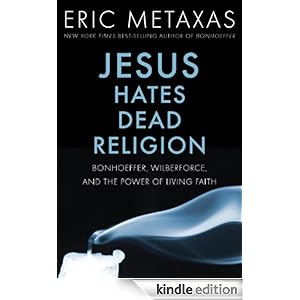
Jesus Hates Dead Religion by Eric Metaxas


"…it was people who go to church and do not show the love of Jesus. it was people who know the Bible and use it as a weapon. People who don't practice what they preach. People who are indifferent to the poor and the suffering. People who use religion as a way to judge others. I had rejected that....Jesus had also rejected that. He railed against that. And He called people to real life and real faith.... So keep in mind when someone says 'I'm a Christian', it might mean absolutely nothing'


Eric Metaxas is super cool.  My dad ( who is the world’s biggest William Wilberforce fan ) and I went to see him speak at Tyndale here in Toronto a few years back (even shook his hand as he signed my Wilberforce book--- AUTHOR LOVE)and I remember thinking: “This guy--- if this guy is a Christian, I SO want to be one!”  Oh wait! I already was a Christian; but hyper-intellectuals like Eric Metaxas make me proud that we’re on the same “team.” 

Eric Metaxas doesn’t settle for ignorance or stupidity or shy from debate.  Famously, he has engaged in conversation with atheist Christopher Hitchens and he is the noted founder of Socrates in the City: a forum wherein dignitaries and scholars and theologians and writers can argue (in an informed manner) about a cornucopia of topics.  Yale-educated, funny and outwardly passionate about philosophy, academia and the world of the thinking, life-changing Christians, Metaxas is a beacon of thoughtful light in a faith of ignorance, prejudice and conformity. (He currently hangs out at Breakpoint)

I read and thoroughly enjoyed his banter-y series for WaterBrook: “Everything you ever wanted to know about God (But were afraid to ask)” and its sequels and was, of course, smitten with his conversational forage into the life of William Wilberforce and the mammoth work-turned-unexpected blockbuster that was his perspective on noted theologian Dietrich Bonhoeffer.

You see, Metaxas hits on celebrities from my formative years. Celebrity, you ask, right word? In my house, yes.  Next to God was CS Lewis and next to CS Lewis was Dietrich Bonhoeffer.  Should there be assigned seating at the Marriage Supper of the Lamb, my minister father would have it thus:  CS Lewis, Bonhoeffer, William Wilberforce, Philip Yancey (so cool!), Guy who founded the Salvation Army…William…something or other… BOOTH! Yes, BOOTH!, John Stott and Ravi Zacharias.  They all get a table and dad would want to be positioned somewhere near so he could hear EVERYTHING.  Corrie Ten Boom might be allowed a drop-in before dessert.  But, he would want to meet her on her own time.  Christian heroes became Christian celebrities: inasmuch as they peppered Dad’s sermons and formed his voracious reading habits.  Metaxas, delving into the lives of two of these magnum Christian entities, fleshed out in conversational and bewildering and awed tone, his own appraisal of two men who lived by REAL faith.

REAL faith, you ask?  Well, it’s Metaxas’ undercurrent and casual thesis when we mete out his prayer breakfast speech.

But, to begin, let’s speak to the ease in which Metaxas continues his excessively readable nature.  When you read Wilberforce or Bonhoeffer or when you see him on 100 Huntley Street ( go CANADA!...it’s like our 700 Club; but with fewer moments of awkward judgment and un-PC behavior) as he spreads a smile for that astronaut who took communion on the moon, you feel as if you have been invited to tea and Metaxas is sitting directly across from you and telling you little secrets --- all the while determined to make you laugh, think and rejoice.  JesusHates Dead Religion has a precursor, a witty and beguiling prologue preluding the interred National Prayer Breakfast speech. Herein, readers are given first-hand look into Metaxas’ busy speaking schedule, his playful ideas for possible speech topics, his disbelief that he is the KEYNOTE speaker at a function attended by the Obamas and Joe Biden and, well, every big American ever, his pressure and stress at having to type a speech for transcribers (odd for someone who usually works off a short page of notes and a lot of conversational improvisation) and the long night before he is about to speak about faith to the president of the United States and one of the most powerful figures in the world.

Is Metaxas nervous?  Damn skippy; but not in the way I would be. I would be having a conniption fit; Metaxas believes that opportunities like this are a platform given by God. …..And what a platform! With his trademark wit and ease, Metaxas addresses some of the most famous politicians of our age in front of a group of over 3500 and he speaks honestly, blatantly and without the watered-down conservative, colouring-in-the-lines one might expect of a speaker at such a juncture. Instead, Metaxas owns his faith, his thought, his intellect, his belief ( and such a true one ), that Christianity has been muddled down by religiousity.  Indeed, Metaxas is of the lineage of Martin Luther and Wilberforce and Bonhoeffer---amazing men and thinkers who knew that to love God was to LIVE by God; not just tote his high-faluting and monumental consternation from lofty platforms. Prayer, Metaxas believes, is the first extension of ‘real’ faith: it is not practiced or dictated; rather a firm and floating communication: a two-way signal combining our hearts and minds with God’s.  Bonhoeffer learned this and was able to act in faith in a time of extreme pain and prejudice.  More still, Wilberforce was able to learn this and set the wheels in motion for social reform.  In both cases, these men were wrought of an unsettling time in history and were able to see through with God-given clarity. Metaxas does not shy away from the same undercurrents of evil in modern society.  He advocates questions, thinkers, believers, the expelling of religiousity in exchange for real, active faith.

I was convicted and moved.  In more than one fleeting instance, he inserts a few more political stances; but as I was not reading this from a political standpoint and as I know far less than I should ( or care to ) about American Politics ( I spend enough time staying informed on my own country’s policies), this was not the intent of my reading; nor did it colour it at all. 

This is a great sort of devotional, a battery-recharger, a momentary dive into the waters of someone frustrated by the complacency of modern religion and the taint it is giving our flawed world.


This is the best 4.99 I have ever spent on a book. 

Tuesday, June 05, 2012

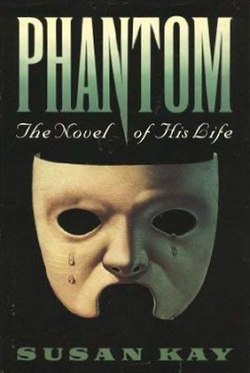
"Phantom" by Susan Kay


My voice was my one beauty, my only power, my only hope; my voice would open a magic pathway into her life. I could not steal her body---but I could steal her voice and weld it irretrievably with mine; I could take it and mold it and make it mine forever, one little part of her that no other man should ever possess. All I had to do was break the silence that stood like a wall between us

Oh Phantom of theOpera, like every other grade 7 Canadian I was so buzzed about you.  You ran at the Pantages forever. I’ve seen you 7 times on stage , I devoured the Gaston Leroux novel (free on kindle---click link) like there was a drought of demon-possessed opera ghosts, I saw all the bad film incarnations (including one with Burt Lancaster that no one should see), I sat through Emmy Rossum andGerard Butler in the Joel Schumacher version, I started taking classical voice lessons because I wanted to be Christine.

My story and life-long love affair with you ( and, let’s face it, mostly with Colm Wilkinson )  is nothing new.  So, of course, my grade 7 self ALWAYS wanted to read the Susan Kay novel. But, it was long out of print and I didn’t figure I’d fork over whatever gargantuan asking price was listed on ABEbooks or amazon.  However, e-bookversion? Damn right!  So, away I went.

The thing is, you guys, that this is FAN FICTION! This is the stuff that people write on fanfic.net ALL the time. However, Susan Kay was fortunate enough to be able to spin a yarn excavating the fictional past of a fictional character at an inspired time.  Phantom-mania ricocheted around the world, and Kay picked up the fire and ran with it.  She did it, I’ll admit, remarkably well.

Yes, she speaks directly to her fanbase: those like me who are all “GAH! MUSICALS! MUSICALS! MARIUS! MUSICALS!RAOUL, YOU SUCK! MUSICALS! MISS SAIGON! MUSICALS! BLOCKBUSTER! MUSICALS NIGGGGHTTTTIMMME SHAAAAARPENS! MUSICALS MUSICALS POOR PHANTOM! JAVERT!”  by tossing in slight and knowing references to  the Lloyd Webber adaptation; but she also knows her Gaston Leroux and her Phantom universe and, moreover, she has an incredible sense of 19th century history and a penchant for heartbreaking, melodramatic, melancholic narration. I would expect nothing less of the silver platter serving up Erik’s story.

It poses an interesting question; can fanfiction stand on its own as  real, plausible literary endeavor? This memoir of a fictional personage is so well-drawn and intertwined with such believable and well-strung details that you feel as if Erik really lived… does that not speak to the compelling and timeless nature of a character so well-drawn out he is able to spring from his creator’s mind and into a book wholly his own?  Kay paints a winding, mystical backstory that is at times spiritual and reverent and at most awe-inspiring and disturbed.


Hi! I'm Colm Wilkinson. I am the best at everything


The innocent part of myself that felt sorry for the Phantom/Erik and was all, like “ Oh my god! Raoul, you suck! See, Christine! He can pop up in a mirror and he has a boat! On a lake! Under a theatre! With candles! Who lit the candles? Does he light the candles! They are MAGICAL CANDLES! They float! So cool! MASQUERAAAAAAAAAAAAAAAAAAAAAAAAAAAAAAAAAAAAAADE” was rattled by the sexualized and synergized masochism of this mentally disturbed hybrid human/creature.  From the beginning, he cannot keep his mother’s love, his visage is one of a rotting corpse, his ingenious nature is baffling beyond prodigious prodigy and there seem to be darker forces at work.  Is Erik a satanic stand-in? It would seem thus.  He joins a gypsy circus, he works with a kind-hearted stone mason until warped by unintentional murder, he is educated in the craft of magic, torture and booby traps in India and finally he makes his way to the Paris Opera where he becomes resident Ghost in Box 5 and the cool stuff all we Phantom-ites were waiting for begins to transpire.

He hears Christine: she has long dark hair and looks like his mother--- he has so many issues he decides to make her his.  He lures her into his damp, molted lair and they sing together. He sits by his foreboding organ and pounds out Don Juan Triumphant.  Upstairs, Christine is drawn to Raoul: the most cardboard character since David Grantland met Gilbert Blythe (HAD David Grantland met Gilbert Blythe). It’s fascinating. There are mirrors. There is a statue of Apollo on the rooftop.  It so harkens back to the Leroux novel and to the musical source material that one’s recollection of both, in perfect symmetry, are sprung into overdrive.

This is a cool experience, kids.  And it is WELL-WRITTEN!  It’s a little cheesy and hokey; but SO IS THE WHOLE FRIGGIN’ plot of the original….

So, if you find yourself clapping whenever “Prima Donna” pops up on your ipod, jump in.

Monday, June 04, 2012

Over at Dickensblog....

Gina was nice enough to let me ramble about Esther Summerson from Bleak House and our society's obsession with physical appearance


Friday, June 01, 2012

faith, god, doubt and asking the hard questions in catherine marshall's Christy

What ho, fair readers of ye olde bloggie!

Today I AM FAMOUS ELSEWHERE

I have once more contributed to Femnista at Charity's Place  and you can find me on p.24-25 of the May/June Issue: HERE

Did I write about Christy? yes.  Do you want a gratuitous Christy and Neil MacNeill picture from the cheesy tv adaptation? Okay. Well.....