I enjoy buzzing around to different booksellers on the web. This one, Book Crossing from Maryland in the States is no exception. The site tells me it is located in historic Brunswick and has some pictures of cute bookclubs and events. A quaint, happy, cozy little shop not unlike the store I work at or The Shop Around the Corner Meg Ryan's character perpetuates in You've Got Mail.
Adorable. And then I scrolled down and my eyes caught the Hours of Operation:
Monday thru Friday — 5am to 7pm
Saturday — 10am to 6pm
Sunday — 1pm to 5pm Nov/Dec.
Also open during events on the square
Monday through Friday 5 AM?!?!?!? Are these people insane?! Who is up in time to bookshop at five o'clock in the morning? They had BETTER have a Starbucks, poor souls. I know that Independents have to keep up with the Joneses but is this necessary? !! Even if desperate times call for......
oh well. You get the point. I am a bigger booklover than most but my obsession will never take me into 5 AM territory.
Egads !
Sunday, November 12, 2006

Saturday, November 11, 2006
Splendid !
Arthur Slade visited my blog. That just made my whole day. Once and awhile authors drop by and I think " Gee, I think I'll sell tons more of your books ! "
Picked up Downhill Chance by Donna Morrissey today..... my Newfoundland writer du jour!
Half-way through Dairy Queen Days by Robert Inman..... I quite enjoy the southern flavour.
Remembrance Day here in Canada: solemn and rainy. I am always moved to tears at the cenotaph.... the pipers, the uniformity, most of all, the attendance. It seemed more than half of my small city was there; standing in the drizzle, appreciating. Glad to Kailana for her November Challenge: am onto Night Watch now. Followed by Sojourn by Alan Cumyn.
Will write more tomorrow ---- post Author-Visit Euphoria.
Off to read.
Picked up Downhill Chance by Donna Morrissey today..... my Newfoundland writer du jour!
Half-way through Dairy Queen Days by Robert Inman..... I quite enjoy the southern flavour.
Remembrance Day here in Canada: solemn and rainy. I am always moved to tears at the cenotaph.... the pipers, the uniformity, most of all, the attendance. It seemed more than half of my small city was there; standing in the drizzle, appreciating. Glad to Kailana for her November Challenge: am onto Night Watch now. Followed by Sojourn by Alan Cumyn.
Will write more tomorrow ---- post Author-Visit Euphoria.
Off to read.
Wednesday, November 08, 2006
Eclectic
I thought I better catch you all up on some of the books that I have read recently.
First, let's chat a bit about Time was Soft There by Jeremy Mercer. Mercer deftly paints a stunning portrait of his early 21st century sojourn at Shakespeare and Co.; the renowned bookshop near the Seine in Paris. Home to aspiring writers and established poets ( Alan Ginsberg included ), Mercer like many before him was given a job and a place to stay by the eccentric and brilliantly literate George Whitman. Imagine ! Living at a bookstore. A bohemian wonder with hidden beds and staircases and enough room at a table for perfect strangers to sit at high tea on Sunday afternoons. Many bookish people permeate Shakespeare and Co. on pilgrimages yearly. Mercer's story reminded me of the golden age of literary Paris ( that explored in Everybody was So Young by Amanda Vaill, That Summer in Paris by Morley Callaghan ....which we all know as one of my favourites...and A Moveable Feast by Ernest Hemingway ). Mercer, a former crime reporter for the Ottawa Citizen, is surprisingly romantic and self-effacing. In fact,his prose.... peppered with anecdotes of long nights with a bottle of wine and scraps of poetry.... makes you feel as if this book were written decades ago and the story was more deliciously aged than its 2005 publication date.
Charming. Read it.
My Dream of You by Nuala O'Faolain is a dissertation on passion: whether found or thwarted. Kathleen is a London travel writer long absorbed in a xerox of a divorce case an ex-lover once gave her. The "Talbot" divorce case involves the supposedly adulturous affair between the wealthy Marianne Talbot and the lowly groom, William during the aftermath of the Irish Potato famine. Akin to Possession , the story jumps ( seamlessly ) from the present to the early 1850's. The metaphor of famine as a physical and emotional state is pretty astute. Further, the idea of passion starved is fully realized in the old-maidenly narrator, the lonely Kathleen.
This book has a twist which makes the one so praised recently in The Thirteenth Tale pale quickly in comparison.
I read this brilliant book in one sitting with a cup of tea while watching the snow outside my window. The portrait of the famine was heartbreaking; especially in comparison to the wealthy excess she paints in the ignorant Talbots. More heartbreaking still is the starved existence of Kathleen....who yearns for passion and romance and must revisit a tattered courtcase to live it ( Think The Lonely Passion of Judith Hearn by Brian Moore ).
Adam of the Road by Elizabeth Gray is one of the Newbery Award winners of yesteryear. I have decided to try and read atleast one Newbery book every month. I have flirted with reading older Newbery books on and off for the past year, so I knew I would get to this one eventually. Adam is the son of Roger-the-Minstrel, in his Canterbury Tale-esque adventures we read of their musical adventures from town to town and Adam's captivating medieval journey. I was reminded ( delightfully ) of Crispin by Avi and his minstrel friend Bear.
Megiddo's Shadow by Arthur Slade is a Red Maple nominee this year and the first book of my November Reading Challenge. Edward, an upstanding Saskatchewan farmer's kid leaves his home on the prairie and enlists in the Great War despite his mere sixteen years to avenge the death of his beloved older brother. A natural horseman, he is sent to tame horses in the Palestine and to fight the Turks. The "Lawrence of Arabia" theme is coupled with Edward's love for his home and native land. Thus, the vast desert he rides becomes a stand-in for the similar dry Prairie terrain of his youth. The end brought me to tears. Arthur Slade.... now inducted into my Canadian YA authors hall of fame. Loved it ! Love him! More MORE MORE !!!
On the night table:
The Widow of the South by Robert Hicks
The Night Watch by Sarah Waters
Forbidden City by William Bell
Keturah and Lord Death by Martine Leavitt
Fly by Night by Francis Hardinge
Thomas Hardy by Clare Tomalin ( I LOVE advanced reader's copies )
Miss Marjoribanks by Margaret Oliphant
First, let's chat a bit about Time was Soft There by Jeremy Mercer. Mercer deftly paints a stunning portrait of his early 21st century sojourn at Shakespeare and Co.; the renowned bookshop near the Seine in Paris. Home to aspiring writers and established poets ( Alan Ginsberg included ), Mercer like many before him was given a job and a place to stay by the eccentric and brilliantly literate George Whitman. Imagine ! Living at a bookstore. A bohemian wonder with hidden beds and staircases and enough room at a table for perfect strangers to sit at high tea on Sunday afternoons. Many bookish people permeate Shakespeare and Co. on pilgrimages yearly. Mercer's story reminded me of the golden age of literary Paris ( that explored in Everybody was So Young by Amanda Vaill, That Summer in Paris by Morley Callaghan ....which we all know as one of my favourites...and A Moveable Feast by Ernest Hemingway ). Mercer, a former crime reporter for the Ottawa Citizen, is surprisingly romantic and self-effacing. In fact,his prose.... peppered with anecdotes of long nights with a bottle of wine and scraps of poetry.... makes you feel as if this book were written decades ago and the story was more deliciously aged than its 2005 publication date.
Charming. Read it.
My Dream of You by Nuala O'Faolain is a dissertation on passion: whether found or thwarted. Kathleen is a London travel writer long absorbed in a xerox of a divorce case an ex-lover once gave her. The "Talbot" divorce case involves the supposedly adulturous affair between the wealthy Marianne Talbot and the lowly groom, William during the aftermath of the Irish Potato famine. Akin to Possession , the story jumps ( seamlessly ) from the present to the early 1850's. The metaphor of famine as a physical and emotional state is pretty astute. Further, the idea of passion starved is fully realized in the old-maidenly narrator, the lonely Kathleen.
This book has a twist which makes the one so praised recently in The Thirteenth Tale pale quickly in comparison.
I read this brilliant book in one sitting with a cup of tea while watching the snow outside my window. The portrait of the famine was heartbreaking; especially in comparison to the wealthy excess she paints in the ignorant Talbots. More heartbreaking still is the starved existence of Kathleen....who yearns for passion and romance and must revisit a tattered courtcase to live it ( Think The Lonely Passion of Judith Hearn by Brian Moore ).
Adam of the Road by Elizabeth Gray is one of the Newbery Award winners of yesteryear. I have decided to try and read atleast one Newbery book every month. I have flirted with reading older Newbery books on and off for the past year, so I knew I would get to this one eventually. Adam is the son of Roger-the-Minstrel, in his Canterbury Tale-esque adventures we read of their musical adventures from town to town and Adam's captivating medieval journey. I was reminded ( delightfully ) of Crispin by Avi and his minstrel friend Bear.
Megiddo's Shadow by Arthur Slade is a Red Maple nominee this year and the first book of my November Reading Challenge. Edward, an upstanding Saskatchewan farmer's kid leaves his home on the prairie and enlists in the Great War despite his mere sixteen years to avenge the death of his beloved older brother. A natural horseman, he is sent to tame horses in the Palestine and to fight the Turks. The "Lawrence of Arabia" theme is coupled with Edward's love for his home and native land. Thus, the vast desert he rides becomes a stand-in for the similar dry Prairie terrain of his youth. The end brought me to tears. Arthur Slade.... now inducted into my Canadian YA authors hall of fame. Loved it ! Love him! More MORE MORE !!!
On the night table:
The Widow of the South by Robert Hicks
The Night Watch by Sarah Waters
Forbidden City by William Bell
Keturah and Lord Death by Martine Leavitt
Fly by Night by Francis Hardinge
Thomas Hardy by Clare Tomalin ( I LOVE advanced reader's copies )
Miss Marjoribanks by Margaret Oliphant
Tuesday, November 07, 2006
Idiot? ces't moi
Anyone else notice that I wrote Gabriel Garcia Marquez as the author of All Quiet on the Western Front?
Ridiculous, I am.
I think it's because I just finished ordering Love in the time of Cholera on the web: and we all know how these three-tiered name sound alike.
Ridiculous, I am.
I think it's because I just finished ordering Love in the time of Cholera on the web: and we all know how these three-tiered name sound alike.
Saturday, November 04, 2006
Excessive Adaptations 101 and November Challenge
THE BAD:
Sometimes the worst you can do when in the euphoria following the reading of a good book, is watch the adaptation of the book you have eagerly wanted to see on film.
Tonight's movie was Francis Ford Coppola's Bram Stoker's Dracula (1992) which I had heard to be the closest interpretation of the novel I had read earlier this week. Instead what I stumbled upon was 2.5 hours of werewolf orgies, gushing blood, stigmatism and head-chopping and lots of bare chestage that had little to do with the book itself.
My mental checklist noted the introduction of Dracula as Vlad the Impaler, fiend and Crusading soldier, proudly brandishing the crest of the Order of the Dragon ( that templar-like society one now associates with the historical figure Dracula ). What it didn't mark so highly was the appearance of Winona Ryder's Mina clad as a Transylvanian Princess and Anthony Hopkin's Van Helsing as one historic incarnation of mentor/sage/spiritual advisor. All of this before the opening credits.
From there, it took any creepy and harrowing subtleties and bashed them over the head with lavish excess. In fact, I thought I was watching a kaleidoscope.... or carnival at best.... a campy, colourful affair that built no character further than its sexual desire or need to chop off people's heads.
The Dracula I read was erotic by default: lace pulled back to reveal an exposed white neck, a strange caped figure lurking near an open window, the touch of a hand, the thirst for an embrace. This adaptation left nothing for the imagination. In fact, I believe Coppola refused to believe we had any imagination at all the way he blatently stripped the text of any hauntingly mystic quality. Mystery? I think not. It was all laid quite bare on the table.... as bare as the well-endowed vampire brides who spent most of the film feasting on Keanu Reeves' pant legs and causing him such distress (?!) his hair was spray painted white for the rest of the film.
Even the Victorian scenes were bashed to shoddy death with Dracula and Mina rendevouzing in the Lyceum theatre toting a rather bawdy spectacle of women in corsets and each in turn strangling the fur of a wolf with gloved hands.
It was a stupid and ridiculous movie and I laughed throughout. How could they butcher such a book to that extent? Butcher seeming the appropriate word because the prop people had lots and lots of red paint to throw around the limestone bricks of Dracula's decaying castle.
I am a firm believer in subtlety. In Dracula's case, less is definitely more. Think of him....as a character... when presented with hallowed grace; sliding mistlike into rooms and vanishing as an apparition, touching no part of skin but the side of the neck and leaving his two pin-pricked calling card, he is a creepy and volatile not boring and disturbingly malleable.
There was so much wrong with this movie it was hard to know where to begin my dissection of it......
The diary sequence voice-overs were true to form, but spoiled alas by Keanu Reeves and Wynona Ryder---neither possessing credible English accents. Lucy, draped in red like flowing blood was more than the Jezebel..... her figure was the first to disturb me.
Gary Oldman does what he can but the whole thing is so dreadfully misconstrued.
Poor Bram Stoker.... I bet you tons of wooden stakes he didn't want his name attached to this atrocity.
THE GOOD:
Kailana has come up with an excellent November reading challenge in honour of Remembrance Day. Having already partaken of most of the books she listed as her roster, I came up with a few of my own:
Megiddo's Shadow by Arthur Slade: a YA novel currently nominated for the Red Maple award which has a Saskatchewan farmboy experiencing the desert warfare of the Great War first hand.
Night Watch by Sarah Waters : Booker finalist that paints London during the Blitz years ( literary Foyle's War ... hmmm!)
The Sojourn by Alan Cumyn. I have heard this is one of the most beautiful Canadian novels of the past couple of years.
Here are some recommendations for your own November Challenge lists:
Deafening by Frances Itani
Birdsong by Sebastian Faulks
The Wars by Timothy Findley
The Russlander by Sandra Birdsell
All Quiet on the Western Front by Eric Maria Remarque
Regeneration by Pat Barker
Selected Poems by Wilfred Owen
A Farewell to Arms by Ernest Hemingway
Three Day Road by Joseph Boyden
The Boy in The Striped Pajamas by John Boyne
Sometimes the worst you can do when in the euphoria following the reading of a good book, is watch the adaptation of the book you have eagerly wanted to see on film.
Tonight's movie was Francis Ford Coppola's Bram Stoker's Dracula (1992) which I had heard to be the closest interpretation of the novel I had read earlier this week. Instead what I stumbled upon was 2.5 hours of werewolf orgies, gushing blood, stigmatism and head-chopping and lots of bare chestage that had little to do with the book itself.
My mental checklist noted the introduction of Dracula as Vlad the Impaler, fiend and Crusading soldier, proudly brandishing the crest of the Order of the Dragon ( that templar-like society one now associates with the historical figure Dracula ). What it didn't mark so highly was the appearance of Winona Ryder's Mina clad as a Transylvanian Princess and Anthony Hopkin's Van Helsing as one historic incarnation of mentor/sage/spiritual advisor. All of this before the opening credits.
From there, it took any creepy and harrowing subtleties and bashed them over the head with lavish excess. In fact, I thought I was watching a kaleidoscope.... or carnival at best.... a campy, colourful affair that built no character further than its sexual desire or need to chop off people's heads.
The Dracula I read was erotic by default: lace pulled back to reveal an exposed white neck, a strange caped figure lurking near an open window, the touch of a hand, the thirst for an embrace. This adaptation left nothing for the imagination. In fact, I believe Coppola refused to believe we had any imagination at all the way he blatently stripped the text of any hauntingly mystic quality. Mystery? I think not. It was all laid quite bare on the table.... as bare as the well-endowed vampire brides who spent most of the film feasting on Keanu Reeves' pant legs and causing him such distress (?!) his hair was spray painted white for the rest of the film.
Even the Victorian scenes were bashed to shoddy death with Dracula and Mina rendevouzing in the Lyceum theatre toting a rather bawdy spectacle of women in corsets and each in turn strangling the fur of a wolf with gloved hands.
It was a stupid and ridiculous movie and I laughed throughout. How could they butcher such a book to that extent? Butcher seeming the appropriate word because the prop people had lots and lots of red paint to throw around the limestone bricks of Dracula's decaying castle.
I am a firm believer in subtlety. In Dracula's case, less is definitely more. Think of him....as a character... when presented with hallowed grace; sliding mistlike into rooms and vanishing as an apparition, touching no part of skin but the side of the neck and leaving his two pin-pricked calling card, he is a creepy and volatile not boring and disturbingly malleable.
There was so much wrong with this movie it was hard to know where to begin my dissection of it......
The diary sequence voice-overs were true to form, but spoiled alas by Keanu Reeves and Wynona Ryder---neither possessing credible English accents. Lucy, draped in red like flowing blood was more than the Jezebel..... her figure was the first to disturb me.
Gary Oldman does what he can but the whole thing is so dreadfully misconstrued.
Poor Bram Stoker.... I bet you tons of wooden stakes he didn't want his name attached to this atrocity.
THE GOOD:
Kailana has come up with an excellent November reading challenge in honour of Remembrance Day. Having already partaken of most of the books she listed as her roster, I came up with a few of my own:
Megiddo's Shadow by Arthur Slade: a YA novel currently nominated for the Red Maple award which has a Saskatchewan farmboy experiencing the desert warfare of the Great War first hand.
Night Watch by Sarah Waters : Booker finalist that paints London during the Blitz years ( literary Foyle's War ... hmmm!)
The Sojourn by Alan Cumyn. I have heard this is one of the most beautiful Canadian novels of the past couple of years.
Here are some recommendations for your own November Challenge lists:
Deafening by Frances Itani
Birdsong by Sebastian Faulks
The Wars by Timothy Findley
The Russlander by Sandra Birdsell
All Quiet on the Western Front by Eric Maria Remarque
Regeneration by Pat Barker
Selected Poems by Wilfred Owen
A Farewell to Arms by Ernest Hemingway
Three Day Road by Joseph Boyden
The Boy in The Striped Pajamas by John Boyne
Thursday, November 02, 2006
Miles Dorrington...... Alright.... if we must ....
The Masque of the Black Tulip by Lauren Willig is an even more enchanting read than its predecessor, The Secret History of the Pink Carnation. Using the lore of Scarlet Pimpernel-esque spies of the Napoleonic Era, Willig has fashioned a dollop of brainy chicklet that counterbalances the topsy-turvey adventures of a Bridget Jones-esh grad student with the romantic and flowery ton of the early 19th Century.
Best of both worlds? Well, counting some irresistibly dashing and rakish spies, some cravats, some sprig muslin and a healthy dollop of innuendo-ed wit, I would say definitely so.
The icing on this layer cake? Willig's astute sense of humour. My kind of humour.
I think the sentence: Miles contemplated leaping into the fishpond had me snort a generous load of tea up my nose.
Take Turnip Fitzhugh: the foppish frump who reminds one of the flappable Percy Blakeney ..... when NOT the dazzling Pimpernel.
Take Henrietta Selwick ( think Catherine Morland of Northanger Abbey ) : daring and romanticized little sister of the cherished Purple Gentian, whose mind wavers somewhat between the ghostly and sentimentalized notion of a "Phantom of Donwell Abbey", her steadfast loyalty to her favourite stuffed toy ( Bunny-the-bunny ) , her growing love for her brother's best friend, the charming CHARMING CHARMING !!! ( sorry... can't help myself ) Miles Dorrington, and her eager dreams of being in cahoots with the idolized Pink Carnation.
Take Miles: not quite the hero, not quite the fop: somewhere unceremoniously in the middle.... enamoured and well-intentioned..... a bit of the side-kick, a bit of the leading man.... but meddling in each extreme fleetingly so he retains innocence and more than enough charm.
( Aren't the names deelish? And she had me at Geoffrey Pinchingdale-Snipe ).
Willig subscribes to the school of Austen and LM Montgomery and some of the harlequin-esque romance novelists of our day ( Julia Quinn for one ). She adds to this a healthy dose of educated sensibility ( she is a phd candidate in history at Harvard ).
I quite enjoyed this book. It made me laugh and caused my heart to sing... and provided those warm little moments that stuffed a surreptitious "Ahhhhh " in my throat which melted every last centimetre of the unseasonable snow we have outside.
Did they unmask the Black Tulip and thwart the most dastardly of plans..... ?!?! oh well, probably but who cares ?!?! You don't read these things for espionage and wonder and hidden notes and codes slipped by firelight and over glistening satin at lavish parties. You read these things to find out whose going to end up with whom..... and how fast.
The Regency period is just one big circle of romantic possibility. And Willig is more than a capable matchmaker.
Best of both worlds? Well, counting some irresistibly dashing and rakish spies, some cravats, some sprig muslin and a healthy dollop of innuendo-ed wit, I would say definitely so.
The icing on this layer cake? Willig's astute sense of humour. My kind of humour.
I think the sentence: Miles contemplated leaping into the fishpond had me snort a generous load of tea up my nose.
Take Turnip Fitzhugh: the foppish frump who reminds one of the flappable Percy Blakeney ..... when NOT the dazzling Pimpernel.
Take Henrietta Selwick ( think Catherine Morland of Northanger Abbey ) : daring and romanticized little sister of the cherished Purple Gentian, whose mind wavers somewhat between the ghostly and sentimentalized notion of a "Phantom of Donwell Abbey", her steadfast loyalty to her favourite stuffed toy ( Bunny-the-bunny ) , her growing love for her brother's best friend, the charming CHARMING CHARMING !!! ( sorry... can't help myself ) Miles Dorrington, and her eager dreams of being in cahoots with the idolized Pink Carnation.
Take Miles: not quite the hero, not quite the fop: somewhere unceremoniously in the middle.... enamoured and well-intentioned..... a bit of the side-kick, a bit of the leading man.... but meddling in each extreme fleetingly so he retains innocence and more than enough charm.
( Aren't the names deelish? And she had me at Geoffrey Pinchingdale-Snipe ).
Willig subscribes to the school of Austen and LM Montgomery and some of the harlequin-esque romance novelists of our day ( Julia Quinn for one ). She adds to this a healthy dose of educated sensibility ( she is a phd candidate in history at Harvard ).
I quite enjoyed this book. It made me laugh and caused my heart to sing... and provided those warm little moments that stuffed a surreptitious "Ahhhhh " in my throat which melted every last centimetre of the unseasonable snow we have outside.
Did they unmask the Black Tulip and thwart the most dastardly of plans..... ?!?! oh well, probably but who cares ?!?! You don't read these things for espionage and wonder and hidden notes and codes slipped by firelight and over glistening satin at lavish parties. You read these things to find out whose going to end up with whom..... and how fast.
The Regency period is just one big circle of romantic possibility. And Willig is more than a capable matchmaker.
Tuesday, October 31, 2006
In honour of Hallowe'en I give you: the new grail
Trends in fiction:
Lately, the biggest trend has been to write about the Grail, The Templars, the Codes and other boring stuff- cum-Dan Brown that makes me want to just yell "Watch 'Last Crusade' you friggin' morons!!!!"
Yet, this trend....like so many.... seems to be passe. It is no longer "in", ducks. To be in the innest of "in" crowds you have to be one step ahead of the times. Grail is SOOO done.
VLAD THE IMPALER is the new PINK!!! That's right, friends, farewell Brownish Templar's tossed, welcome Draculiana !!!
My RIP challenge post mortem post is dedicated to the one book on my list that has spurned the most attention of late: Bram Stoker's Vamp extravaganza.
I give you Dracula..... based ( loosely? ) on the horrificest of horrors, the darkest prince of all, that Transylvanian monstrosity, Vlad Dracula ( devil ) aka Guy who Stuck People on Poles while eating dinner out on the front porch of his castle aka Guy who feasted on the flesh and blood of his many victims in a strange masochistic eucharist/tryst aka..... okay, well, erm, you get the point!
Vlad is in, kids. For some tormented, tortured reason it is sexy and erotic to be the pale, fleshy prince with the odd shaped moustache and the thirst for new torturous inventions.
I give you proof:
The Historian by Elizabeth Kostova
Exhibit A: really long, ranting puzzle novel with far too many narrative points of view we renamed " The Dracula Code"
My Swordhand is Singing by Marcus Sedgwick
Exhibit B: very well written Teen book by the master of juvenile macabre. Romanian legend abounds
The Secret Life of Lazlo, Count Dracula by Roderick Ascombe
Exhibit C: Drac is a hot womanizing vamp who sucks lots of blood and kisses half the population .... the kiss of death mwahhhaaaahaaa !
Vlad Dracula The Dragon Prince by Michael Augustyn
More about the order of the dragon and lots of occultish stuff. Yum
Dracula anyone ?
And where else do we see threads of it? Buffy, the vampire slayer, slash Morticia posts about in her blog, Vampire Hunter D, and the latest teen blockbuster phenomenon Twilight by Stephenie Meyer ( the sequel New Moon has werewolfs and vamps deking it out.... boo ya ! )
As for Bram Stoker's original Dracula it creeped the hell out of me. And yet, there was some perverse eroticism streaming through it that was somewhat unexpected. The pale necks of Lucy and the sweet Mina, the heaving bosoms, the dark man creeping through the window with his thin, aescetic lips and drooping moustache and aquiline profile. Did I mention the heaving bosoms?! I was startled by its sexuality. And , moreso, how gawdawfully boring it got in the center bits with the long diary entries and notes and the travel time. Good lord, Jonathan Harker, how long were you on that bloody train?!?!
And Van Helsing....
Raise your hand if you can get Hugh Jackman in a turtleneck out of your head?!
Other RIP reads included:
The Obsidian Dagger by Catherine Webb
The Turn of the Screw by Henry James ( not his best short work.... try Beast in the Jungle )
The Thirteenth Tale by Diane Setterfield
The Naming of the Dead by Ian Rankin
Frankenstein by Mary Shelley
I was shocked that, as a stern and steadfast 19th Century fanatic! I had never read Dracula or Frankenstein before this Hallowe'en.....odd.
I cannot wait for Carl V to post something Christmas-y for the next challenge.
Lately, the biggest trend has been to write about the Grail, The Templars, the Codes and other boring stuff- cum-Dan Brown that makes me want to just yell "Watch 'Last Crusade' you friggin' morons!!!!"
Yet, this trend....like so many.... seems to be passe. It is no longer "in", ducks. To be in the innest of "in" crowds you have to be one step ahead of the times. Grail is SOOO done.
VLAD THE IMPALER is the new PINK!!! That's right, friends, farewell Brownish Templar's tossed, welcome Draculiana !!!
My RIP challenge post mortem post is dedicated to the one book on my list that has spurned the most attention of late: Bram Stoker's Vamp extravaganza.
I give you Dracula..... based ( loosely? ) on the horrificest of horrors, the darkest prince of all, that Transylvanian monstrosity, Vlad Dracula ( devil ) aka Guy who Stuck People on Poles while eating dinner out on the front porch of his castle aka Guy who feasted on the flesh and blood of his many victims in a strange masochistic eucharist/tryst aka..... okay, well, erm, you get the point!
Vlad is in, kids. For some tormented, tortured reason it is sexy and erotic to be the pale, fleshy prince with the odd shaped moustache and the thirst for new torturous inventions.
I give you proof:
The Historian by Elizabeth Kostova
Exhibit A: really long, ranting puzzle novel with far too many narrative points of view we renamed " The Dracula Code"
My Swordhand is Singing by Marcus Sedgwick
Exhibit B: very well written Teen book by the master of juvenile macabre. Romanian legend abounds
The Secret Life of Lazlo, Count Dracula by Roderick Ascombe
Exhibit C: Drac is a hot womanizing vamp who sucks lots of blood and kisses half the population .... the kiss of death mwahhhaaaahaaa !
Vlad Dracula The Dragon Prince by Michael Augustyn
More about the order of the dragon and lots of occultish stuff. Yum
Dracula anyone ?
And where else do we see threads of it? Buffy, the vampire slayer, slash Morticia posts about in her blog, Vampire Hunter D, and the latest teen blockbuster phenomenon Twilight by Stephenie Meyer ( the sequel New Moon has werewolfs and vamps deking it out.... boo ya ! )
As for Bram Stoker's original Dracula it creeped the hell out of me. And yet, there was some perverse eroticism streaming through it that was somewhat unexpected. The pale necks of Lucy and the sweet Mina, the heaving bosoms, the dark man creeping through the window with his thin, aescetic lips and drooping moustache and aquiline profile. Did I mention the heaving bosoms?! I was startled by its sexuality. And , moreso, how gawdawfully boring it got in the center bits with the long diary entries and notes and the travel time. Good lord, Jonathan Harker, how long were you on that bloody train?!?!
And Van Helsing....
Raise your hand if you can get Hugh Jackman in a turtleneck out of your head?!
Other RIP reads included:
The Obsidian Dagger by Catherine Webb
The Turn of the Screw by Henry James ( not his best short work.... try Beast in the Jungle )
The Thirteenth Tale by Diane Setterfield
The Naming of the Dead by Ian Rankin
Frankenstein by Mary Shelley
I was shocked that, as a stern and steadfast 19th Century fanatic! I had never read Dracula or Frankenstein before this Hallowe'en.....odd.
I cannot wait for Carl V to post something Christmas-y for the next challenge.
Sunday, October 29, 2006
we interrupt my over-active imagination....
I would be posting about the books I have read lately, but I am too busy watching the new BBC adaptation of Jane Eyre for the fifth time this weekend.
Thursday, October 26, 2006
on the night-table:
Ghosting---Jenny Erdal
Eragon---Paolini
Shelf Life: My year in a bookstore---Shea
The Masque of the Black Tulip---Lauren Willig
The Meaning of Night---Michael Cox
Son of Interflux---Gordon Korman
The Naming of the Dead -----Ian Rankin
Eragon---Paolini
Shelf Life: My year in a bookstore---Shea
The Masque of the Black Tulip---Lauren Willig
The Meaning of Night---Michael Cox
Son of Interflux---Gordon Korman
The Naming of the Dead -----Ian Rankin
Friday, October 13, 2006
La! Catherine Webb is the greatest thing to hit YA fiction since... since....
The Obsidian Dagger is like chocolate, nay, it's like Christmas.... it's like chocolate and Christmas and everything sparkly all wrapped up with a shiny red bow. It makes me giddy just thinking about how splendid it is.
If you have not read The Extraordinary and Unusual Adventures of Horatio Lyle and hold even the slightest interest in the world of incomparable YA fiction, please indulge now. They should hand this stuff out at workshops. It's delightful. Ingenious. Brilliant.
It deserves every droplet of hyperbole I bestow upon it.... and all the expressive italics I can muster besides.
Her writing has so improved in Obsidian ( a very worthy sequel ). These things are worth reading for the sheer bliss of the language, the smart turn of phrase, the interesting connection and allusions.... and of course, of course of course the dialogue.... that pitch perfect repartee......
I squint and squeal and bubble over. Like the first of this thoroughly fantastic series, I know I will end this and go straight to the beginning. A straight-away re-read is as savoury as the first time.
This kid's nineteen NINETEEN for the love of god.... and already she is one of the most creative and imaginative writers in her market.
I want to compare her to Doyle, to Jonathan Stroud, with a shot of Gorey and a sprinkle of Dr. Who.
She is a wonderful amalgamation.
I will report back once I have finished this darling book... that I am stretching and stretching it out....
And after, well, I am a reader on a committee for a popular Canadian literary award and I have been given the first six of a proposed 55 novels to read before its conclusion.
Step right over Stuart McLean, you're next on my list.
A very happy, bookwormy weekend to you all.
As for the Hallowe'en challenge, the Turn of the Screw lingers never far from reach.
If you have not read The Extraordinary and Unusual Adventures of Horatio Lyle and hold even the slightest interest in the world of incomparable YA fiction, please indulge now. They should hand this stuff out at workshops. It's delightful. Ingenious. Brilliant.
It deserves every droplet of hyperbole I bestow upon it.... and all the expressive italics I can muster besides.
Her writing has so improved in Obsidian ( a very worthy sequel ). These things are worth reading for the sheer bliss of the language, the smart turn of phrase, the interesting connection and allusions.... and of course, of course of course the dialogue.... that pitch perfect repartee......
I squint and squeal and bubble over. Like the first of this thoroughly fantastic series, I know I will end this and go straight to the beginning. A straight-away re-read is as savoury as the first time.
This kid's nineteen NINETEEN for the love of god.... and already she is one of the most creative and imaginative writers in her market.
I want to compare her to Doyle, to Jonathan Stroud, with a shot of Gorey and a sprinkle of Dr. Who.
She is a wonderful amalgamation.
I will report back once I have finished this darling book... that I am stretching and stretching it out....
And after, well, I am a reader on a committee for a popular Canadian literary award and I have been given the first six of a proposed 55 novels to read before its conclusion.
Step right over Stuart McLean, you're next on my list.
A very happy, bookwormy weekend to you all.
As for the Hallowe'en challenge, the Turn of the Screw lingers never far from reach.
Tuesday, October 10, 2006
Absolutely no effort whatsoever went into the production of this...
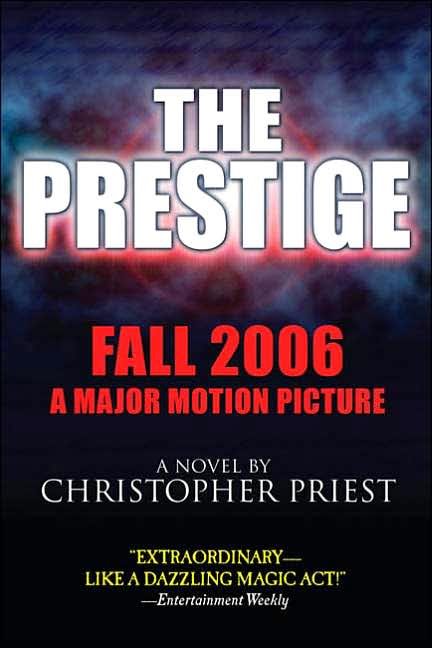
Ladies and Gents, this is now what constitutes as a book cover:
God in heaven, I thought it was an ARC ... Fantastic book; terrible cover.
I mean who wants to pass up on a normal tie-in edition, especially when the film boasts such easy-on-the-eye actors as Christian Bale and Hugh Jackman.
Read the book. Don't support this cover. Boring.
Monday, October 09, 2006
Hopped off the Autumn Reading Challenge slightly....
My Thanksgiving weekend reads:
Secrets from the Vinyl Cafe by the always excellent, Stuart McLean
The Constant Princess by Philippa Gregory ( okay, not classic literature, but so romantic and atmospheric and fun....and, most importantly, a quick read ).
Fairest by Gail Carson Levine ( I think her best in the past couple of years. I loved Dave at Night as well. It was my token YA novel of the week. As Ella Enchanted took a new angle at the Cinderella fable, so Fairest peeks into another more realistic side of Snow White. Loved Ijiro, the Prince ----but I also loved Char (of Ella Enchanted ) especially as personified by Hugh Dancy in the film version).
Starting Shackleton's Stowaway by Victoria McKernan.
Will read more but it is a holiday weekend, ducks, and I am busy living a social cornucopia of festive fun.
Secrets from the Vinyl Cafe by the always excellent, Stuart McLean
The Constant Princess by Philippa Gregory ( okay, not classic literature, but so romantic and atmospheric and fun....and, most importantly, a quick read ).
Fairest by Gail Carson Levine ( I think her best in the past couple of years. I loved Dave at Night as well. It was my token YA novel of the week. As Ella Enchanted took a new angle at the Cinderella fable, so Fairest peeks into another more realistic side of Snow White. Loved Ijiro, the Prince ----but I also loved Char (of Ella Enchanted ) especially as personified by Hugh Dancy in the film version).
Starting Shackleton's Stowaway by Victoria McKernan.
Will read more but it is a holiday weekend, ducks, and I am busy living a social cornucopia of festive fun.
Tuesday, October 03, 2006
Weekend Reads
I have read a ton recently, but have not been blogging about it. Bad me.
Anyhow, here's a list:
Gideon the Cutpurse --Linda Buckley Archer
The Thirteenth Tale - Diane Setterfield
The Strange Case of Dr. Jekyll and Mr. Hyde ---RL Stevenson
Frankenstein- Mary Shelley
Mirror Dreams --Catherine Webb
Mirror Wakes ---Catherine Webb
Kit's Law
Downhill Chance ---- Donna Morrissey ( by the way, Donna Morrisey is one of the most captivating authors I have discovered of late. We all know my passion for East Coast literature. It is well-founded here, I assure you ).
The Other Boleyn Girl -- Philippa Gregory ( I needed to read a token Gregory novel and it looks like I picked the right one. Dishy and fast paced, it reads well in first person. Not a masterpiece by any stretch, but a nice dollop of gossip from the court. In actuality, it just further drove the idea that women were all commodities and sexual pawns in the Tudor Court but, heck, they got to wear really pretty clothes ).
Angus, Thongs and Full-Frontal Snogging -- Louise Rennison. ( Bridget Jones for kids. It was my YA read of the week ).
Darcy's Story by Janet Aylmer ( Shut up! I know. You don't need to tell me. This is pathetic, really it is. But I love Mr. Darcy and I always promised myself I would read one Austen pastiche in my life....well, there it is. And I enjoyed it and got giggly and spit herbal tea out a couple of times ).
Anyhow, here's a list:
Gideon the Cutpurse --Linda Buckley Archer
The Thirteenth Tale - Diane Setterfield
The Strange Case of Dr. Jekyll and Mr. Hyde ---RL Stevenson
Frankenstein- Mary Shelley
Mirror Dreams --Catherine Webb
Mirror Wakes ---Catherine Webb
Kit's Law
Downhill Chance ---- Donna Morrissey ( by the way, Donna Morrisey is one of the most captivating authors I have discovered of late. We all know my passion for East Coast literature. It is well-founded here, I assure you ).
The Other Boleyn Girl -- Philippa Gregory ( I needed to read a token Gregory novel and it looks like I picked the right one. Dishy and fast paced, it reads well in first person. Not a masterpiece by any stretch, but a nice dollop of gossip from the court. In actuality, it just further drove the idea that women were all commodities and sexual pawns in the Tudor Court but, heck, they got to wear really pretty clothes ).
Angus, Thongs and Full-Frontal Snogging -- Louise Rennison. ( Bridget Jones for kids. It was my YA read of the week ).
Darcy's Story by Janet Aylmer ( Shut up! I know. You don't need to tell me. This is pathetic, really it is. But I love Mr. Darcy and I always promised myself I would read one Austen pastiche in my life....well, there it is. And I enjoyed it and got giggly and spit herbal tea out a couple of times ).
Friday, September 29, 2006
Gideon the Cutpurse vs. Montmorency by Eleanor Updale Round 1
Mid-Gideon the Cutpurse by the sort-of talented Linda Buckley-Archer, I am thrown into a fit of puzzlement.
Gideon has been extremely well advertised by the publisher. I mean, who didn't get a copy of the ARC in the Spring. Everyone got one !! I saw a couple of squirrells at Queen's Park reading them.
There are banners and posters and slip covers and booths dedicated to its glory at bookfairs and preview shows and I am wondering why, WHY is Gideon the YA book of the year. It certainly has had the best publicity of any new kids' novelist this past year and yet, it is not the best book I have read. The expectations were high. The bar was waaaaaaaaay up there * Melrose demonstratively draws line in air with finger* and the book is, well, erm... half way down.
See, kids, I have discovered some fantastic YA novelists this year. It being my guilty passion, I read a ton of it. And Gideon is lagging somewhat behind.
I have heard Gideon compared to the fantastic and breathtaking Montmorency series by Eleanor Updale. Updale is one of the few YA novelists who has really broken many of the rules. Her series is fresh and groundbreaking. I sell it to kids and adults alike. The reason being, Montmorency the Jekyll/Hyde-esque thief and gentleman is not a kid. Moreover, none of the other characters in the novels are. What a concept. To write a challenging and engaging series for kids that does not underestimate them;That expects them to reach her level. They are expected to keep up and move on.
Another exception to the rule is the beautiful novelist, Megan Whalen Turner, whose hero Eugenides has captured hearts of many in the gorgeously-woven Attolia series ( The King of Attolia being the most recent ). Turner's darkish character, Gen, spins a fresh thread of dual-nature. The politics undermining the duelling kingdoms is complex and illuminating. Kids can breeze through it for its fantastic adventure and creepy dark caverns and corners, yes, but they must have their thinking caps on. It is almost mythical..... a legendary fantasy set in a time not unlike how I picture ancient Greece.
Catherine Webb is a 2nd year history major at the University of London and already, at the meagre age of 19, has written a handful of fantasy books. Damned good fantasy books at that !The one that most captured my heart was The Extraordinary and Unusual Adventures of Horatio Lyle. Dr. Who meets Sherlock Holmes in this rollicking mystery set at the height of the Industrial Revolution. Webb is an atmospheric writer with a tongue-in-cheek turn of phrase and one of the best senses of humour I have read in a long time. Once again, Horatio Lyle is an adult star the children who help ( Thomas the young aristocrat and Tess the pickpocket) are yes, more than archetypal, but still figure as secondary characters. I am aching for the second installment( "The Obsidian Dagger" ) to reach my doorstep later this week ( godspeed chapters.ca!! )
So, with all of this outstanding ( and most importantly, literate ) YA stuff out there why are the publishers so attracted to this particular story?
Is it the time travel thing? ( ummm, think not !! Read the Fetch by CC Humphreys.... it has smoother transitions from the modern period to the age of the Vikings. Gideon's time-hops are clunky and awkward ).
Is it the historical aspect? Nope. There's tons out there. Even from the 18th Century.
Is it the boy/girl dynamic? I think we can all safely say that that has peaked in Meyer's blockbustering phenomenon Twilight and its sequel, New Moon.
Is it the character waning between good and evil ? Nope. Read Jonathan Stroud.
Is it the scar-faced villain? Ummm, the "tar man?" I should think no imaginative youngster is trembling in their boots. No hair is raised unsuspectingly on their arms. No spider-like tingle is crawling up the backs of their hairlines.
I am absolutely flabberghasted as to this fall's major kids' pick. There's no code to break, no style to start, no movie options. Why is this thing so huge?!!?
That being said, it is a mellow and entertaining novel, and Gideon ( the mysterious aristocrat/cutpurse ) of the title reads very much like Percy of the Scarlet Pimpernel ( read the long blonde queu and the engaging smile and the other "hidden" side).
But, as far as I can tell it is not worth this unprecedented acclaim. In fact, unless Buckley-Archer crams in a lot of explaining as to "why" the transported children hover phantom-like between past and present and "why" they were slipped through the sky to a field of yesteryear, then I will be a very sceptical reader.
What connections does this lady have ?
Read later on for why I think the same over-hype is perpetuated in the build-up to the Thirteenth Tale by Setterfield.
NOTE: I have just read the reviews for Gideon on amazon and have discovered that most good reviews come from adults who got advanced reader copies. Ironic.
Gideon has been extremely well advertised by the publisher. I mean, who didn't get a copy of the ARC in the Spring. Everyone got one !! I saw a couple of squirrells at Queen's Park reading them.
There are banners and posters and slip covers and booths dedicated to its glory at bookfairs and preview shows and I am wondering why, WHY is Gideon the YA book of the year. It certainly has had the best publicity of any new kids' novelist this past year and yet, it is not the best book I have read. The expectations were high. The bar was waaaaaaaaay up there * Melrose demonstratively draws line in air with finger* and the book is, well, erm... half way down.
See, kids, I have discovered some fantastic YA novelists this year. It being my guilty passion, I read a ton of it. And Gideon is lagging somewhat behind.
I have heard Gideon compared to the fantastic and breathtaking Montmorency series by Eleanor Updale. Updale is one of the few YA novelists who has really broken many of the rules. Her series is fresh and groundbreaking. I sell it to kids and adults alike. The reason being, Montmorency the Jekyll/Hyde-esque thief and gentleman is not a kid. Moreover, none of the other characters in the novels are. What a concept. To write a challenging and engaging series for kids that does not underestimate them;That expects them to reach her level. They are expected to keep up and move on.
Another exception to the rule is the beautiful novelist, Megan Whalen Turner, whose hero Eugenides has captured hearts of many in the gorgeously-woven Attolia series ( The King of Attolia being the most recent ). Turner's darkish character, Gen, spins a fresh thread of dual-nature. The politics undermining the duelling kingdoms is complex and illuminating. Kids can breeze through it for its fantastic adventure and creepy dark caverns and corners, yes, but they must have their thinking caps on. It is almost mythical..... a legendary fantasy set in a time not unlike how I picture ancient Greece.
Catherine Webb is a 2nd year history major at the University of London and already, at the meagre age of 19, has written a handful of fantasy books. Damned good fantasy books at that !The one that most captured my heart was The Extraordinary and Unusual Adventures of Horatio Lyle. Dr. Who meets Sherlock Holmes in this rollicking mystery set at the height of the Industrial Revolution. Webb is an atmospheric writer with a tongue-in-cheek turn of phrase and one of the best senses of humour I have read in a long time. Once again, Horatio Lyle is an adult star the children who help ( Thomas the young aristocrat and Tess the pickpocket) are yes, more than archetypal, but still figure as secondary characters. I am aching for the second installment( "The Obsidian Dagger" ) to reach my doorstep later this week ( godspeed chapters.ca!! )
So, with all of this outstanding ( and most importantly, literate ) YA stuff out there why are the publishers so attracted to this particular story?
Is it the time travel thing? ( ummm, think not !! Read the Fetch by CC Humphreys.... it has smoother transitions from the modern period to the age of the Vikings. Gideon's time-hops are clunky and awkward ).
Is it the historical aspect? Nope. There's tons out there. Even from the 18th Century.
Is it the boy/girl dynamic? I think we can all safely say that that has peaked in Meyer's blockbustering phenomenon Twilight and its sequel, New Moon.
Is it the character waning between good and evil ? Nope. Read Jonathan Stroud.
Is it the scar-faced villain? Ummm, the "tar man?" I should think no imaginative youngster is trembling in their boots. No hair is raised unsuspectingly on their arms. No spider-like tingle is crawling up the backs of their hairlines.
I am absolutely flabberghasted as to this fall's major kids' pick. There's no code to break, no style to start, no movie options. Why is this thing so huge?!!?
That being said, it is a mellow and entertaining novel, and Gideon ( the mysterious aristocrat/cutpurse ) of the title reads very much like Percy of the Scarlet Pimpernel ( read the long blonde queu and the engaging smile and the other "hidden" side).
But, as far as I can tell it is not worth this unprecedented acclaim. In fact, unless Buckley-Archer crams in a lot of explaining as to "why" the transported children hover phantom-like between past and present and "why" they were slipped through the sky to a field of yesteryear, then I will be a very sceptical reader.
What connections does this lady have ?
Read later on for why I think the same over-hype is perpetuated in the build-up to the Thirteenth Tale by Setterfield.
NOTE: I have just read the reviews for Gideon on amazon and have discovered that most good reviews come from adults who got advanced reader copies. Ironic.
Tuesday, September 26, 2006
Reading Challenge
most people are doing October reading challenges, pertaining to dark and dreary things.
I am making my own.
It's not actually a challenge because I am very excited about it, and some of the books I have read before, but we shall have gothic, cookies ! lots of gothic!
---Frankenstein by Mary Shelley
---Dracula by Bram Stoker
----the Obsidian Dagger by Catherine Webb
----The Naming of the Dead by Ian Rankin
----The Turn of the Screw by Henry James
---the Strange Case of Dr. Jekyll and Mr. Hyde by Robert Louis Stevenson
I am making my own.
It's not actually a challenge because I am very excited about it, and some of the books I have read before, but we shall have gothic, cookies ! lots of gothic!
---Frankenstein by Mary Shelley
---Dracula by Bram Stoker
----the Obsidian Dagger by Catherine Webb
----The Naming of the Dead by Ian Rankin
----The Turn of the Screw by Henry James
---the Strange Case of Dr. Jekyll and Mr. Hyde by Robert Louis Stevenson
Sunday, September 17, 2006
violence. violence.
I often hear movie-goers gripe about the amount of gratuitous violence saturating the films nowadays. There's gore, there's explicitly rendered scenes with people being riddled with bullets or sliced right open, and society does not always approve.
Though a different medium, I have often wondered how many lobby against violence in fiction. Should it not, in its imaginative realm, fixate the mind with more gruesome images when conjured in your own way?
My love for Harry Potter is only waylaid slightly by the amount of violence in it ( especially in the Goblet of Fire ) , people are murdered, Harry and Voldemort confront each other in a less than tame way, and children are shivering in their beds at night, unable to sleep. Could Rowling not evoke the same dark magical realm without the needless and long-drawn battle scenes that momentarily eclipse anything innocent or light in her stories?
While watching the crux of Goblet of Fire, Harry stalwartly brandishing Voldemort, wand in hand like sword, my cousin was so overwrought with fright she was almost incontrollable. She loves the books and the movies, but somehow that dismal part and the death of Harry's comrade that follows it, shake her to the bone. Should she then dismiss her love for Harry Potter merely because she is so frightened by, what I feel to be, overtly horrific scenes? Should we expect our younger readers to get over it merely because it is the trend in YA fantasy today? Should my cousin change and slip on a thicker skin, or should Rowling cater to her proven audience? She knows how young children are when they start her books (the peer pressure so taut, they open them younger and younger now, or parents read Philosopher's Stone aloud to their toddlers ), as the film producers know the demographic of their audience.
Children's Lit like Harry Potter is not the only problematic genre. My recent reading of Bryce Courtenay's excellently atmospheric novel, Tommo and Hawk, forced me to contempate the need of such explicitly graphic sequences. The brutal rape and beating of a six year old child ( while still in chapter one of the novel, I might add ), made me momentarily slam the book shut and close my eyes. How much is too much? Especially since readers are known to have such vivid imaginations? Courtenay's novel was soaked in graphic imagery. So much so, it often broke the narrative to the part of redundancy. I became immune, the shock value wore off.
CC Humphreys' Anne Boleyn-esque legend, The French Executioner, is no different. There are scenes in that book that haunt me still though it has been years since I read it. The violence did not enhance the plot. The author would probably argue that it was necessary for capturing the essence of the time, the injustice, the conflict, the brink of war.
I argue differently, as I shove Bryce Courtenay near Fr. Executioner on the shelves that contain my mass market books. Violence does not have to be necessary. It is as gratuitous in fiction as it can be in film. Images splashed ---whether across the eyes or the brain-- are equally potent to the imagination and the capsule of memory.
Consider an author such as Bernard Cornwell. His Sharpe series, though occasionally graphic, is one I often recommend to younger readers. Though possibly not as talented a writer as the two aforementioned, he certainly can capture his audience, AND ( most importantly ) Sharpe's rank-rising amidst the Peninsular wars, without the overly-described bloodshed I have found in other novels of late.
Though a different medium, I have often wondered how many lobby against violence in fiction. Should it not, in its imaginative realm, fixate the mind with more gruesome images when conjured in your own way?
My love for Harry Potter is only waylaid slightly by the amount of violence in it ( especially in the Goblet of Fire ) , people are murdered, Harry and Voldemort confront each other in a less than tame way, and children are shivering in their beds at night, unable to sleep. Could Rowling not evoke the same dark magical realm without the needless and long-drawn battle scenes that momentarily eclipse anything innocent or light in her stories?
While watching the crux of Goblet of Fire, Harry stalwartly brandishing Voldemort, wand in hand like sword, my cousin was so overwrought with fright she was almost incontrollable. She loves the books and the movies, but somehow that dismal part and the death of Harry's comrade that follows it, shake her to the bone. Should she then dismiss her love for Harry Potter merely because she is so frightened by, what I feel to be, overtly horrific scenes? Should we expect our younger readers to get over it merely because it is the trend in YA fantasy today? Should my cousin change and slip on a thicker skin, or should Rowling cater to her proven audience? She knows how young children are when they start her books (the peer pressure so taut, they open them younger and younger now, or parents read Philosopher's Stone aloud to their toddlers ), as the film producers know the demographic of their audience.
Children's Lit like Harry Potter is not the only problematic genre. My recent reading of Bryce Courtenay's excellently atmospheric novel, Tommo and Hawk, forced me to contempate the need of such explicitly graphic sequences. The brutal rape and beating of a six year old child ( while still in chapter one of the novel, I might add ), made me momentarily slam the book shut and close my eyes. How much is too much? Especially since readers are known to have such vivid imaginations? Courtenay's novel was soaked in graphic imagery. So much so, it often broke the narrative to the part of redundancy. I became immune, the shock value wore off.
CC Humphreys' Anne Boleyn-esque legend, The French Executioner, is no different. There are scenes in that book that haunt me still though it has been years since I read it. The violence did not enhance the plot. The author would probably argue that it was necessary for capturing the essence of the time, the injustice, the conflict, the brink of war.
I argue differently, as I shove Bryce Courtenay near Fr. Executioner on the shelves that contain my mass market books. Violence does not have to be necessary. It is as gratuitous in fiction as it can be in film. Images splashed ---whether across the eyes or the brain-- are equally potent to the imagination and the capsule of memory.
Consider an author such as Bernard Cornwell. His Sharpe series, though occasionally graphic, is one I often recommend to younger readers. Though possibly not as talented a writer as the two aforementioned, he certainly can capture his audience, AND ( most importantly ) Sharpe's rank-rising amidst the Peninsular wars, without the overly-described bloodshed I have found in other novels of late.
Saturday, September 16, 2006
"I'll Tell you a Secret" by Anne Coleman
This seems like the first "real" book I have read in ages; probably because it infused in me the profound awe I have when I read an author explicitly extraordinary. It is a well-spun classic, in my mind, and I am now very proud to spine it in the Canadian literature section of my personal library: ready for further examination on another weekend.
I have long had an obsession with the Canadian authors who I feel manifest the Golden Age of Canadian literature. The striving, seeking, finding kind most definitely subscribing to the school of my favourites: Leacock (back in Orillia, natch!! ) W.O. Mitchell ( rounding out the latter years ), Mavis Gallant, Robertson Davies ( the silver lining..... ) Hugh Maclennan and, of course, the indomitable Morley Callaghan.
Sometimes I think, in the case of Maclennan and Callaghan especially, that my admiration rises more from their representation of a literal "type" then the actual works they left behind. For example, I have always been far more smitten with the colloquial, yet unspoken language expressed through Callaghan's boxing gloves when he punched out Ernest Hemingway than I have with the colourful palette of his memoirs ( That Summer in Paris resonates most in that peerless climax figuring Hemingway and Callaghan's metaphoric battle ...which I read to be that of champion and defeated in the realm of Canadian/American literature ...while F. Scott Fitzgerald stands timidly by). If Callaghan encapsulates the binary world of Toronto the Great of the 20's and the Paris idolized by that "Moveable Feast" of Hemingway's circle, then surely MacLennan is ensconced in the marriage of writer and poetic prism a la Cape Breton Island and the determined miner's plight.
Both represent a type of collared world that holds such lasting significance to our bustling and changing Canadian realm of identity and mystique. We hold these figures steadfastly as we do our bilingual language, our colonial ties, our bloody win at the Soviet Game late 70's and our Olympic Gold Medals because they help us forge an identity writers like Will Ferguson and Alice Munro have been shoving at us to maintain for years.
Thus, my inclination toward Hugh McLennan as literary model as well as renowned author was fully realized in Anne Coleman's self-proclaimed "Memory of Seven Summers". The "secret" she evokes in her title is that of her lasting coming-of-age relationship with Hugh McLennan at the cottage resort town of North Hatley in Quebec.
The struggle of identity painted so vividly in McLennan's masterpiece, "Two Solitudes" is once again forked out Coleman's remembrance of Quebec in the 1950's. Amidst the cold war, the lasting Francophile and Anglophile conflicts and the changing patriarchal and parochial roles in the boarding school Anne attends and later at McGill, Anne fleshes out a tender relationship any fourteen year old girl with a passion for reading and an insatiable mind would die for.
Hugh McLennan becomes a sort of trinity: father, mentor and almost-lover, as Anne relates to us ( ellipses occuring when memory lapses ) the story of an eager young girl infatuated with a celebrity writer many years her senior.
The word" master" is often used: as becomes the diction of a girl so enveloped in the world of Jane Eyre she peeks all over for "Mrs. Rochesters" and molds her own story on its figurative counterparts in her favourite novel.
My liking for Hugh McLennan was not lessened by this odd ( and at times seemingly irrational and almost dishonourable ) relationship, yet heightened. Anne does not taunt us with a recount of some "Dynasty"-worthy spill-all. Instead, she threads out the bundled and bustling awkwardness of adolescent calamity. She invites us into her world and keeps us there. Our heart catches for her nearly-blossomed relationship and somewhat sinks when it doesn't quite evolve.
She pushes hard and teases and lures..... but that ending, the one you crave despite the inevitability of history, fate and time, keeps you staunchly( albeit wisely) at bay.
I have long had an obsession with the Canadian authors who I feel manifest the Golden Age of Canadian literature. The striving, seeking, finding kind most definitely subscribing to the school of my favourites: Leacock (back in Orillia, natch!! ) W.O. Mitchell ( rounding out the latter years ), Mavis Gallant, Robertson Davies ( the silver lining..... ) Hugh Maclennan and, of course, the indomitable Morley Callaghan.
Sometimes I think, in the case of Maclennan and Callaghan especially, that my admiration rises more from their representation of a literal "type" then the actual works they left behind. For example, I have always been far more smitten with the colloquial, yet unspoken language expressed through Callaghan's boxing gloves when he punched out Ernest Hemingway than I have with the colourful palette of his memoirs ( That Summer in Paris resonates most in that peerless climax figuring Hemingway and Callaghan's metaphoric battle ...which I read to be that of champion and defeated in the realm of Canadian/American literature ...while F. Scott Fitzgerald stands timidly by). If Callaghan encapsulates the binary world of Toronto the Great of the 20's and the Paris idolized by that "Moveable Feast" of Hemingway's circle, then surely MacLennan is ensconced in the marriage of writer and poetic prism a la Cape Breton Island and the determined miner's plight.
Both represent a type of collared world that holds such lasting significance to our bustling and changing Canadian realm of identity and mystique. We hold these figures steadfastly as we do our bilingual language, our colonial ties, our bloody win at the Soviet Game late 70's and our Olympic Gold Medals because they help us forge an identity writers like Will Ferguson and Alice Munro have been shoving at us to maintain for years.
Thus, my inclination toward Hugh McLennan as literary model as well as renowned author was fully realized in Anne Coleman's self-proclaimed "Memory of Seven Summers". The "secret" she evokes in her title is that of her lasting coming-of-age relationship with Hugh McLennan at the cottage resort town of North Hatley in Quebec.
The struggle of identity painted so vividly in McLennan's masterpiece, "Two Solitudes" is once again forked out Coleman's remembrance of Quebec in the 1950's. Amidst the cold war, the lasting Francophile and Anglophile conflicts and the changing patriarchal and parochial roles in the boarding school Anne attends and later at McGill, Anne fleshes out a tender relationship any fourteen year old girl with a passion for reading and an insatiable mind would die for.
Hugh McLennan becomes a sort of trinity: father, mentor and almost-lover, as Anne relates to us ( ellipses occuring when memory lapses ) the story of an eager young girl infatuated with a celebrity writer many years her senior.
The word" master" is often used: as becomes the diction of a girl so enveloped in the world of Jane Eyre she peeks all over for "Mrs. Rochesters" and molds her own story on its figurative counterparts in her favourite novel.
My liking for Hugh McLennan was not lessened by this odd ( and at times seemingly irrational and almost dishonourable ) relationship, yet heightened. Anne does not taunt us with a recount of some "Dynasty"-worthy spill-all. Instead, she threads out the bundled and bustling awkwardness of adolescent calamity. She invites us into her world and keeps us there. Our heart catches for her nearly-blossomed relationship and somewhat sinks when it doesn't quite evolve.
She pushes hard and teases and lures..... but that ending, the one you crave despite the inevitability of history, fate and time, keeps you staunchly( albeit wisely) at bay.
Thursday, September 14, 2006
The Mermaid Chair by Sue Monk Kidd
oh my god it's the Thorn Birds!!! ( except it's in America).
Our heroine ( a sort of Kate Chopin's Awakening type for the millenium ) travels to an island off of South Caroline where spiritualism and eroticism combine in the form of a sexy, ascetic Benedictine Monk.
So, there's lots of brooding and steamy glances and some good descriptions of a historic chair which serves as the hub of the combined Higher and comparitively lower and lustful world.
Whatever. It's all entertaining for lunch breaks at Mariposa Market but a far cry from a real emotional tweaker like The Awakening.
For instance, our heroine returns to the pretty island of her childhood because her mother purposely chopped off her finger with a machete and is now deemed psychologically deranged because she keeps it in a mayonnaise jar beside her bed.
( that's right Sue Monk Kidd, you keep those psychological shockers coming ! )
There's the stock lot: the mentally inept Benne who understands the town's adopted dog, the godmother, Kat; who serves as pendulum between Jessie and finger-decapitated mom and Mage, and a lot full of other eccentrics ( including Mr. Smouldery Richard-Chamberlain-in-waiting) and the poor, desolate husband at home ( who, incidentally, happens to be a psychiatrist).
But the water and rebirth motif is in full form and everyone is liberated and off on pilgrimages. Oooooo eeeee!
And, yet another bookclub perennial and New York Times Bestseller, well-reviewed by Publisher's Weekly gets ticked off of my list..... with another grizzly yawn.
Our heroine ( a sort of Kate Chopin's Awakening type for the millenium ) travels to an island off of South Caroline where spiritualism and eroticism combine in the form of a sexy, ascetic Benedictine Monk.
So, there's lots of brooding and steamy glances and some good descriptions of a historic chair which serves as the hub of the combined Higher and comparitively lower and lustful world.
Whatever. It's all entertaining for lunch breaks at Mariposa Market but a far cry from a real emotional tweaker like The Awakening.
For instance, our heroine returns to the pretty island of her childhood because her mother purposely chopped off her finger with a machete and is now deemed psychologically deranged because she keeps it in a mayonnaise jar beside her bed.
( that's right Sue Monk Kidd, you keep those psychological shockers coming ! )
There's the stock lot: the mentally inept Benne who understands the town's adopted dog, the godmother, Kat; who serves as pendulum between Jessie and finger-decapitated mom and Mage, and a lot full of other eccentrics ( including Mr. Smouldery Richard-Chamberlain-in-waiting) and the poor, desolate husband at home ( who, incidentally, happens to be a psychiatrist).
But the water and rebirth motif is in full form and everyone is liberated and off on pilgrimages. Oooooo eeeee!
And, yet another bookclub perennial and New York Times Bestseller, well-reviewed by Publisher's Weekly gets ticked off of my list..... with another grizzly yawn.
Sunday, September 10, 2006
books.
Who says that the internet is an impersonal, automaton, non-entity? They are wrong, I tell you, WRONG!!
Some good duck I met on LJ sent me a slew of Lisa Samson titles this week. And, as a follow-up to the worthy Songbird, I was equally impressed with Straight Up and Club Sandwich.
My favourite of the lot so far is Tiger Lillie; about a ( and I quote her ) "Strong Hungarian" singleton who co-ordinates extreme weddings in the Baltimore area. The daughter of an Episcopalian "priest" ( not preacher, she adamantly informs us ), her narrative intersperses her logs of theology and faith. As I am learning is customary with Samson's well-written first narrative ( YAY!... we all know how I hate a badly written first-person ), elements of faith and the prospective hypocrisy of Christianizing the world through organized religion play through.
I enjoyed some of the literary (natch! ) parallels between the carefully constructed episcopalian world of Lillie's blind father and that of her brother-in-law's dictating, cultish, Scientology-like religion founded under the perverse and power hungry con, Alban Cole.
At times violent, disturbing and challenging, Lisa Samson deals with things I thought long hushed in the strict CBA. For example, the unpracticed homosexuality of Lillie's best friend Gilbert, the sexual awakening of Lillie's younger sister Tacy, the saturation of secular "pop-culture" idiosyncrasies, the loose and liberal language and mostly the round-table discussion housing both sides of the "free will" debate.
Samson is definitely fresh and unusual in today's Christian market. She seems to single-handedly redeem so much of what is wrong in its nature and conservative safe-place.
I yearn to rise up onto my soapbox and proclaim "Fear not worthy, intelligent Christian reader!! Though shalt not be subjected to Gilbert Morris and Janette Oke for the rest of time."
I think the face of Christian publishing is slowly revolving. I like to think Dale Cramer is the pioneer of resuscitation when it comes to the refurbishing of the Christian literary world, but I see now I have to include Samson's powerful, pseudo-feministic sprawls as well. She definitely holds her gutsy own.
In Brett Lott's A Song I knew by Heart, I was thrilled to find more than a thread of my favourite story of the Bible: that of Ruth. The aged Naomi and her recently widowed daughter-in-law travel statewide to settle in the South of Naomi's past. Here plenty of skeletons pop out of her seemingly pure closet. With a mixture of heartbreak and subtle grace, I was delighted to find the parallels between the scripture I so love ( that Boaz is just the bomb!!) and a gentleman author who fits nicely in the hub of the Oprah-lore of the past decade.
In kid's lit, I explored the tasty travails of Emmaline Cayley, pioneering aviatrix and her rapscallion, often airborne guinea pig Robert Burns in The Strictest School in the World by Howard Whitehouse Deliciously illustrated and with hilarious captions, this book reads like Lemony Snicket out of Wackford Squeers ( the totalitarian despot disguised as a schoolmaster in the treacherous sequences of "Nicholas Nickleby" ) Emmaline takes flight.... it's charming, fantastical and humorous. Highly recommended to those who share my passion for the neo-Victorianized fantasy world of Horatio Lyle.
The Book without Words by Avi was quite a different experience than the Crispin books I had recently read and loved. Pure fable, Avi teaches his young readers about the power of proverb and parallel. The story of Sybil, Odo the raven and a treacherous alchemist swearing the secret to spinning gold is filled with dramatic irony, creepy foreshadows and spine-tingling terror. Avi's prose is sparse: but decidedly clever words help paint an ambiance that would chill even the most stalwart of readers.
Avi excels in his archaic worlds and this particular fairytale is no exception. His powers often seem limitless.
Some good duck I met on LJ sent me a slew of Lisa Samson titles this week. And, as a follow-up to the worthy Songbird, I was equally impressed with Straight Up and Club Sandwich.
My favourite of the lot so far is Tiger Lillie; about a ( and I quote her ) "Strong Hungarian" singleton who co-ordinates extreme weddings in the Baltimore area. The daughter of an Episcopalian "priest" ( not preacher, she adamantly informs us ), her narrative intersperses her logs of theology and faith. As I am learning is customary with Samson's well-written first narrative ( YAY!... we all know how I hate a badly written first-person ), elements of faith and the prospective hypocrisy of Christianizing the world through organized religion play through.
I enjoyed some of the literary (natch! ) parallels between the carefully constructed episcopalian world of Lillie's blind father and that of her brother-in-law's dictating, cultish, Scientology-like religion founded under the perverse and power hungry con, Alban Cole.
At times violent, disturbing and challenging, Lisa Samson deals with things I thought long hushed in the strict CBA. For example, the unpracticed homosexuality of Lillie's best friend Gilbert, the sexual awakening of Lillie's younger sister Tacy, the saturation of secular "pop-culture" idiosyncrasies, the loose and liberal language and mostly the round-table discussion housing both sides of the "free will" debate.
Samson is definitely fresh and unusual in today's Christian market. She seems to single-handedly redeem so much of what is wrong in its nature and conservative safe-place.
I yearn to rise up onto my soapbox and proclaim "Fear not worthy, intelligent Christian reader!! Though shalt not be subjected to Gilbert Morris and Janette Oke for the rest of time."
I think the face of Christian publishing is slowly revolving. I like to think Dale Cramer is the pioneer of resuscitation when it comes to the refurbishing of the Christian literary world, but I see now I have to include Samson's powerful, pseudo-feministic sprawls as well. She definitely holds her gutsy own.
In Brett Lott's A Song I knew by Heart, I was thrilled to find more than a thread of my favourite story of the Bible: that of Ruth. The aged Naomi and her recently widowed daughter-in-law travel statewide to settle in the South of Naomi's past. Here plenty of skeletons pop out of her seemingly pure closet. With a mixture of heartbreak and subtle grace, I was delighted to find the parallels between the scripture I so love ( that Boaz is just the bomb!!) and a gentleman author who fits nicely in the hub of the Oprah-lore of the past decade.
In kid's lit, I explored the tasty travails of Emmaline Cayley, pioneering aviatrix and her rapscallion, often airborne guinea pig Robert Burns in The Strictest School in the World by Howard Whitehouse Deliciously illustrated and with hilarious captions, this book reads like Lemony Snicket out of Wackford Squeers ( the totalitarian despot disguised as a schoolmaster in the treacherous sequences of "Nicholas Nickleby" ) Emmaline takes flight.... it's charming, fantastical and humorous. Highly recommended to those who share my passion for the neo-Victorianized fantasy world of Horatio Lyle.
The Book without Words by Avi was quite a different experience than the Crispin books I had recently read and loved. Pure fable, Avi teaches his young readers about the power of proverb and parallel. The story of Sybil, Odo the raven and a treacherous alchemist swearing the secret to spinning gold is filled with dramatic irony, creepy foreshadows and spine-tingling terror. Avi's prose is sparse: but decidedly clever words help paint an ambiance that would chill even the most stalwart of readers.
Avi excels in his archaic worlds and this particular fairytale is no exception. His powers often seem limitless.
Thursday, September 07, 2006
"I, Coriander" by Sally Gardner
This book intrigued me because it received so many fantastic reviews. Not to mention, it gobbled up many children's literary prizes.
Coriander's story reads like a fairytale: her birth mother seems to have one foot steeped in the land of mystical magic ( think the rule of Oberon in "A Midsummer Night's Dream" ) and the other planted firmly as the mistress of a wealthy home in London..... tantalizingly near the bridge.
The Cromwell rebellion strikes and soon Coriander's world ( and that of her mythical mother's ) seems to slide downward.
Once an epoch in her young life, the discovery and testing of a pair of silver shoes is far too soon the crux between an enchanted world and one of realism, devastation and despair. Coriander loses all that she holds dear while , paradoxically, the land she so loves is overtaken by war and plague.
Balancing a world full of magic against the puritanical reignings of two new locals, Gardner sets Coriander midplace in two drastically different spheres.
I was much taken by Mr. Thankless ( the aptly named tailor ) and his shy apprentice, Gabriel. Not to mention the role of the effervescent "Puck"- type character, here fleshed out in the noble Tycho.
Gardner's prose is outstanding, liquid, moving.... her worlds taut and tangible.
I only wish this stellar book had developed more of one side of Coriander's life.
Read it for yourself and find out why.
Coriander's story reads like a fairytale: her birth mother seems to have one foot steeped in the land of mystical magic ( think the rule of Oberon in "A Midsummer Night's Dream" ) and the other planted firmly as the mistress of a wealthy home in London..... tantalizingly near the bridge.
The Cromwell rebellion strikes and soon Coriander's world ( and that of her mythical mother's ) seems to slide downward.
Once an epoch in her young life, the discovery and testing of a pair of silver shoes is far too soon the crux between an enchanted world and one of realism, devastation and despair. Coriander loses all that she holds dear while , paradoxically, the land she so loves is overtaken by war and plague.
Balancing a world full of magic against the puritanical reignings of two new locals, Gardner sets Coriander midplace in two drastically different spheres.
I was much taken by Mr. Thankless ( the aptly named tailor ) and his shy apprentice, Gabriel. Not to mention the role of the effervescent "Puck"- type character, here fleshed out in the noble Tycho.
Gardner's prose is outstanding, liquid, moving.... her worlds taut and tangible.
I only wish this stellar book had developed more of one side of Coriander's life.
Read it for yourself and find out why.
Monday, September 04, 2006
"Songbird" by Lisa Samson
This is one of the edgiest and most riveting of the Christian fic fare I have ever read. Not since Dale Cramer's debut have I been so impressed by an author boasting faith in their novels. A highly-flawed character, Charmaine Hopewell adds a humane and relative voice to the world of derelict despair she finds throughout her Southern life.
The atmosphere and dialect read like Billie Letts meets Faulkner. The deep integration of characters into the piece reminded me somewhat of John Irving.
I was thoroughly impressed with Samson's gutsy rhetoric. This story----with its sin and long-time-in-finding redemption ---points the finger at some of the less tangible strains of evangelism: the reliance on the promise of God over medication, the scandalous surroundings of televised programs and their subsequent revivals ( mostly those in the mid-80's with the surge of retreats and resorts a la PTL).
Our focal couple, Charmaine and Harlan, remain the groundwork for a sometimes unbelievable whirlwind of hypocrisy, doubt and selfishness.
This " on the road" novel dips and dives in places I never expected it too. Though it lacks some of Cramer's subtlety, it has a much-needed literate slant that continues to evade so many in the marketplace.
I will definitely read more from her.
The atmosphere and dialect read like Billie Letts meets Faulkner. The deep integration of characters into the piece reminded me somewhat of John Irving.
I was thoroughly impressed with Samson's gutsy rhetoric. This story----with its sin and long-time-in-finding redemption ---points the finger at some of the less tangible strains of evangelism: the reliance on the promise of God over medication, the scandalous surroundings of televised programs and their subsequent revivals ( mostly those in the mid-80's with the surge of retreats and resorts a la PTL).
Our focal couple, Charmaine and Harlan, remain the groundwork for a sometimes unbelievable whirlwind of hypocrisy, doubt and selfishness.
This " on the road" novel dips and dives in places I never expected it too. Though it lacks some of Cramer's subtlety, it has a much-needed literate slant that continues to evade so many in the marketplace.
I will definitely read more from her.
Thursday, August 31, 2006
"Goodnight Nobody" by Jennifer Wiener
Sometimes, if I feel I HAVE to read a chicklit just to feel like I still belong to the female populus, I will only read Jennifer Weiner or Marian Keyes ( the two chicklit writers with brains ).
This book was long, occasionally funny but convoluted. If I had read it in one sitting on the beach instead of over a series of nights before dozing, I would have thought differently. Weiner is a good writer though. Probably the best of the American lot of her genre.
I am too tired to talk about it.Hopefully this weekend I can catch you all up on the five or so books I have read in the past week..... ones worthy of a little more speculation.
This book was long, occasionally funny but convoluted. If I had read it in one sitting on the beach instead of over a series of nights before dozing, I would have thought differently. Weiner is a good writer though. Probably the best of the American lot of her genre.
I am too tired to talk about it.Hopefully this weekend I can catch you all up on the five or so books I have read in the past week..... ones worthy of a little more speculation.
Saturday, August 26, 2006
Sheer Brilliance....
I cannot escape the beautifully literate and folklore-laden Bartimaeus Trilogy by Jonathan
Stroud.
Makes Harry Potter look more than pale in comparison!
Squeal!!
Stroud.
Makes Harry Potter look more than pale in comparison!
Squeal!!
Tuesday, August 22, 2006
Ahoy Cornwellians!!!
Go check out the site to the new Sharpe film!!
I have been a Sharpeaholic for many moons now and my excitement over the release of the new book Sharpe's Fury is only countered by this .............
Long Live Patrick Harper !
I have been a Sharpeaholic for many moons now and my excitement over the release of the new book Sharpe's Fury is only countered by this .............
Long Live Patrick Harper !
Friday, August 18, 2006
I took forever to get to this tag:
1. One book that Changed Your Life---
There's two actually; a.) Les Miserables by Victor Hugo. When I was in grade eight, I dropped whatever installment of the Fear Street Saga I was indugled in and opened this puppy. It remains the most influential of my life. I devoured it: the themes, the wisdom, the interspersed poetry, Hugo's turn of phrase, the characters most of all. 1800 pages later, I was sure that there had to be another book just as powerful and captivating. Forsaking RL Stine for the rest of my life, I associated Les Miserables ( thus splendour ) with the 19th Century. I read Austen and Dickens and Hardy and Twain and Doyle from that point onward. The Brontes and Hawthorne and Thackeray. My love for the Victorians was born at 14 thanks to Hugo and a convict who snatches candlesticks from a well-meaning bishop. It's the sole reason I went into Lit at University, won the grade eight English award and scored the highest mark in English in high school, not to mention my love and fervour for the English programme at the University of Toronto ( where I just finished a five year specialist degree in the self same period ). So, I am the geeky bookworm born a century-to-late because of Hugo.
b.) The Blue Castle by LM Montgomery
I maintain this is the first work of female emancipations literature to come out of Canada. A prudish, self-conscious minister's daughter in a small, judgmental and suppressive town, this book showed me a heroine who was brave enough to be everything I was not. I read it in the last semester of high school. Listlessly, chin-in-hand, burrowed in University applications and ready to take, like Valancy our title character, the biggest plunge in my life. It set a surge of lightning through me---presented a character and life I related to. Once finished, I immediately spun back to page one and started all over again. I now know it by heart and wrote my senior thesis on LM Montgomery ( primarily the Blue Castle ) as the purest example of a life vicariously lived through fiction.
2.) one book you wish that you had written:
As a little duck, I idolized Sherlock Holmes ( who am I kidding, I still do ). I pretended I was the Master and connecting the proverbial dots I saw murder and mayhem everywhere in miniscule Orillia. One re-read mid-canon on a stormy winter's night, I admitted I would have loved Doyle's brilliance. I could never stay one step ahead of Holmes. Sick of lagging behind, I felt had I written Sherlock Holmes I would have the ultimate in first-hand knowledge. I would never need to worry about solving a mystery again.
The green eyes of envy also flash brightly when I appreciate the glory of a well-turned YA novel. Mostly because it is the genre I wish to personally dabble my creative mind in. " I wish I had been onto that!" sighs my brain: "That" usually encapsulates Anthony Horowitz, Catherine Webb for the wonderful " Horatio Lyle", Avi, Hilary McKay, Gordon Korman, Eleanor Updale.....sooo sooo many.
3. One book you wish had never been written:
Need you ask? The Bloody Da Vinci Code!! It has been sponging the brain cells out of many unsuspecting readers since March 2002. Hate the pulpy prose, hate the italics, hate the hyperbole, the hype... it's trash in the purest form. A bad Patterson spin-off someone misread as a piece of art. No thought, nor creed no literary spin is worthy of its atrocious acclaim. Drop this purile Blockbuster and read a real book. Or, atleast, admit it is two beach towels on the wrong side of Robert Ludlum and abashedly hide it in a book cover.
4.) One book that you'd want on a desert island:
"Villette" by Charlotte Bronte ( it is my panic-attack, calm-down book ). " A Connecticut Yankee in King Arthur's Court" by Mark Twain.... any Twain for that matter, "Prince and the Pauper" is a favourite, " anything by Martha Grimes
5.) One book that made you cry:
" I Capture the Castle" by Dodie Smith, "Night" by Elie Wiesel. I'm a friggin' sap. I cried when Lord Peter got trapped in the bell tower in Sayers' " The Nine Tailors.", "On Beulah Height" by Reginald Hill ( when Rosie Pascoe is in the hospital with meningitis... it killed me! killed me ! )
6.) One book that made you laugh:
I have my perennial favourites: Mark Twain, W.O. Mitchell's "According to Jake and the Kid", Gordon Korman, Martha Grimes ( there are brilliant moments in the Stargazey, the Blue Last and the Grave Maurice.... I loove her !! ) and the Blooding of Jack Absolute by CC Humphreys. I have to gasp for air when I read this. My sides split. Ate is too funny; quoting his " infernal Hamlet."
7.) One book that you're currently reading:
the Bartimaeus Trilogy by Jonathan Stroud
"A Song I Knew by Heart" by Brett Lott
"Lighthousekeeping" by Jeannette Winterson
8.) One book that you've been meaning to read:
The Wreckage by Michael Crummey
Never Let me Go by Kazuo Ishiguro
There's two actually; a.) Les Miserables by Victor Hugo. When I was in grade eight, I dropped whatever installment of the Fear Street Saga I was indugled in and opened this puppy. It remains the most influential of my life. I devoured it: the themes, the wisdom, the interspersed poetry, Hugo's turn of phrase, the characters most of all. 1800 pages later, I was sure that there had to be another book just as powerful and captivating. Forsaking RL Stine for the rest of my life, I associated Les Miserables ( thus splendour ) with the 19th Century. I read Austen and Dickens and Hardy and Twain and Doyle from that point onward. The Brontes and Hawthorne and Thackeray. My love for the Victorians was born at 14 thanks to Hugo and a convict who snatches candlesticks from a well-meaning bishop. It's the sole reason I went into Lit at University, won the grade eight English award and scored the highest mark in English in high school, not to mention my love and fervour for the English programme at the University of Toronto ( where I just finished a five year specialist degree in the self same period ). So, I am the geeky bookworm born a century-to-late because of Hugo.
b.) The Blue Castle by LM Montgomery
I maintain this is the first work of female emancipations literature to come out of Canada. A prudish, self-conscious minister's daughter in a small, judgmental and suppressive town, this book showed me a heroine who was brave enough to be everything I was not. I read it in the last semester of high school. Listlessly, chin-in-hand, burrowed in University applications and ready to take, like Valancy our title character, the biggest plunge in my life. It set a surge of lightning through me---presented a character and life I related to. Once finished, I immediately spun back to page one and started all over again. I now know it by heart and wrote my senior thesis on LM Montgomery ( primarily the Blue Castle ) as the purest example of a life vicariously lived through fiction.
2.) one book you wish that you had written:
As a little duck, I idolized Sherlock Holmes ( who am I kidding, I still do ). I pretended I was the Master and connecting the proverbial dots I saw murder and mayhem everywhere in miniscule Orillia. One re-read mid-canon on a stormy winter's night, I admitted I would have loved Doyle's brilliance. I could never stay one step ahead of Holmes. Sick of lagging behind, I felt had I written Sherlock Holmes I would have the ultimate in first-hand knowledge. I would never need to worry about solving a mystery again.
The green eyes of envy also flash brightly when I appreciate the glory of a well-turned YA novel. Mostly because it is the genre I wish to personally dabble my creative mind in. " I wish I had been onto that!" sighs my brain: "That" usually encapsulates Anthony Horowitz, Catherine Webb for the wonderful " Horatio Lyle", Avi, Hilary McKay, Gordon Korman, Eleanor Updale.....sooo sooo many.
3. One book you wish had never been written:
Need you ask? The Bloody Da Vinci Code!! It has been sponging the brain cells out of many unsuspecting readers since March 2002. Hate the pulpy prose, hate the italics, hate the hyperbole, the hype... it's trash in the purest form. A bad Patterson spin-off someone misread as a piece of art. No thought, nor creed no literary spin is worthy of its atrocious acclaim. Drop this purile Blockbuster and read a real book. Or, atleast, admit it is two beach towels on the wrong side of Robert Ludlum and abashedly hide it in a book cover.
4.) One book that you'd want on a desert island:
"Villette" by Charlotte Bronte ( it is my panic-attack, calm-down book ). " A Connecticut Yankee in King Arthur's Court" by Mark Twain.... any Twain for that matter, "Prince and the Pauper" is a favourite, " anything by Martha Grimes
5.) One book that made you cry:
" I Capture the Castle" by Dodie Smith, "Night" by Elie Wiesel. I'm a friggin' sap. I cried when Lord Peter got trapped in the bell tower in Sayers' " The Nine Tailors.", "On Beulah Height" by Reginald Hill ( when Rosie Pascoe is in the hospital with meningitis... it killed me! killed me ! )
6.) One book that made you laugh:
I have my perennial favourites: Mark Twain, W.O. Mitchell's "According to Jake and the Kid", Gordon Korman, Martha Grimes ( there are brilliant moments in the Stargazey, the Blue Last and the Grave Maurice.... I loove her !! ) and the Blooding of Jack Absolute by CC Humphreys. I have to gasp for air when I read this. My sides split. Ate is too funny; quoting his " infernal Hamlet."
7.) One book that you're currently reading:
the Bartimaeus Trilogy by Jonathan Stroud
"A Song I Knew by Heart" by Brett Lott
"Lighthousekeeping" by Jeannette Winterson
8.) One book that you've been meaning to read:
The Wreckage by Michael Crummey
Never Let me Go by Kazuo Ishiguro
Thursday, August 17, 2006
Crispin at the Edge of the World by Avi
This book came in a month earlier than I anticipated as per what my pre-order date read. I loved the Newberry winning first instalment, "Crispin: The Cross of Lead", and was eagerly awaiting the next two volumes in the supposed trilogy.
Avi is the kind of writer ( specifically in the Crispin books ) that proves YA authors and childrens authors often have a more treacherous task and are required to be more openly resilient than certain adult authors. If anyone ever doubted that children's writing was a serious art craft, well, Avi proves them otherwise. He is a wordsmith of the first degree and paints a beautiful, medieval landscape. His prose is scintillating. Though often distilled and acute to make it clear for his age group demographic ( and perhaps to loan itself to oral recitation), Avi is a splendid writer. I kept hanging on his words.
His pacing is also wonderful; which is one of the most difficult tasks I think a YA author must undertake.
Despite its literate beauty and historical interest, this was a rather depressing way to glue two framing books together. It didn't end on a cliffhanger, but on a death.
As to the characters, Crispin remains a sprite and intriguing narrator. Avi centers more on the coming-of-age story backdropping the front conflict and I was eager to learn more about Crispin's desire to be a "man" as he watches Bear ( the guardian/minstrel he met and hooked up with in volume 1 ) in a new context. Crispin learns more and more about his mentor and becomes unsure as to whether life ( and people, for that matter ) can be shelved in the extremity of black or white. The current war they find in ravaged Rye, and the wars that Bear fought in previously cause Bear to remember a less than happy past.
Bear, the monstrous, redheaded, humorous oaf never fully recovers his spry spirit ( think the Ghost of Christmas Present ) after his bout in a prison at the end of "Cross of Lead." As such, Avi completely ruled out humour because we are sure as heck were not going to derive it from Crispin ( too serious ) or Troth ( too scared ).
Troth is a character who joins their band in this volume. And it was interesting to watch her character progress alongside Crispin's. She has a harelip ( think Precious Bane ! ) and introduces a folkloric, pagan tradition to the otherwise heavily-steeped Christian forefront of Avi's tale.
This book despite its beautiful prose and steafast plot, left me feeling empty. Perhaps because it was so melancholic. I realize the conflict of the late 14th Century lends itself to such scrutiny, but nonetheless, I kept hankering for the first " Crispin": the lighthearted one with the dodging of arrows and the traveling from town-to-town with offers of a song and dance.
As such, immediately after finishing " Edge of the World", I picked up the first one again for another roll.
Avi is the kind of writer ( specifically in the Crispin books ) that proves YA authors and childrens authors often have a more treacherous task and are required to be more openly resilient than certain adult authors. If anyone ever doubted that children's writing was a serious art craft, well, Avi proves them otherwise. He is a wordsmith of the first degree and paints a beautiful, medieval landscape. His prose is scintillating. Though often distilled and acute to make it clear for his age group demographic ( and perhaps to loan itself to oral recitation), Avi is a splendid writer. I kept hanging on his words.
His pacing is also wonderful; which is one of the most difficult tasks I think a YA author must undertake.
Despite its literate beauty and historical interest, this was a rather depressing way to glue two framing books together. It didn't end on a cliffhanger, but on a death.
As to the characters, Crispin remains a sprite and intriguing narrator. Avi centers more on the coming-of-age story backdropping the front conflict and I was eager to learn more about Crispin's desire to be a "man" as he watches Bear ( the guardian/minstrel he met and hooked up with in volume 1 ) in a new context. Crispin learns more and more about his mentor and becomes unsure as to whether life ( and people, for that matter ) can be shelved in the extremity of black or white. The current war they find in ravaged Rye, and the wars that Bear fought in previously cause Bear to remember a less than happy past.
Bear, the monstrous, redheaded, humorous oaf never fully recovers his spry spirit ( think the Ghost of Christmas Present ) after his bout in a prison at the end of "Cross of Lead." As such, Avi completely ruled out humour because we are sure as heck were not going to derive it from Crispin ( too serious ) or Troth ( too scared ).
Troth is a character who joins their band in this volume. And it was interesting to watch her character progress alongside Crispin's. She has a harelip ( think Precious Bane ! ) and introduces a folkloric, pagan tradition to the otherwise heavily-steeped Christian forefront of Avi's tale.
This book despite its beautiful prose and steafast plot, left me feeling empty. Perhaps because it was so melancholic. I realize the conflict of the late 14th Century lends itself to such scrutiny, but nonetheless, I kept hankering for the first " Crispin": the lighthearted one with the dodging of arrows and the traveling from town-to-town with offers of a song and dance.
As such, immediately after finishing " Edge of the World", I picked up the first one again for another roll.
Monday, August 14, 2006
Erm....loved this.
Horatio Lyle writer Catherine Webb in an interview.
Thank god I preorder the Obsidian Dagger. Should be here in a couple of weeks. *GRIN*
Thank god I preorder the Obsidian Dagger. Should be here in a couple of weeks. *GRIN*
Booker long list
Yes we read the Waters, the Mitchell, the Unsworth.
Must we read more?
Screw you highbrow literary world, gimme more Bartimeaus trilogy.
*winks*
Must we read more?
Screw you highbrow literary world, gimme more Bartimeaus trilogy.
*winks*
on my night table
--- The Fetch by Chris Humphreys
---Trickster's Queen by Tamora Pierce
---Before Scarlett: Juvenalia of Margaret Mitchell
---The Birth House by Ami McKay
----Lighthousekeeping by Jeannette Winterson
---The Extraordinary and Unusual Adventures of Horatio Lyle by Catherine Webb *GRIIIN!*
On a Lyle note:I have a tendency to lapse back into books and not be able to leave them for awhile. I am rather like LM Montgomery in a way. After she read The Prisoner of Zenda for the first time, she said everything else tasted bland for weeks afterward and she could only inhabit Hope's fantastical, regal realm. This is me and Horatio Lyle ( as cheesy as that sounds ). I just love it. I love the banter, the rapport, the cute narrative tricks ( they really are like pulling a rabbit out of a hat).I will finish The Fetch by the end of this week. I will. I will. I have been picking it up and putting it down for over a month now. GARRR !
---Trickster's Queen by Tamora Pierce
---Before Scarlett: Juvenalia of Margaret Mitchell
---The Birth House by Ami McKay
----Lighthousekeeping by Jeannette Winterson
---The Extraordinary and Unusual Adventures of Horatio Lyle by Catherine Webb *GRIIIN!*
On a Lyle note:I have a tendency to lapse back into books and not be able to leave them for awhile. I am rather like LM Montgomery in a way. After she read The Prisoner of Zenda for the first time, she said everything else tasted bland for weeks afterward and she could only inhabit Hope's fantastical, regal realm. This is me and Horatio Lyle ( as cheesy as that sounds ). I just love it. I love the banter, the rapport, the cute narrative tricks ( they really are like pulling a rabbit out of a hat).I will finish The Fetch by the end of this week. I will. I will. I have been picking it up and putting it down for over a month now. GARRR !
Tuesday, August 08, 2006
Carolan's Farewell by Charles Foran
I have been meaning to read this book for a long while. The cover intrigued me; a Don Quixotic tale unravelling the relationship between a blind man and his Sancho Panza, set in Ireland in the 18th Century; the lore of a real harpist whose history is surrounded by as much enigma as the tunes he wrote.
I was most taken by the narrative form Foran used to weave his tale. In almost mythic proportion, the first half focuses on the aging Carolan, a celebrity harpist who is making one redeeming pilgrimage before the end of his life. Carolan and his best friend and guide, Owen Connor, traipse through the countryside and encounter many locals from sheriffs to paupers, all spun under the magic of Carolan's infamous spell.
The setting lends for a grisly and crude scope into the world of a bygone era of famine and despair.
The second half of the story focuses on Owen Connor, Carolan's much younger guide, his budding relationship with the scullery maid Annie, his desire to rise above his lesser position, and the trouble he encounters for stealing books the prove food for his voracious mind.
The disintegration of Carolan physically and mentally, and the caveat given Owen pertaining to his own potential demise is a well-woven parallel.
This is an interesting snapshot into a time and country where music and lore abound and the oral tradition spread like wild fire. Foran is a more than competent purveyor of such a tale and intermixes history and fiction quite well. He also has a supreme talent for dialect and dialogue.
Enjoyable.
I was most taken by the narrative form Foran used to weave his tale. In almost mythic proportion, the first half focuses on the aging Carolan, a celebrity harpist who is making one redeeming pilgrimage before the end of his life. Carolan and his best friend and guide, Owen Connor, traipse through the countryside and encounter many locals from sheriffs to paupers, all spun under the magic of Carolan's infamous spell.
The setting lends for a grisly and crude scope into the world of a bygone era of famine and despair.
The second half of the story focuses on Owen Connor, Carolan's much younger guide, his budding relationship with the scullery maid Annie, his desire to rise above his lesser position, and the trouble he encounters for stealing books the prove food for his voracious mind.
The disintegration of Carolan physically and mentally, and the caveat given Owen pertaining to his own potential demise is a well-woven parallel.
This is an interesting snapshot into a time and country where music and lore abound and the oral tradition spread like wild fire. Foran is a more than competent purveyor of such a tale and intermixes history and fiction quite well. He also has a supreme talent for dialect and dialogue.
Enjoyable.
Subscribe to:
Posts (Atom)