The Obsidian Dagger is like chocolate, nay, it's like Christmas.... it's like chocolate and Christmas and everything sparkly all wrapped up with a shiny red bow. It makes me giddy just thinking about how splendid it is.
If you have not read The Extraordinary and Unusual Adventures of Horatio Lyle and hold even the slightest interest in the world of incomparable YA fiction, please indulge now. They should hand this stuff out at workshops. It's delightful. Ingenious. Brilliant.
It deserves every droplet of hyperbole I bestow upon it.... and all the expressive italics I can muster besides.
Her writing has so improved in Obsidian ( a very worthy sequel ). These things are worth reading for the sheer bliss of the language, the smart turn of phrase, the interesting connection and allusions.... and of course, of course of course the dialogue.... that pitch perfect repartee......
I squint and squeal and bubble over. Like the first of this thoroughly fantastic series, I know I will end this and go straight to the beginning. A straight-away re-read is as savoury as the first time.
This kid's nineteen NINETEEN for the love of god.... and already she is one of the most creative and imaginative writers in her market.
I want to compare her to Doyle, to Jonathan Stroud, with a shot of Gorey and a sprinkle of Dr. Who.
She is a wonderful amalgamation.
I will report back once I have finished this darling book... that I am stretching and stretching it out....
And after, well, I am a reader on a committee for a popular Canadian literary award and I have been given the first six of a proposed 55 novels to read before its conclusion.
Step right over Stuart McLean, you're next on my list.
A very happy, bookwormy weekend to you all.
As for the Hallowe'en challenge, the Turn of the Screw lingers never far from reach.
Friday, October 13, 2006

Tuesday, October 10, 2006
Absolutely no effort whatsoever went into the production of this...
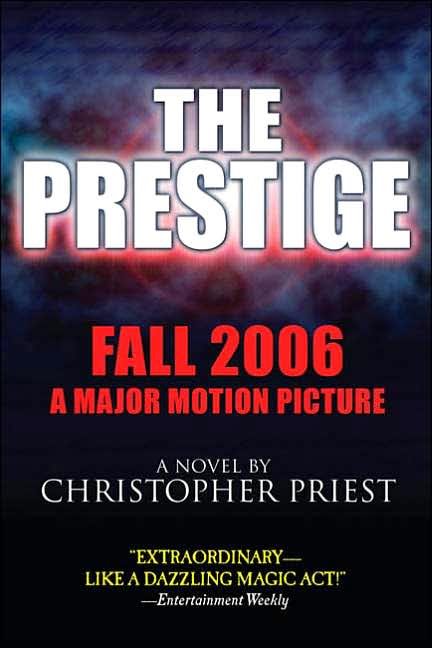
Ladies and Gents, this is now what constitutes as a book cover:
God in heaven, I thought it was an ARC ... Fantastic book; terrible cover.
I mean who wants to pass up on a normal tie-in edition, especially when the film boasts such easy-on-the-eye actors as Christian Bale and Hugh Jackman.
Read the book. Don't support this cover. Boring.
Monday, October 09, 2006
Hopped off the Autumn Reading Challenge slightly....
My Thanksgiving weekend reads:
Secrets from the Vinyl Cafe by the always excellent, Stuart McLean
The Constant Princess by Philippa Gregory ( okay, not classic literature, but so romantic and atmospheric and fun....and, most importantly, a quick read ).
Fairest by Gail Carson Levine ( I think her best in the past couple of years. I loved Dave at Night as well. It was my token YA novel of the week. As Ella Enchanted took a new angle at the Cinderella fable, so Fairest peeks into another more realistic side of Snow White. Loved Ijiro, the Prince ----but I also loved Char (of Ella Enchanted ) especially as personified by Hugh Dancy in the film version).
Starting Shackleton's Stowaway by Victoria McKernan.
Will read more but it is a holiday weekend, ducks, and I am busy living a social cornucopia of festive fun.
Secrets from the Vinyl Cafe by the always excellent, Stuart McLean
The Constant Princess by Philippa Gregory ( okay, not classic literature, but so romantic and atmospheric and fun....and, most importantly, a quick read ).
Fairest by Gail Carson Levine ( I think her best in the past couple of years. I loved Dave at Night as well. It was my token YA novel of the week. As Ella Enchanted took a new angle at the Cinderella fable, so Fairest peeks into another more realistic side of Snow White. Loved Ijiro, the Prince ----but I also loved Char (of Ella Enchanted ) especially as personified by Hugh Dancy in the film version).
Starting Shackleton's Stowaway by Victoria McKernan.
Will read more but it is a holiday weekend, ducks, and I am busy living a social cornucopia of festive fun.
Tuesday, October 03, 2006
Weekend Reads
I have read a ton recently, but have not been blogging about it. Bad me.
Anyhow, here's a list:
Gideon the Cutpurse --Linda Buckley Archer
The Thirteenth Tale - Diane Setterfield
The Strange Case of Dr. Jekyll and Mr. Hyde ---RL Stevenson
Frankenstein- Mary Shelley
Mirror Dreams --Catherine Webb
Mirror Wakes ---Catherine Webb
Kit's Law
Downhill Chance ---- Donna Morrissey ( by the way, Donna Morrisey is one of the most captivating authors I have discovered of late. We all know my passion for East Coast literature. It is well-founded here, I assure you ).
The Other Boleyn Girl -- Philippa Gregory ( I needed to read a token Gregory novel and it looks like I picked the right one. Dishy and fast paced, it reads well in first person. Not a masterpiece by any stretch, but a nice dollop of gossip from the court. In actuality, it just further drove the idea that women were all commodities and sexual pawns in the Tudor Court but, heck, they got to wear really pretty clothes ).
Angus, Thongs and Full-Frontal Snogging -- Louise Rennison. ( Bridget Jones for kids. It was my YA read of the week ).
Darcy's Story by Janet Aylmer ( Shut up! I know. You don't need to tell me. This is pathetic, really it is. But I love Mr. Darcy and I always promised myself I would read one Austen pastiche in my life....well, there it is. And I enjoyed it and got giggly and spit herbal tea out a couple of times ).
Anyhow, here's a list:
Gideon the Cutpurse --Linda Buckley Archer
The Thirteenth Tale - Diane Setterfield
The Strange Case of Dr. Jekyll and Mr. Hyde ---RL Stevenson
Frankenstein- Mary Shelley
Mirror Dreams --Catherine Webb
Mirror Wakes ---Catherine Webb
Kit's Law
Downhill Chance ---- Donna Morrissey ( by the way, Donna Morrisey is one of the most captivating authors I have discovered of late. We all know my passion for East Coast literature. It is well-founded here, I assure you ).
The Other Boleyn Girl -- Philippa Gregory ( I needed to read a token Gregory novel and it looks like I picked the right one. Dishy and fast paced, it reads well in first person. Not a masterpiece by any stretch, but a nice dollop of gossip from the court. In actuality, it just further drove the idea that women were all commodities and sexual pawns in the Tudor Court but, heck, they got to wear really pretty clothes ).
Angus, Thongs and Full-Frontal Snogging -- Louise Rennison. ( Bridget Jones for kids. It was my YA read of the week ).
Darcy's Story by Janet Aylmer ( Shut up! I know. You don't need to tell me. This is pathetic, really it is. But I love Mr. Darcy and I always promised myself I would read one Austen pastiche in my life....well, there it is. And I enjoyed it and got giggly and spit herbal tea out a couple of times ).
Friday, September 29, 2006
Gideon the Cutpurse vs. Montmorency by Eleanor Updale Round 1
Mid-Gideon the Cutpurse by the sort-of talented Linda Buckley-Archer, I am thrown into a fit of puzzlement.
Gideon has been extremely well advertised by the publisher. I mean, who didn't get a copy of the ARC in the Spring. Everyone got one !! I saw a couple of squirrells at Queen's Park reading them.
There are banners and posters and slip covers and booths dedicated to its glory at bookfairs and preview shows and I am wondering why, WHY is Gideon the YA book of the year. It certainly has had the best publicity of any new kids' novelist this past year and yet, it is not the best book I have read. The expectations were high. The bar was waaaaaaaaay up there * Melrose demonstratively draws line in air with finger* and the book is, well, erm... half way down.
See, kids, I have discovered some fantastic YA novelists this year. It being my guilty passion, I read a ton of it. And Gideon is lagging somewhat behind.
I have heard Gideon compared to the fantastic and breathtaking Montmorency series by Eleanor Updale. Updale is one of the few YA novelists who has really broken many of the rules. Her series is fresh and groundbreaking. I sell it to kids and adults alike. The reason being, Montmorency the Jekyll/Hyde-esque thief and gentleman is not a kid. Moreover, none of the other characters in the novels are. What a concept. To write a challenging and engaging series for kids that does not underestimate them;That expects them to reach her level. They are expected to keep up and move on.
Another exception to the rule is the beautiful novelist, Megan Whalen Turner, whose hero Eugenides has captured hearts of many in the gorgeously-woven Attolia series ( The King of Attolia being the most recent ). Turner's darkish character, Gen, spins a fresh thread of dual-nature. The politics undermining the duelling kingdoms is complex and illuminating. Kids can breeze through it for its fantastic adventure and creepy dark caverns and corners, yes, but they must have their thinking caps on. It is almost mythical..... a legendary fantasy set in a time not unlike how I picture ancient Greece.
Catherine Webb is a 2nd year history major at the University of London and already, at the meagre age of 19, has written a handful of fantasy books. Damned good fantasy books at that !The one that most captured my heart was The Extraordinary and Unusual Adventures of Horatio Lyle. Dr. Who meets Sherlock Holmes in this rollicking mystery set at the height of the Industrial Revolution. Webb is an atmospheric writer with a tongue-in-cheek turn of phrase and one of the best senses of humour I have read in a long time. Once again, Horatio Lyle is an adult star the children who help ( Thomas the young aristocrat and Tess the pickpocket) are yes, more than archetypal, but still figure as secondary characters. I am aching for the second installment( "The Obsidian Dagger" ) to reach my doorstep later this week ( godspeed chapters.ca!! )
So, with all of this outstanding ( and most importantly, literate ) YA stuff out there why are the publishers so attracted to this particular story?
Is it the time travel thing? ( ummm, think not !! Read the Fetch by CC Humphreys.... it has smoother transitions from the modern period to the age of the Vikings. Gideon's time-hops are clunky and awkward ).
Is it the historical aspect? Nope. There's tons out there. Even from the 18th Century.
Is it the boy/girl dynamic? I think we can all safely say that that has peaked in Meyer's blockbustering phenomenon Twilight and its sequel, New Moon.
Is it the character waning between good and evil ? Nope. Read Jonathan Stroud.
Is it the scar-faced villain? Ummm, the "tar man?" I should think no imaginative youngster is trembling in their boots. No hair is raised unsuspectingly on their arms. No spider-like tingle is crawling up the backs of their hairlines.
I am absolutely flabberghasted as to this fall's major kids' pick. There's no code to break, no style to start, no movie options. Why is this thing so huge?!!?
That being said, it is a mellow and entertaining novel, and Gideon ( the mysterious aristocrat/cutpurse ) of the title reads very much like Percy of the Scarlet Pimpernel ( read the long blonde queu and the engaging smile and the other "hidden" side).
But, as far as I can tell it is not worth this unprecedented acclaim. In fact, unless Buckley-Archer crams in a lot of explaining as to "why" the transported children hover phantom-like between past and present and "why" they were slipped through the sky to a field of yesteryear, then I will be a very sceptical reader.
What connections does this lady have ?
Read later on for why I think the same over-hype is perpetuated in the build-up to the Thirteenth Tale by Setterfield.
NOTE: I have just read the reviews for Gideon on amazon and have discovered that most good reviews come from adults who got advanced reader copies. Ironic.
Gideon has been extremely well advertised by the publisher. I mean, who didn't get a copy of the ARC in the Spring. Everyone got one !! I saw a couple of squirrells at Queen's Park reading them.
There are banners and posters and slip covers and booths dedicated to its glory at bookfairs and preview shows and I am wondering why, WHY is Gideon the YA book of the year. It certainly has had the best publicity of any new kids' novelist this past year and yet, it is not the best book I have read. The expectations were high. The bar was waaaaaaaaay up there * Melrose demonstratively draws line in air with finger* and the book is, well, erm... half way down.
See, kids, I have discovered some fantastic YA novelists this year. It being my guilty passion, I read a ton of it. And Gideon is lagging somewhat behind.
I have heard Gideon compared to the fantastic and breathtaking Montmorency series by Eleanor Updale. Updale is one of the few YA novelists who has really broken many of the rules. Her series is fresh and groundbreaking. I sell it to kids and adults alike. The reason being, Montmorency the Jekyll/Hyde-esque thief and gentleman is not a kid. Moreover, none of the other characters in the novels are. What a concept. To write a challenging and engaging series for kids that does not underestimate them;That expects them to reach her level. They are expected to keep up and move on.
Another exception to the rule is the beautiful novelist, Megan Whalen Turner, whose hero Eugenides has captured hearts of many in the gorgeously-woven Attolia series ( The King of Attolia being the most recent ). Turner's darkish character, Gen, spins a fresh thread of dual-nature. The politics undermining the duelling kingdoms is complex and illuminating. Kids can breeze through it for its fantastic adventure and creepy dark caverns and corners, yes, but they must have their thinking caps on. It is almost mythical..... a legendary fantasy set in a time not unlike how I picture ancient Greece.
Catherine Webb is a 2nd year history major at the University of London and already, at the meagre age of 19, has written a handful of fantasy books. Damned good fantasy books at that !The one that most captured my heart was The Extraordinary and Unusual Adventures of Horatio Lyle. Dr. Who meets Sherlock Holmes in this rollicking mystery set at the height of the Industrial Revolution. Webb is an atmospheric writer with a tongue-in-cheek turn of phrase and one of the best senses of humour I have read in a long time. Once again, Horatio Lyle is an adult star the children who help ( Thomas the young aristocrat and Tess the pickpocket) are yes, more than archetypal, but still figure as secondary characters. I am aching for the second installment( "The Obsidian Dagger" ) to reach my doorstep later this week ( godspeed chapters.ca!! )
So, with all of this outstanding ( and most importantly, literate ) YA stuff out there why are the publishers so attracted to this particular story?
Is it the time travel thing? ( ummm, think not !! Read the Fetch by CC Humphreys.... it has smoother transitions from the modern period to the age of the Vikings. Gideon's time-hops are clunky and awkward ).
Is it the historical aspect? Nope. There's tons out there. Even from the 18th Century.
Is it the boy/girl dynamic? I think we can all safely say that that has peaked in Meyer's blockbustering phenomenon Twilight and its sequel, New Moon.
Is it the character waning between good and evil ? Nope. Read Jonathan Stroud.
Is it the scar-faced villain? Ummm, the "tar man?" I should think no imaginative youngster is trembling in their boots. No hair is raised unsuspectingly on their arms. No spider-like tingle is crawling up the backs of their hairlines.
I am absolutely flabberghasted as to this fall's major kids' pick. There's no code to break, no style to start, no movie options. Why is this thing so huge?!!?
That being said, it is a mellow and entertaining novel, and Gideon ( the mysterious aristocrat/cutpurse ) of the title reads very much like Percy of the Scarlet Pimpernel ( read the long blonde queu and the engaging smile and the other "hidden" side).
But, as far as I can tell it is not worth this unprecedented acclaim. In fact, unless Buckley-Archer crams in a lot of explaining as to "why" the transported children hover phantom-like between past and present and "why" they were slipped through the sky to a field of yesteryear, then I will be a very sceptical reader.
What connections does this lady have ?
Read later on for why I think the same over-hype is perpetuated in the build-up to the Thirteenth Tale by Setterfield.
NOTE: I have just read the reviews for Gideon on amazon and have discovered that most good reviews come from adults who got advanced reader copies. Ironic.
Tuesday, September 26, 2006
Reading Challenge
most people are doing October reading challenges, pertaining to dark and dreary things.
I am making my own.
It's not actually a challenge because I am very excited about it, and some of the books I have read before, but we shall have gothic, cookies ! lots of gothic!
---Frankenstein by Mary Shelley
---Dracula by Bram Stoker
----the Obsidian Dagger by Catherine Webb
----The Naming of the Dead by Ian Rankin
----The Turn of the Screw by Henry James
---the Strange Case of Dr. Jekyll and Mr. Hyde by Robert Louis Stevenson
I am making my own.
It's not actually a challenge because I am very excited about it, and some of the books I have read before, but we shall have gothic, cookies ! lots of gothic!
---Frankenstein by Mary Shelley
---Dracula by Bram Stoker
----the Obsidian Dagger by Catherine Webb
----The Naming of the Dead by Ian Rankin
----The Turn of the Screw by Henry James
---the Strange Case of Dr. Jekyll and Mr. Hyde by Robert Louis Stevenson
Sunday, September 17, 2006
violence. violence.
I often hear movie-goers gripe about the amount of gratuitous violence saturating the films nowadays. There's gore, there's explicitly rendered scenes with people being riddled with bullets or sliced right open, and society does not always approve.
Though a different medium, I have often wondered how many lobby against violence in fiction. Should it not, in its imaginative realm, fixate the mind with more gruesome images when conjured in your own way?
My love for Harry Potter is only waylaid slightly by the amount of violence in it ( especially in the Goblet of Fire ) , people are murdered, Harry and Voldemort confront each other in a less than tame way, and children are shivering in their beds at night, unable to sleep. Could Rowling not evoke the same dark magical realm without the needless and long-drawn battle scenes that momentarily eclipse anything innocent or light in her stories?
While watching the crux of Goblet of Fire, Harry stalwartly brandishing Voldemort, wand in hand like sword, my cousin was so overwrought with fright she was almost incontrollable. She loves the books and the movies, but somehow that dismal part and the death of Harry's comrade that follows it, shake her to the bone. Should she then dismiss her love for Harry Potter merely because she is so frightened by, what I feel to be, overtly horrific scenes? Should we expect our younger readers to get over it merely because it is the trend in YA fantasy today? Should my cousin change and slip on a thicker skin, or should Rowling cater to her proven audience? She knows how young children are when they start her books (the peer pressure so taut, they open them younger and younger now, or parents read Philosopher's Stone aloud to their toddlers ), as the film producers know the demographic of their audience.
Children's Lit like Harry Potter is not the only problematic genre. My recent reading of Bryce Courtenay's excellently atmospheric novel, Tommo and Hawk, forced me to contempate the need of such explicitly graphic sequences. The brutal rape and beating of a six year old child ( while still in chapter one of the novel, I might add ), made me momentarily slam the book shut and close my eyes. How much is too much? Especially since readers are known to have such vivid imaginations? Courtenay's novel was soaked in graphic imagery. So much so, it often broke the narrative to the part of redundancy. I became immune, the shock value wore off.
CC Humphreys' Anne Boleyn-esque legend, The French Executioner, is no different. There are scenes in that book that haunt me still though it has been years since I read it. The violence did not enhance the plot. The author would probably argue that it was necessary for capturing the essence of the time, the injustice, the conflict, the brink of war.
I argue differently, as I shove Bryce Courtenay near Fr. Executioner on the shelves that contain my mass market books. Violence does not have to be necessary. It is as gratuitous in fiction as it can be in film. Images splashed ---whether across the eyes or the brain-- are equally potent to the imagination and the capsule of memory.
Consider an author such as Bernard Cornwell. His Sharpe series, though occasionally graphic, is one I often recommend to younger readers. Though possibly not as talented a writer as the two aforementioned, he certainly can capture his audience, AND ( most importantly ) Sharpe's rank-rising amidst the Peninsular wars, without the overly-described bloodshed I have found in other novels of late.
Though a different medium, I have often wondered how many lobby against violence in fiction. Should it not, in its imaginative realm, fixate the mind with more gruesome images when conjured in your own way?
My love for Harry Potter is only waylaid slightly by the amount of violence in it ( especially in the Goblet of Fire ) , people are murdered, Harry and Voldemort confront each other in a less than tame way, and children are shivering in their beds at night, unable to sleep. Could Rowling not evoke the same dark magical realm without the needless and long-drawn battle scenes that momentarily eclipse anything innocent or light in her stories?
While watching the crux of Goblet of Fire, Harry stalwartly brandishing Voldemort, wand in hand like sword, my cousin was so overwrought with fright she was almost incontrollable. She loves the books and the movies, but somehow that dismal part and the death of Harry's comrade that follows it, shake her to the bone. Should she then dismiss her love for Harry Potter merely because she is so frightened by, what I feel to be, overtly horrific scenes? Should we expect our younger readers to get over it merely because it is the trend in YA fantasy today? Should my cousin change and slip on a thicker skin, or should Rowling cater to her proven audience? She knows how young children are when they start her books (the peer pressure so taut, they open them younger and younger now, or parents read Philosopher's Stone aloud to their toddlers ), as the film producers know the demographic of their audience.
Children's Lit like Harry Potter is not the only problematic genre. My recent reading of Bryce Courtenay's excellently atmospheric novel, Tommo and Hawk, forced me to contempate the need of such explicitly graphic sequences. The brutal rape and beating of a six year old child ( while still in chapter one of the novel, I might add ), made me momentarily slam the book shut and close my eyes. How much is too much? Especially since readers are known to have such vivid imaginations? Courtenay's novel was soaked in graphic imagery. So much so, it often broke the narrative to the part of redundancy. I became immune, the shock value wore off.
CC Humphreys' Anne Boleyn-esque legend, The French Executioner, is no different. There are scenes in that book that haunt me still though it has been years since I read it. The violence did not enhance the plot. The author would probably argue that it was necessary for capturing the essence of the time, the injustice, the conflict, the brink of war.
I argue differently, as I shove Bryce Courtenay near Fr. Executioner on the shelves that contain my mass market books. Violence does not have to be necessary. It is as gratuitous in fiction as it can be in film. Images splashed ---whether across the eyes or the brain-- are equally potent to the imagination and the capsule of memory.
Consider an author such as Bernard Cornwell. His Sharpe series, though occasionally graphic, is one I often recommend to younger readers. Though possibly not as talented a writer as the two aforementioned, he certainly can capture his audience, AND ( most importantly ) Sharpe's rank-rising amidst the Peninsular wars, without the overly-described bloodshed I have found in other novels of late.
Saturday, September 16, 2006
"I'll Tell you a Secret" by Anne Coleman
This seems like the first "real" book I have read in ages; probably because it infused in me the profound awe I have when I read an author explicitly extraordinary. It is a well-spun classic, in my mind, and I am now very proud to spine it in the Canadian literature section of my personal library: ready for further examination on another weekend.
I have long had an obsession with the Canadian authors who I feel manifest the Golden Age of Canadian literature. The striving, seeking, finding kind most definitely subscribing to the school of my favourites: Leacock (back in Orillia, natch!! ) W.O. Mitchell ( rounding out the latter years ), Mavis Gallant, Robertson Davies ( the silver lining..... ) Hugh Maclennan and, of course, the indomitable Morley Callaghan.
Sometimes I think, in the case of Maclennan and Callaghan especially, that my admiration rises more from their representation of a literal "type" then the actual works they left behind. For example, I have always been far more smitten with the colloquial, yet unspoken language expressed through Callaghan's boxing gloves when he punched out Ernest Hemingway than I have with the colourful palette of his memoirs ( That Summer in Paris resonates most in that peerless climax figuring Hemingway and Callaghan's metaphoric battle ...which I read to be that of champion and defeated in the realm of Canadian/American literature ...while F. Scott Fitzgerald stands timidly by). If Callaghan encapsulates the binary world of Toronto the Great of the 20's and the Paris idolized by that "Moveable Feast" of Hemingway's circle, then surely MacLennan is ensconced in the marriage of writer and poetic prism a la Cape Breton Island and the determined miner's plight.
Both represent a type of collared world that holds such lasting significance to our bustling and changing Canadian realm of identity and mystique. We hold these figures steadfastly as we do our bilingual language, our colonial ties, our bloody win at the Soviet Game late 70's and our Olympic Gold Medals because they help us forge an identity writers like Will Ferguson and Alice Munro have been shoving at us to maintain for years.
Thus, my inclination toward Hugh McLennan as literary model as well as renowned author was fully realized in Anne Coleman's self-proclaimed "Memory of Seven Summers". The "secret" she evokes in her title is that of her lasting coming-of-age relationship with Hugh McLennan at the cottage resort town of North Hatley in Quebec.
The struggle of identity painted so vividly in McLennan's masterpiece, "Two Solitudes" is once again forked out Coleman's remembrance of Quebec in the 1950's. Amidst the cold war, the lasting Francophile and Anglophile conflicts and the changing patriarchal and parochial roles in the boarding school Anne attends and later at McGill, Anne fleshes out a tender relationship any fourteen year old girl with a passion for reading and an insatiable mind would die for.
Hugh McLennan becomes a sort of trinity: father, mentor and almost-lover, as Anne relates to us ( ellipses occuring when memory lapses ) the story of an eager young girl infatuated with a celebrity writer many years her senior.
The word" master" is often used: as becomes the diction of a girl so enveloped in the world of Jane Eyre she peeks all over for "Mrs. Rochesters" and molds her own story on its figurative counterparts in her favourite novel.
My liking for Hugh McLennan was not lessened by this odd ( and at times seemingly irrational and almost dishonourable ) relationship, yet heightened. Anne does not taunt us with a recount of some "Dynasty"-worthy spill-all. Instead, she threads out the bundled and bustling awkwardness of adolescent calamity. She invites us into her world and keeps us there. Our heart catches for her nearly-blossomed relationship and somewhat sinks when it doesn't quite evolve.
She pushes hard and teases and lures..... but that ending, the one you crave despite the inevitability of history, fate and time, keeps you staunchly( albeit wisely) at bay.
I have long had an obsession with the Canadian authors who I feel manifest the Golden Age of Canadian literature. The striving, seeking, finding kind most definitely subscribing to the school of my favourites: Leacock (back in Orillia, natch!! ) W.O. Mitchell ( rounding out the latter years ), Mavis Gallant, Robertson Davies ( the silver lining..... ) Hugh Maclennan and, of course, the indomitable Morley Callaghan.
Sometimes I think, in the case of Maclennan and Callaghan especially, that my admiration rises more from their representation of a literal "type" then the actual works they left behind. For example, I have always been far more smitten with the colloquial, yet unspoken language expressed through Callaghan's boxing gloves when he punched out Ernest Hemingway than I have with the colourful palette of his memoirs ( That Summer in Paris resonates most in that peerless climax figuring Hemingway and Callaghan's metaphoric battle ...which I read to be that of champion and defeated in the realm of Canadian/American literature ...while F. Scott Fitzgerald stands timidly by). If Callaghan encapsulates the binary world of Toronto the Great of the 20's and the Paris idolized by that "Moveable Feast" of Hemingway's circle, then surely MacLennan is ensconced in the marriage of writer and poetic prism a la Cape Breton Island and the determined miner's plight.
Both represent a type of collared world that holds such lasting significance to our bustling and changing Canadian realm of identity and mystique. We hold these figures steadfastly as we do our bilingual language, our colonial ties, our bloody win at the Soviet Game late 70's and our Olympic Gold Medals because they help us forge an identity writers like Will Ferguson and Alice Munro have been shoving at us to maintain for years.
Thus, my inclination toward Hugh McLennan as literary model as well as renowned author was fully realized in Anne Coleman's self-proclaimed "Memory of Seven Summers". The "secret" she evokes in her title is that of her lasting coming-of-age relationship with Hugh McLennan at the cottage resort town of North Hatley in Quebec.
The struggle of identity painted so vividly in McLennan's masterpiece, "Two Solitudes" is once again forked out Coleman's remembrance of Quebec in the 1950's. Amidst the cold war, the lasting Francophile and Anglophile conflicts and the changing patriarchal and parochial roles in the boarding school Anne attends and later at McGill, Anne fleshes out a tender relationship any fourteen year old girl with a passion for reading and an insatiable mind would die for.
Hugh McLennan becomes a sort of trinity: father, mentor and almost-lover, as Anne relates to us ( ellipses occuring when memory lapses ) the story of an eager young girl infatuated with a celebrity writer many years her senior.
The word" master" is often used: as becomes the diction of a girl so enveloped in the world of Jane Eyre she peeks all over for "Mrs. Rochesters" and molds her own story on its figurative counterparts in her favourite novel.
My liking for Hugh McLennan was not lessened by this odd ( and at times seemingly irrational and almost dishonourable ) relationship, yet heightened. Anne does not taunt us with a recount of some "Dynasty"-worthy spill-all. Instead, she threads out the bundled and bustling awkwardness of adolescent calamity. She invites us into her world and keeps us there. Our heart catches for her nearly-blossomed relationship and somewhat sinks when it doesn't quite evolve.
She pushes hard and teases and lures..... but that ending, the one you crave despite the inevitability of history, fate and time, keeps you staunchly( albeit wisely) at bay.
Thursday, September 14, 2006
The Mermaid Chair by Sue Monk Kidd
oh my god it's the Thorn Birds!!! ( except it's in America).
Our heroine ( a sort of Kate Chopin's Awakening type for the millenium ) travels to an island off of South Caroline where spiritualism and eroticism combine in the form of a sexy, ascetic Benedictine Monk.
So, there's lots of brooding and steamy glances and some good descriptions of a historic chair which serves as the hub of the combined Higher and comparitively lower and lustful world.
Whatever. It's all entertaining for lunch breaks at Mariposa Market but a far cry from a real emotional tweaker like The Awakening.
For instance, our heroine returns to the pretty island of her childhood because her mother purposely chopped off her finger with a machete and is now deemed psychologically deranged because she keeps it in a mayonnaise jar beside her bed.
( that's right Sue Monk Kidd, you keep those psychological shockers coming ! )
There's the stock lot: the mentally inept Benne who understands the town's adopted dog, the godmother, Kat; who serves as pendulum between Jessie and finger-decapitated mom and Mage, and a lot full of other eccentrics ( including Mr. Smouldery Richard-Chamberlain-in-waiting) and the poor, desolate husband at home ( who, incidentally, happens to be a psychiatrist).
But the water and rebirth motif is in full form and everyone is liberated and off on pilgrimages. Oooooo eeeee!
And, yet another bookclub perennial and New York Times Bestseller, well-reviewed by Publisher's Weekly gets ticked off of my list..... with another grizzly yawn.
Our heroine ( a sort of Kate Chopin's Awakening type for the millenium ) travels to an island off of South Caroline where spiritualism and eroticism combine in the form of a sexy, ascetic Benedictine Monk.
So, there's lots of brooding and steamy glances and some good descriptions of a historic chair which serves as the hub of the combined Higher and comparitively lower and lustful world.
Whatever. It's all entertaining for lunch breaks at Mariposa Market but a far cry from a real emotional tweaker like The Awakening.
For instance, our heroine returns to the pretty island of her childhood because her mother purposely chopped off her finger with a machete and is now deemed psychologically deranged because she keeps it in a mayonnaise jar beside her bed.
( that's right Sue Monk Kidd, you keep those psychological shockers coming ! )
There's the stock lot: the mentally inept Benne who understands the town's adopted dog, the godmother, Kat; who serves as pendulum between Jessie and finger-decapitated mom and Mage, and a lot full of other eccentrics ( including Mr. Smouldery Richard-Chamberlain-in-waiting) and the poor, desolate husband at home ( who, incidentally, happens to be a psychiatrist).
But the water and rebirth motif is in full form and everyone is liberated and off on pilgrimages. Oooooo eeeee!
And, yet another bookclub perennial and New York Times Bestseller, well-reviewed by Publisher's Weekly gets ticked off of my list..... with another grizzly yawn.
Sunday, September 10, 2006
books.
Who says that the internet is an impersonal, automaton, non-entity? They are wrong, I tell you, WRONG!!
Some good duck I met on LJ sent me a slew of Lisa Samson titles this week. And, as a follow-up to the worthy Songbird, I was equally impressed with Straight Up and Club Sandwich.
My favourite of the lot so far is Tiger Lillie; about a ( and I quote her ) "Strong Hungarian" singleton who co-ordinates extreme weddings in the Baltimore area. The daughter of an Episcopalian "priest" ( not preacher, she adamantly informs us ), her narrative intersperses her logs of theology and faith. As I am learning is customary with Samson's well-written first narrative ( YAY!... we all know how I hate a badly written first-person ), elements of faith and the prospective hypocrisy of Christianizing the world through organized religion play through.
I enjoyed some of the literary (natch! ) parallels between the carefully constructed episcopalian world of Lillie's blind father and that of her brother-in-law's dictating, cultish, Scientology-like religion founded under the perverse and power hungry con, Alban Cole.
At times violent, disturbing and challenging, Lisa Samson deals with things I thought long hushed in the strict CBA. For example, the unpracticed homosexuality of Lillie's best friend Gilbert, the sexual awakening of Lillie's younger sister Tacy, the saturation of secular "pop-culture" idiosyncrasies, the loose and liberal language and mostly the round-table discussion housing both sides of the "free will" debate.
Samson is definitely fresh and unusual in today's Christian market. She seems to single-handedly redeem so much of what is wrong in its nature and conservative safe-place.
I yearn to rise up onto my soapbox and proclaim "Fear not worthy, intelligent Christian reader!! Though shalt not be subjected to Gilbert Morris and Janette Oke for the rest of time."
I think the face of Christian publishing is slowly revolving. I like to think Dale Cramer is the pioneer of resuscitation when it comes to the refurbishing of the Christian literary world, but I see now I have to include Samson's powerful, pseudo-feministic sprawls as well. She definitely holds her gutsy own.
In Brett Lott's A Song I knew by Heart, I was thrilled to find more than a thread of my favourite story of the Bible: that of Ruth. The aged Naomi and her recently widowed daughter-in-law travel statewide to settle in the South of Naomi's past. Here plenty of skeletons pop out of her seemingly pure closet. With a mixture of heartbreak and subtle grace, I was delighted to find the parallels between the scripture I so love ( that Boaz is just the bomb!!) and a gentleman author who fits nicely in the hub of the Oprah-lore of the past decade.
In kid's lit, I explored the tasty travails of Emmaline Cayley, pioneering aviatrix and her rapscallion, often airborne guinea pig Robert Burns in The Strictest School in the World by Howard Whitehouse Deliciously illustrated and with hilarious captions, this book reads like Lemony Snicket out of Wackford Squeers ( the totalitarian despot disguised as a schoolmaster in the treacherous sequences of "Nicholas Nickleby" ) Emmaline takes flight.... it's charming, fantastical and humorous. Highly recommended to those who share my passion for the neo-Victorianized fantasy world of Horatio Lyle.
The Book without Words by Avi was quite a different experience than the Crispin books I had recently read and loved. Pure fable, Avi teaches his young readers about the power of proverb and parallel. The story of Sybil, Odo the raven and a treacherous alchemist swearing the secret to spinning gold is filled with dramatic irony, creepy foreshadows and spine-tingling terror. Avi's prose is sparse: but decidedly clever words help paint an ambiance that would chill even the most stalwart of readers.
Avi excels in his archaic worlds and this particular fairytale is no exception. His powers often seem limitless.
Some good duck I met on LJ sent me a slew of Lisa Samson titles this week. And, as a follow-up to the worthy Songbird, I was equally impressed with Straight Up and Club Sandwich.
My favourite of the lot so far is Tiger Lillie; about a ( and I quote her ) "Strong Hungarian" singleton who co-ordinates extreme weddings in the Baltimore area. The daughter of an Episcopalian "priest" ( not preacher, she adamantly informs us ), her narrative intersperses her logs of theology and faith. As I am learning is customary with Samson's well-written first narrative ( YAY!... we all know how I hate a badly written first-person ), elements of faith and the prospective hypocrisy of Christianizing the world through organized religion play through.
I enjoyed some of the literary (natch! ) parallels between the carefully constructed episcopalian world of Lillie's blind father and that of her brother-in-law's dictating, cultish, Scientology-like religion founded under the perverse and power hungry con, Alban Cole.
At times violent, disturbing and challenging, Lisa Samson deals with things I thought long hushed in the strict CBA. For example, the unpracticed homosexuality of Lillie's best friend Gilbert, the sexual awakening of Lillie's younger sister Tacy, the saturation of secular "pop-culture" idiosyncrasies, the loose and liberal language and mostly the round-table discussion housing both sides of the "free will" debate.
Samson is definitely fresh and unusual in today's Christian market. She seems to single-handedly redeem so much of what is wrong in its nature and conservative safe-place.
I yearn to rise up onto my soapbox and proclaim "Fear not worthy, intelligent Christian reader!! Though shalt not be subjected to Gilbert Morris and Janette Oke for the rest of time."
I think the face of Christian publishing is slowly revolving. I like to think Dale Cramer is the pioneer of resuscitation when it comes to the refurbishing of the Christian literary world, but I see now I have to include Samson's powerful, pseudo-feministic sprawls as well. She definitely holds her gutsy own.
In Brett Lott's A Song I knew by Heart, I was thrilled to find more than a thread of my favourite story of the Bible: that of Ruth. The aged Naomi and her recently widowed daughter-in-law travel statewide to settle in the South of Naomi's past. Here plenty of skeletons pop out of her seemingly pure closet. With a mixture of heartbreak and subtle grace, I was delighted to find the parallels between the scripture I so love ( that Boaz is just the bomb!!) and a gentleman author who fits nicely in the hub of the Oprah-lore of the past decade.
In kid's lit, I explored the tasty travails of Emmaline Cayley, pioneering aviatrix and her rapscallion, often airborne guinea pig Robert Burns in The Strictest School in the World by Howard Whitehouse Deliciously illustrated and with hilarious captions, this book reads like Lemony Snicket out of Wackford Squeers ( the totalitarian despot disguised as a schoolmaster in the treacherous sequences of "Nicholas Nickleby" ) Emmaline takes flight.... it's charming, fantastical and humorous. Highly recommended to those who share my passion for the neo-Victorianized fantasy world of Horatio Lyle.
The Book without Words by Avi was quite a different experience than the Crispin books I had recently read and loved. Pure fable, Avi teaches his young readers about the power of proverb and parallel. The story of Sybil, Odo the raven and a treacherous alchemist swearing the secret to spinning gold is filled with dramatic irony, creepy foreshadows and spine-tingling terror. Avi's prose is sparse: but decidedly clever words help paint an ambiance that would chill even the most stalwart of readers.
Avi excels in his archaic worlds and this particular fairytale is no exception. His powers often seem limitless.
Thursday, September 07, 2006
"I, Coriander" by Sally Gardner
This book intrigued me because it received so many fantastic reviews. Not to mention, it gobbled up many children's literary prizes.
Coriander's story reads like a fairytale: her birth mother seems to have one foot steeped in the land of mystical magic ( think the rule of Oberon in "A Midsummer Night's Dream" ) and the other planted firmly as the mistress of a wealthy home in London..... tantalizingly near the bridge.
The Cromwell rebellion strikes and soon Coriander's world ( and that of her mythical mother's ) seems to slide downward.
Once an epoch in her young life, the discovery and testing of a pair of silver shoes is far too soon the crux between an enchanted world and one of realism, devastation and despair. Coriander loses all that she holds dear while , paradoxically, the land she so loves is overtaken by war and plague.
Balancing a world full of magic against the puritanical reignings of two new locals, Gardner sets Coriander midplace in two drastically different spheres.
I was much taken by Mr. Thankless ( the aptly named tailor ) and his shy apprentice, Gabriel. Not to mention the role of the effervescent "Puck"- type character, here fleshed out in the noble Tycho.
Gardner's prose is outstanding, liquid, moving.... her worlds taut and tangible.
I only wish this stellar book had developed more of one side of Coriander's life.
Read it for yourself and find out why.
Coriander's story reads like a fairytale: her birth mother seems to have one foot steeped in the land of mystical magic ( think the rule of Oberon in "A Midsummer Night's Dream" ) and the other planted firmly as the mistress of a wealthy home in London..... tantalizingly near the bridge.
The Cromwell rebellion strikes and soon Coriander's world ( and that of her mythical mother's ) seems to slide downward.
Once an epoch in her young life, the discovery and testing of a pair of silver shoes is far too soon the crux between an enchanted world and one of realism, devastation and despair. Coriander loses all that she holds dear while , paradoxically, the land she so loves is overtaken by war and plague.
Balancing a world full of magic against the puritanical reignings of two new locals, Gardner sets Coriander midplace in two drastically different spheres.
I was much taken by Mr. Thankless ( the aptly named tailor ) and his shy apprentice, Gabriel. Not to mention the role of the effervescent "Puck"- type character, here fleshed out in the noble Tycho.
Gardner's prose is outstanding, liquid, moving.... her worlds taut and tangible.
I only wish this stellar book had developed more of one side of Coriander's life.
Read it for yourself and find out why.
Monday, September 04, 2006
"Songbird" by Lisa Samson
This is one of the edgiest and most riveting of the Christian fic fare I have ever read. Not since Dale Cramer's debut have I been so impressed by an author boasting faith in their novels. A highly-flawed character, Charmaine Hopewell adds a humane and relative voice to the world of derelict despair she finds throughout her Southern life.
The atmosphere and dialect read like Billie Letts meets Faulkner. The deep integration of characters into the piece reminded me somewhat of John Irving.
I was thoroughly impressed with Samson's gutsy rhetoric. This story----with its sin and long-time-in-finding redemption ---points the finger at some of the less tangible strains of evangelism: the reliance on the promise of God over medication, the scandalous surroundings of televised programs and their subsequent revivals ( mostly those in the mid-80's with the surge of retreats and resorts a la PTL).
Our focal couple, Charmaine and Harlan, remain the groundwork for a sometimes unbelievable whirlwind of hypocrisy, doubt and selfishness.
This " on the road" novel dips and dives in places I never expected it too. Though it lacks some of Cramer's subtlety, it has a much-needed literate slant that continues to evade so many in the marketplace.
I will definitely read more from her.
The atmosphere and dialect read like Billie Letts meets Faulkner. The deep integration of characters into the piece reminded me somewhat of John Irving.
I was thoroughly impressed with Samson's gutsy rhetoric. This story----with its sin and long-time-in-finding redemption ---points the finger at some of the less tangible strains of evangelism: the reliance on the promise of God over medication, the scandalous surroundings of televised programs and their subsequent revivals ( mostly those in the mid-80's with the surge of retreats and resorts a la PTL).
Our focal couple, Charmaine and Harlan, remain the groundwork for a sometimes unbelievable whirlwind of hypocrisy, doubt and selfishness.
This " on the road" novel dips and dives in places I never expected it too. Though it lacks some of Cramer's subtlety, it has a much-needed literate slant that continues to evade so many in the marketplace.
I will definitely read more from her.
Thursday, August 31, 2006
"Goodnight Nobody" by Jennifer Wiener
Sometimes, if I feel I HAVE to read a chicklit just to feel like I still belong to the female populus, I will only read Jennifer Weiner or Marian Keyes ( the two chicklit writers with brains ).
This book was long, occasionally funny but convoluted. If I had read it in one sitting on the beach instead of over a series of nights before dozing, I would have thought differently. Weiner is a good writer though. Probably the best of the American lot of her genre.
I am too tired to talk about it.Hopefully this weekend I can catch you all up on the five or so books I have read in the past week..... ones worthy of a little more speculation.
This book was long, occasionally funny but convoluted. If I had read it in one sitting on the beach instead of over a series of nights before dozing, I would have thought differently. Weiner is a good writer though. Probably the best of the American lot of her genre.
I am too tired to talk about it.Hopefully this weekend I can catch you all up on the five or so books I have read in the past week..... ones worthy of a little more speculation.
Saturday, August 26, 2006
Sheer Brilliance....
I cannot escape the beautifully literate and folklore-laden Bartimaeus Trilogy by Jonathan
Stroud.
Makes Harry Potter look more than pale in comparison!
Squeal!!
Stroud.
Makes Harry Potter look more than pale in comparison!
Squeal!!
Tuesday, August 22, 2006
Ahoy Cornwellians!!!
Go check out the site to the new Sharpe film!!
I have been a Sharpeaholic for many moons now and my excitement over the release of the new book Sharpe's Fury is only countered by this .............
Long Live Patrick Harper !
I have been a Sharpeaholic for many moons now and my excitement over the release of the new book Sharpe's Fury is only countered by this .............
Long Live Patrick Harper !
Friday, August 18, 2006
I took forever to get to this tag:
1. One book that Changed Your Life---
There's two actually; a.) Les Miserables by Victor Hugo. When I was in grade eight, I dropped whatever installment of the Fear Street Saga I was indugled in and opened this puppy. It remains the most influential of my life. I devoured it: the themes, the wisdom, the interspersed poetry, Hugo's turn of phrase, the characters most of all. 1800 pages later, I was sure that there had to be another book just as powerful and captivating. Forsaking RL Stine for the rest of my life, I associated Les Miserables ( thus splendour ) with the 19th Century. I read Austen and Dickens and Hardy and Twain and Doyle from that point onward. The Brontes and Hawthorne and Thackeray. My love for the Victorians was born at 14 thanks to Hugo and a convict who snatches candlesticks from a well-meaning bishop. It's the sole reason I went into Lit at University, won the grade eight English award and scored the highest mark in English in high school, not to mention my love and fervour for the English programme at the University of Toronto ( where I just finished a five year specialist degree in the self same period ). So, I am the geeky bookworm born a century-to-late because of Hugo.
b.) The Blue Castle by LM Montgomery
I maintain this is the first work of female emancipations literature to come out of Canada. A prudish, self-conscious minister's daughter in a small, judgmental and suppressive town, this book showed me a heroine who was brave enough to be everything I was not. I read it in the last semester of high school. Listlessly, chin-in-hand, burrowed in University applications and ready to take, like Valancy our title character, the biggest plunge in my life. It set a surge of lightning through me---presented a character and life I related to. Once finished, I immediately spun back to page one and started all over again. I now know it by heart and wrote my senior thesis on LM Montgomery ( primarily the Blue Castle ) as the purest example of a life vicariously lived through fiction.
2.) one book you wish that you had written:
As a little duck, I idolized Sherlock Holmes ( who am I kidding, I still do ). I pretended I was the Master and connecting the proverbial dots I saw murder and mayhem everywhere in miniscule Orillia. One re-read mid-canon on a stormy winter's night, I admitted I would have loved Doyle's brilliance. I could never stay one step ahead of Holmes. Sick of lagging behind, I felt had I written Sherlock Holmes I would have the ultimate in first-hand knowledge. I would never need to worry about solving a mystery again.
The green eyes of envy also flash brightly when I appreciate the glory of a well-turned YA novel. Mostly because it is the genre I wish to personally dabble my creative mind in. " I wish I had been onto that!" sighs my brain: "That" usually encapsulates Anthony Horowitz, Catherine Webb for the wonderful " Horatio Lyle", Avi, Hilary McKay, Gordon Korman, Eleanor Updale.....sooo sooo many.
3. One book you wish had never been written:
Need you ask? The Bloody Da Vinci Code!! It has been sponging the brain cells out of many unsuspecting readers since March 2002. Hate the pulpy prose, hate the italics, hate the hyperbole, the hype... it's trash in the purest form. A bad Patterson spin-off someone misread as a piece of art. No thought, nor creed no literary spin is worthy of its atrocious acclaim. Drop this purile Blockbuster and read a real book. Or, atleast, admit it is two beach towels on the wrong side of Robert Ludlum and abashedly hide it in a book cover.
4.) One book that you'd want on a desert island:
"Villette" by Charlotte Bronte ( it is my panic-attack, calm-down book ). " A Connecticut Yankee in King Arthur's Court" by Mark Twain.... any Twain for that matter, "Prince and the Pauper" is a favourite, " anything by Martha Grimes
5.) One book that made you cry:
" I Capture the Castle" by Dodie Smith, "Night" by Elie Wiesel. I'm a friggin' sap. I cried when Lord Peter got trapped in the bell tower in Sayers' " The Nine Tailors.", "On Beulah Height" by Reginald Hill ( when Rosie Pascoe is in the hospital with meningitis... it killed me! killed me ! )
6.) One book that made you laugh:
I have my perennial favourites: Mark Twain, W.O. Mitchell's "According to Jake and the Kid", Gordon Korman, Martha Grimes ( there are brilliant moments in the Stargazey, the Blue Last and the Grave Maurice.... I loove her !! ) and the Blooding of Jack Absolute by CC Humphreys. I have to gasp for air when I read this. My sides split. Ate is too funny; quoting his " infernal Hamlet."
7.) One book that you're currently reading:
the Bartimaeus Trilogy by Jonathan Stroud
"A Song I Knew by Heart" by Brett Lott
"Lighthousekeeping" by Jeannette Winterson
8.) One book that you've been meaning to read:
The Wreckage by Michael Crummey
Never Let me Go by Kazuo Ishiguro
There's two actually; a.) Les Miserables by Victor Hugo. When I was in grade eight, I dropped whatever installment of the Fear Street Saga I was indugled in and opened this puppy. It remains the most influential of my life. I devoured it: the themes, the wisdom, the interspersed poetry, Hugo's turn of phrase, the characters most of all. 1800 pages later, I was sure that there had to be another book just as powerful and captivating. Forsaking RL Stine for the rest of my life, I associated Les Miserables ( thus splendour ) with the 19th Century. I read Austen and Dickens and Hardy and Twain and Doyle from that point onward. The Brontes and Hawthorne and Thackeray. My love for the Victorians was born at 14 thanks to Hugo and a convict who snatches candlesticks from a well-meaning bishop. It's the sole reason I went into Lit at University, won the grade eight English award and scored the highest mark in English in high school, not to mention my love and fervour for the English programme at the University of Toronto ( where I just finished a five year specialist degree in the self same period ). So, I am the geeky bookworm born a century-to-late because of Hugo.
b.) The Blue Castle by LM Montgomery
I maintain this is the first work of female emancipations literature to come out of Canada. A prudish, self-conscious minister's daughter in a small, judgmental and suppressive town, this book showed me a heroine who was brave enough to be everything I was not. I read it in the last semester of high school. Listlessly, chin-in-hand, burrowed in University applications and ready to take, like Valancy our title character, the biggest plunge in my life. It set a surge of lightning through me---presented a character and life I related to. Once finished, I immediately spun back to page one and started all over again. I now know it by heart and wrote my senior thesis on LM Montgomery ( primarily the Blue Castle ) as the purest example of a life vicariously lived through fiction.
2.) one book you wish that you had written:
As a little duck, I idolized Sherlock Holmes ( who am I kidding, I still do ). I pretended I was the Master and connecting the proverbial dots I saw murder and mayhem everywhere in miniscule Orillia. One re-read mid-canon on a stormy winter's night, I admitted I would have loved Doyle's brilliance. I could never stay one step ahead of Holmes. Sick of lagging behind, I felt had I written Sherlock Holmes I would have the ultimate in first-hand knowledge. I would never need to worry about solving a mystery again.
The green eyes of envy also flash brightly when I appreciate the glory of a well-turned YA novel. Mostly because it is the genre I wish to personally dabble my creative mind in. " I wish I had been onto that!" sighs my brain: "That" usually encapsulates Anthony Horowitz, Catherine Webb for the wonderful " Horatio Lyle", Avi, Hilary McKay, Gordon Korman, Eleanor Updale.....sooo sooo many.
3. One book you wish had never been written:
Need you ask? The Bloody Da Vinci Code!! It has been sponging the brain cells out of many unsuspecting readers since March 2002. Hate the pulpy prose, hate the italics, hate the hyperbole, the hype... it's trash in the purest form. A bad Patterson spin-off someone misread as a piece of art. No thought, nor creed no literary spin is worthy of its atrocious acclaim. Drop this purile Blockbuster and read a real book. Or, atleast, admit it is two beach towels on the wrong side of Robert Ludlum and abashedly hide it in a book cover.
4.) One book that you'd want on a desert island:
"Villette" by Charlotte Bronte ( it is my panic-attack, calm-down book ). " A Connecticut Yankee in King Arthur's Court" by Mark Twain.... any Twain for that matter, "Prince and the Pauper" is a favourite, " anything by Martha Grimes
5.) One book that made you cry:
" I Capture the Castle" by Dodie Smith, "Night" by Elie Wiesel. I'm a friggin' sap. I cried when Lord Peter got trapped in the bell tower in Sayers' " The Nine Tailors.", "On Beulah Height" by Reginald Hill ( when Rosie Pascoe is in the hospital with meningitis... it killed me! killed me ! )
6.) One book that made you laugh:
I have my perennial favourites: Mark Twain, W.O. Mitchell's "According to Jake and the Kid", Gordon Korman, Martha Grimes ( there are brilliant moments in the Stargazey, the Blue Last and the Grave Maurice.... I loove her !! ) and the Blooding of Jack Absolute by CC Humphreys. I have to gasp for air when I read this. My sides split. Ate is too funny; quoting his " infernal Hamlet."
7.) One book that you're currently reading:
the Bartimaeus Trilogy by Jonathan Stroud
"A Song I Knew by Heart" by Brett Lott
"Lighthousekeeping" by Jeannette Winterson
8.) One book that you've been meaning to read:
The Wreckage by Michael Crummey
Never Let me Go by Kazuo Ishiguro
Thursday, August 17, 2006
Crispin at the Edge of the World by Avi
This book came in a month earlier than I anticipated as per what my pre-order date read. I loved the Newberry winning first instalment, "Crispin: The Cross of Lead", and was eagerly awaiting the next two volumes in the supposed trilogy.
Avi is the kind of writer ( specifically in the Crispin books ) that proves YA authors and childrens authors often have a more treacherous task and are required to be more openly resilient than certain adult authors. If anyone ever doubted that children's writing was a serious art craft, well, Avi proves them otherwise. He is a wordsmith of the first degree and paints a beautiful, medieval landscape. His prose is scintillating. Though often distilled and acute to make it clear for his age group demographic ( and perhaps to loan itself to oral recitation), Avi is a splendid writer. I kept hanging on his words.
His pacing is also wonderful; which is one of the most difficult tasks I think a YA author must undertake.
Despite its literate beauty and historical interest, this was a rather depressing way to glue two framing books together. It didn't end on a cliffhanger, but on a death.
As to the characters, Crispin remains a sprite and intriguing narrator. Avi centers more on the coming-of-age story backdropping the front conflict and I was eager to learn more about Crispin's desire to be a "man" as he watches Bear ( the guardian/minstrel he met and hooked up with in volume 1 ) in a new context. Crispin learns more and more about his mentor and becomes unsure as to whether life ( and people, for that matter ) can be shelved in the extremity of black or white. The current war they find in ravaged Rye, and the wars that Bear fought in previously cause Bear to remember a less than happy past.
Bear, the monstrous, redheaded, humorous oaf never fully recovers his spry spirit ( think the Ghost of Christmas Present ) after his bout in a prison at the end of "Cross of Lead." As such, Avi completely ruled out humour because we are sure as heck were not going to derive it from Crispin ( too serious ) or Troth ( too scared ).
Troth is a character who joins their band in this volume. And it was interesting to watch her character progress alongside Crispin's. She has a harelip ( think Precious Bane ! ) and introduces a folkloric, pagan tradition to the otherwise heavily-steeped Christian forefront of Avi's tale.
This book despite its beautiful prose and steafast plot, left me feeling empty. Perhaps because it was so melancholic. I realize the conflict of the late 14th Century lends itself to such scrutiny, but nonetheless, I kept hankering for the first " Crispin": the lighthearted one with the dodging of arrows and the traveling from town-to-town with offers of a song and dance.
As such, immediately after finishing " Edge of the World", I picked up the first one again for another roll.
Avi is the kind of writer ( specifically in the Crispin books ) that proves YA authors and childrens authors often have a more treacherous task and are required to be more openly resilient than certain adult authors. If anyone ever doubted that children's writing was a serious art craft, well, Avi proves them otherwise. He is a wordsmith of the first degree and paints a beautiful, medieval landscape. His prose is scintillating. Though often distilled and acute to make it clear for his age group demographic ( and perhaps to loan itself to oral recitation), Avi is a splendid writer. I kept hanging on his words.
His pacing is also wonderful; which is one of the most difficult tasks I think a YA author must undertake.
Despite its literate beauty and historical interest, this was a rather depressing way to glue two framing books together. It didn't end on a cliffhanger, but on a death.
As to the characters, Crispin remains a sprite and intriguing narrator. Avi centers more on the coming-of-age story backdropping the front conflict and I was eager to learn more about Crispin's desire to be a "man" as he watches Bear ( the guardian/minstrel he met and hooked up with in volume 1 ) in a new context. Crispin learns more and more about his mentor and becomes unsure as to whether life ( and people, for that matter ) can be shelved in the extremity of black or white. The current war they find in ravaged Rye, and the wars that Bear fought in previously cause Bear to remember a less than happy past.
Bear, the monstrous, redheaded, humorous oaf never fully recovers his spry spirit ( think the Ghost of Christmas Present ) after his bout in a prison at the end of "Cross of Lead." As such, Avi completely ruled out humour because we are sure as heck were not going to derive it from Crispin ( too serious ) or Troth ( too scared ).
Troth is a character who joins their band in this volume. And it was interesting to watch her character progress alongside Crispin's. She has a harelip ( think Precious Bane ! ) and introduces a folkloric, pagan tradition to the otherwise heavily-steeped Christian forefront of Avi's tale.
This book despite its beautiful prose and steafast plot, left me feeling empty. Perhaps because it was so melancholic. I realize the conflict of the late 14th Century lends itself to such scrutiny, but nonetheless, I kept hankering for the first " Crispin": the lighthearted one with the dodging of arrows and the traveling from town-to-town with offers of a song and dance.
As such, immediately after finishing " Edge of the World", I picked up the first one again for another roll.
Monday, August 14, 2006
Erm....loved this.
Horatio Lyle writer Catherine Webb in an interview.
Thank god I preorder the Obsidian Dagger. Should be here in a couple of weeks. *GRIN*
Thank god I preorder the Obsidian Dagger. Should be here in a couple of weeks. *GRIN*
Booker long list
Yes we read the Waters, the Mitchell, the Unsworth.
Must we read more?
Screw you highbrow literary world, gimme more Bartimeaus trilogy.
*winks*
Must we read more?
Screw you highbrow literary world, gimme more Bartimeaus trilogy.
*winks*
on my night table
--- The Fetch by Chris Humphreys
---Trickster's Queen by Tamora Pierce
---Before Scarlett: Juvenalia of Margaret Mitchell
---The Birth House by Ami McKay
----Lighthousekeeping by Jeannette Winterson
---The Extraordinary and Unusual Adventures of Horatio Lyle by Catherine Webb *GRIIIN!*
On a Lyle note:I have a tendency to lapse back into books and not be able to leave them for awhile. I am rather like LM Montgomery in a way. After she read The Prisoner of Zenda for the first time, she said everything else tasted bland for weeks afterward and she could only inhabit Hope's fantastical, regal realm. This is me and Horatio Lyle ( as cheesy as that sounds ). I just love it. I love the banter, the rapport, the cute narrative tricks ( they really are like pulling a rabbit out of a hat).I will finish The Fetch by the end of this week. I will. I will. I have been picking it up and putting it down for over a month now. GARRR !
---Trickster's Queen by Tamora Pierce
---Before Scarlett: Juvenalia of Margaret Mitchell
---The Birth House by Ami McKay
----Lighthousekeeping by Jeannette Winterson
---The Extraordinary and Unusual Adventures of Horatio Lyle by Catherine Webb *GRIIIN!*
On a Lyle note:I have a tendency to lapse back into books and not be able to leave them for awhile. I am rather like LM Montgomery in a way. After she read The Prisoner of Zenda for the first time, she said everything else tasted bland for weeks afterward and she could only inhabit Hope's fantastical, regal realm. This is me and Horatio Lyle ( as cheesy as that sounds ). I just love it. I love the banter, the rapport, the cute narrative tricks ( they really are like pulling a rabbit out of a hat).I will finish The Fetch by the end of this week. I will. I will. I have been picking it up and putting it down for over a month now. GARRR !
Tuesday, August 08, 2006
Carolan's Farewell by Charles Foran
I have been meaning to read this book for a long while. The cover intrigued me; a Don Quixotic tale unravelling the relationship between a blind man and his Sancho Panza, set in Ireland in the 18th Century; the lore of a real harpist whose history is surrounded by as much enigma as the tunes he wrote.
I was most taken by the narrative form Foran used to weave his tale. In almost mythic proportion, the first half focuses on the aging Carolan, a celebrity harpist who is making one redeeming pilgrimage before the end of his life. Carolan and his best friend and guide, Owen Connor, traipse through the countryside and encounter many locals from sheriffs to paupers, all spun under the magic of Carolan's infamous spell.
The setting lends for a grisly and crude scope into the world of a bygone era of famine and despair.
The second half of the story focuses on Owen Connor, Carolan's much younger guide, his budding relationship with the scullery maid Annie, his desire to rise above his lesser position, and the trouble he encounters for stealing books the prove food for his voracious mind.
The disintegration of Carolan physically and mentally, and the caveat given Owen pertaining to his own potential demise is a well-woven parallel.
This is an interesting snapshot into a time and country where music and lore abound and the oral tradition spread like wild fire. Foran is a more than competent purveyor of such a tale and intermixes history and fiction quite well. He also has a supreme talent for dialect and dialogue.
Enjoyable.
I was most taken by the narrative form Foran used to weave his tale. In almost mythic proportion, the first half focuses on the aging Carolan, a celebrity harpist who is making one redeeming pilgrimage before the end of his life. Carolan and his best friend and guide, Owen Connor, traipse through the countryside and encounter many locals from sheriffs to paupers, all spun under the magic of Carolan's infamous spell.
The setting lends for a grisly and crude scope into the world of a bygone era of famine and despair.
The second half of the story focuses on Owen Connor, Carolan's much younger guide, his budding relationship with the scullery maid Annie, his desire to rise above his lesser position, and the trouble he encounters for stealing books the prove food for his voracious mind.
The disintegration of Carolan physically and mentally, and the caveat given Owen pertaining to his own potential demise is a well-woven parallel.
This is an interesting snapshot into a time and country where music and lore abound and the oral tradition spread like wild fire. Foran is a more than competent purveyor of such a tale and intermixes history and fiction quite well. He also has a supreme talent for dialect and dialogue.
Enjoyable.
Sunday, August 06, 2006
No wonder CS Lewis fell for this....
I have a weakness for reading books that CS Lewis enjoyed. I have more than one compilation of works that delve into Lewis' favourite classics and works. One such being Precious Bane by Mary Webb. I have been meaning to read this for eons but finally got around to it ( thank you Orillia Public Library). After a ramble down by the harbour yesterday I wandered into the library to see if it was there on the stacks and sure enough an age old hardcover sat waiting for me to pounce. I cancelled my amazon order for it but after my recent finish may have to put the order in again.
I loved it. I had no trouble becoming accustomed to the Shropshire diction that Webb uses and I found the setting more than amicable. It reads almost like a fairytale, its hare-lipped narrator, Prue Sarn the unlikely fairy princess she dreams of being. Her prince, Kester Woodseaves the perfect knight who whisks her off on his horse to a marriage and a sunset.
A dark fairytale to be sure, with a grim brother an abusive temperamental father and a superstitious tribunal of a town waiting to claim our poor heroine as one of the devil's very own. But Prue is full of love and wit and resource. She saves the life of her beloved before she ever engages in conversation with him.
I loved this heroine and I fell hard for the first person narrative. I was ecstatic that today's read, though so varied from yesterday's, was equally as captivating.
And yes, Clive Staples wins again. This duck has a great track record when it comes to good reads. Come to think of it, for writing good reads as well as recommending them. Awww.
I loved it. I had no trouble becoming accustomed to the Shropshire diction that Webb uses and I found the setting more than amicable. It reads almost like a fairytale, its hare-lipped narrator, Prue Sarn the unlikely fairy princess she dreams of being. Her prince, Kester Woodseaves the perfect knight who whisks her off on his horse to a marriage and a sunset.
A dark fairytale to be sure, with a grim brother an abusive temperamental father and a superstitious tribunal of a town waiting to claim our poor heroine as one of the devil's very own. But Prue is full of love and wit and resource. She saves the life of her beloved before she ever engages in conversation with him.
I loved this heroine and I fell hard for the first person narrative. I was ecstatic that today's read, though so varied from yesterday's, was equally as captivating.
And yes, Clive Staples wins again. This duck has a great track record when it comes to good reads. Come to think of it, for writing good reads as well as recommending them. Awww.
Saturday, August 05, 2006
"When I was Young and in my Prime" Alayna Munce
My friend Kristine has been going on about this book for months now. Apparently a close friend of her sister's, Alayna Munce is a Torontonian who, after reading this book this afternoon, I believe to be one of the most atmospheric Canadian writers on the market. She captures Parkdale and its usual, eccentric, awkward bustle quite acutely.
Our nameless narrator is spun into a world of nostalgia and inspiration as she sorts through her grandparents' timeless letters, diaries and memorabilia. Her grandmother has alzheimers; her grandfather weakens physically the moment they put his spouse in a home. This disintegrating relationship mirrors the narrators' own.
I don't usually enjoy books where poetry is interspersed and breaks the narrative flow. However, Munce is far from overpowering. I found her a little pretentious at times ( a phrase involving Tolstoy and moralistic romanticism comes to mind as a springboard for a thought that is left fragmentary ) but more often that not the narrator's observations ---at No Frills or on the street car --- are a welcome antidote to any Torontonian stuck thinking they live in merely a static, smelly zoo.
This was a good read for someone who has just left the city and is trying to piece together her own reminiscences. What parts and neighbourhoods will stand as the defining ones? What ones make me cringle and crackle: "God! I'm so glad I'm gone!"
When I was Young and In my Prime is a book of love but it is also a book of regret. The prosaic timbre of the book echoes Anne Michael's brilliant Fugitive Pieces and I was grateful for a relapse into that beautiful weaving of poetic realism.
Moving has forbidden as much reading as I would have liked but I have fallen hard for Ellen Kushner author of a series of novels set in the fantastic albeit Regency-esque realm of Riverside. I was captivated most by The Privilege of the Sword which follows a female swashbuckler-to-be, Katherine Talbert and her new status as protector of her eccentric and flamboyant uncle, Alec Campion. Kushner is a painter of words and she has a luscious canvas to embroider. Every salon and every rampant, risque party is a treat. The interweaving metafictional story of The Swordsman whose name was Not death is an ironically witty treat. I was most taken by the character of St.Vier who, to my utter delight, figures prominently in Kushner's Swordspoint. Kushner is the kind of author that makes me want to genre hop and spend more time reading fantasy novels. She is literate and humorous and has a huge heart. I love authors whose personality shines into their work. Kushner delighted me and I hope she does not stop there.
Now having moved, painted and unpacked I hope to be spending more time reading. Reading all of the time is preferable but I am sure there will be moments lent to other activity ( quel dommage ).
Our nameless narrator is spun into a world of nostalgia and inspiration as she sorts through her grandparents' timeless letters, diaries and memorabilia. Her grandmother has alzheimers; her grandfather weakens physically the moment they put his spouse in a home. This disintegrating relationship mirrors the narrators' own.
I don't usually enjoy books where poetry is interspersed and breaks the narrative flow. However, Munce is far from overpowering. I found her a little pretentious at times ( a phrase involving Tolstoy and moralistic romanticism comes to mind as a springboard for a thought that is left fragmentary ) but more often that not the narrator's observations ---at No Frills or on the street car --- are a welcome antidote to any Torontonian stuck thinking they live in merely a static, smelly zoo.
This was a good read for someone who has just left the city and is trying to piece together her own reminiscences. What parts and neighbourhoods will stand as the defining ones? What ones make me cringle and crackle: "God! I'm so glad I'm gone!"
When I was Young and In my Prime is a book of love but it is also a book of regret. The prosaic timbre of the book echoes Anne Michael's brilliant Fugitive Pieces and I was grateful for a relapse into that beautiful weaving of poetic realism.
Moving has forbidden as much reading as I would have liked but I have fallen hard for Ellen Kushner author of a series of novels set in the fantastic albeit Regency-esque realm of Riverside. I was captivated most by The Privilege of the Sword which follows a female swashbuckler-to-be, Katherine Talbert and her new status as protector of her eccentric and flamboyant uncle, Alec Campion. Kushner is a painter of words and she has a luscious canvas to embroider. Every salon and every rampant, risque party is a treat. The interweaving metafictional story of The Swordsman whose name was Not death is an ironically witty treat. I was most taken by the character of St.Vier who, to my utter delight, figures prominently in Kushner's Swordspoint. Kushner is the kind of author that makes me want to genre hop and spend more time reading fantasy novels. She is literate and humorous and has a huge heart. I love authors whose personality shines into their work. Kushner delighted me and I hope she does not stop there.
Now having moved, painted and unpacked I hope to be spending more time reading. Reading all of the time is preferable but I am sure there will be moments lent to other activity ( quel dommage ).
Sunday, July 23, 2006
No Brainer
Levi's Will by Dale Cramer aka the best Christian fiction writer on the market ( though I am still awfully fond of the Thoenes ) won the Christy Award. This may not mean a lot in the grand scheme of secular bookselling, but I have tried to inflitrate him into the Faulkner/Harper Lee/ Leif Enger readership so I hope my small contribution is somehow aiding a bigger effort. Namely, take the two Christian extremes ( Apocalyptical horror a la Frank Peretti and Jenkins/ Lahaye and Mail-Order Bride Historical series with amish people and goats ) and even them out into something greater; Something so fantastic you can slide it to a secular friend without them knowing what they are reading. The archetypal safe fare of poorly written first person romantic narratives paired with the recent fascination with celtic people, the slave trade and composers of hymns as the male leads, should instead be replaced by sterner stuff; books that are literary and challenging and substitute a bludgeon over the head with a more subtle ethical background. Grace at the foremost, yes, but not the kind of grace that expects your reader to be spoonfed the gospels.... or moreover, the kind that shovels it down your throat if your unsuspecting mouth seems to be drooping wide. I want to be proud of Christian fiction. I want to pair the Dostoyevsky and Hugo I slid into the Christian Library I worked at with contemporary pseudo-masterpieces.
A Retrospect: I once engaged in a book I thought held eons of potential. It was set in Oxford in the 1960's and its major motif was that of the Inklings---that famous theological grouping that held Lewis, Williams and Tolkien at the now infamous Eagle and Baby. Here, the aforementioned would gather and plot and discuss--Sometimes deliciously allowing a brilliant female to intercept their predominantly male gatherings. (Here, of course, I refer to my theological goddess/mystery maven Dorothy L. Sayers ). I eagerly read on gathering that the book was peppered with romance, and thought ....to my delight.... Shakespeare. However, there was a car crash, a weepy wide-eyed night worthy of Lavyrle Spencer and, horrifically, a sequel where the once ambitious Shakesperian scholar-to-be traded her Oxford education for a potential brood of children( at the tender age of 21, I believe ) because God had called her to raise a large family. Words cannot descibe how incensed I was at the author and the book. Who am I to question the Will of the Almighty when it comes to dropping higher education to raise children? But, with few other books to counter this familial archetype, I was distraught. If readers who dapple fleetingly in the Christian market are subjected to women adhering to a long-passe social role, how can we ever convince them that there is light outside of Mitford, that not all Christian women are baking in the kitchen, and that the whole of the Christian marketplace is not the rainy-day, feel-good squishiness of Karen Kingsbury.
I want Christian Fiction with heart and guts and brains. When I was in elementary school, my young and developing imagination had no problem seeping the works of Janette Oke and BJ Hoff. The italicized prayers were wonderfully appropos, the cheesy covers ( the gawdawful covers ) with their pastels and portraits of ladies bonneted and gentleman in strawhats and suspenders did not phase me. Then, I grew up and titles like " When Hope Springs New" didn't cut it anymore. For a long time the Christian market did not exist outside of the "prairie" romance; The long series where books 2 and 7 were always out of print or unavailable. And, when it did occasionally stray from the expected, it was only to delve into the antiromance, the antonym. Raise your hands if you're still freaked out by Peretti's Door to the Dragon's Throat. Throw in a Chuck Colson and a Grant Jeffrey for good measure and you have a wavering pendulum. Sappy historical and death, destruction apocalyptic with one or two of a Grisham like law book in between. And is it utterly impossible for these people to throw anything remotely literary into this jargoning jingoism? I was delighted to read " Because of Winn Dixie " by Kate Di Camillo because I found strings of religion in the figure of a mangy mutt. How desperate are we?!?!
Yet in lapses of despair, I have never ever given up on the potential of a great Christian read. Perhaps something that leans more to the Tolkienian ideal of Pre-Evangelim.... a Christian book that has more to do with ethical themes and a woven strand of subtle grace than down right allegory or sermonizing.
Ironically, the book Christy by Catherine Marshall , the namesake of Cramer's recent award, seems still ( and encouragingly) to be a placid middle ground for some readers. Even if it has never been published with a cover worthy of its inner-genius, it is the antidote for a the rumbling rant I have presently typed. I had a customer today come back after falling head-over-heels for Neil MacNeil ( hel-lo! She's human, isn't she? ) and tell me " My friend told me that this was a Christian book. Is that true?" Ahh.... bliss. Carry on Dale Cramer. Break down the barriers and please spare us from the sisterchicks, the uber-apocalyptic destruction scenes ( with the low budget Kirk Cameron spinoffs ) and most of all the new Austen-ish vein of taking a heroine and throwing her in calamitous situations only your great grandmother would find even remotely amusing. If she does crosswords in her spare time, even worse!
A Retrospect: I once engaged in a book I thought held eons of potential. It was set in Oxford in the 1960's and its major motif was that of the Inklings---that famous theological grouping that held Lewis, Williams and Tolkien at the now infamous Eagle and Baby. Here, the aforementioned would gather and plot and discuss--Sometimes deliciously allowing a brilliant female to intercept their predominantly male gatherings. (Here, of course, I refer to my theological goddess/mystery maven Dorothy L. Sayers ). I eagerly read on gathering that the book was peppered with romance, and thought ....to my delight.... Shakespeare. However, there was a car crash, a weepy wide-eyed night worthy of Lavyrle Spencer and, horrifically, a sequel where the once ambitious Shakesperian scholar-to-be traded her Oxford education for a potential brood of children( at the tender age of 21, I believe ) because God had called her to raise a large family. Words cannot descibe how incensed I was at the author and the book. Who am I to question the Will of the Almighty when it comes to dropping higher education to raise children? But, with few other books to counter this familial archetype, I was distraught. If readers who dapple fleetingly in the Christian market are subjected to women adhering to a long-passe social role, how can we ever convince them that there is light outside of Mitford, that not all Christian women are baking in the kitchen, and that the whole of the Christian marketplace is not the rainy-day, feel-good squishiness of Karen Kingsbury.
I want Christian Fiction with heart and guts and brains. When I was in elementary school, my young and developing imagination had no problem seeping the works of Janette Oke and BJ Hoff. The italicized prayers were wonderfully appropos, the cheesy covers ( the gawdawful covers ) with their pastels and portraits of ladies bonneted and gentleman in strawhats and suspenders did not phase me. Then, I grew up and titles like " When Hope Springs New" didn't cut it anymore. For a long time the Christian market did not exist outside of the "prairie" romance; The long series where books 2 and 7 were always out of print or unavailable. And, when it did occasionally stray from the expected, it was only to delve into the antiromance, the antonym. Raise your hands if you're still freaked out by Peretti's Door to the Dragon's Throat. Throw in a Chuck Colson and a Grant Jeffrey for good measure and you have a wavering pendulum. Sappy historical and death, destruction apocalyptic with one or two of a Grisham like law book in between. And is it utterly impossible for these people to throw anything remotely literary into this jargoning jingoism? I was delighted to read " Because of Winn Dixie " by Kate Di Camillo because I found strings of religion in the figure of a mangy mutt. How desperate are we?!?!
Yet in lapses of despair, I have never ever given up on the potential of a great Christian read. Perhaps something that leans more to the Tolkienian ideal of Pre-Evangelim.... a Christian book that has more to do with ethical themes and a woven strand of subtle grace than down right allegory or sermonizing.
Ironically, the book Christy by Catherine Marshall , the namesake of Cramer's recent award, seems still ( and encouragingly) to be a placid middle ground for some readers. Even if it has never been published with a cover worthy of its inner-genius, it is the antidote for a the rumbling rant I have presently typed. I had a customer today come back after falling head-over-heels for Neil MacNeil ( hel-lo! She's human, isn't she? ) and tell me " My friend told me that this was a Christian book. Is that true?" Ahh.... bliss. Carry on Dale Cramer. Break down the barriers and please spare us from the sisterchicks, the uber-apocalyptic destruction scenes ( with the low budget Kirk Cameron spinoffs ) and most of all the new Austen-ish vein of taking a heroine and throwing her in calamitous situations only your great grandmother would find even remotely amusing. If she does crosswords in her spare time, even worse!
Monday, July 17, 2006
Patricia C. Wrede, "New Moon", and some sea-faring for the kiddies
Okay. So, I really like teenie lit. We all know this. But we also know that I can chalk it up to *ahem* research because I am finishing my own teenie lit series. Also, we must recognize that it is summer and I just finished a Specialist degree in Victorian Lit. So, I have paid my dues and read many eight thousand long books with words like "thither", "ponder", and surreptitiously."
Having listed my credentials, I should basically be able to read whate'er I want.
So.... I do.
Take for instance, this wonderful, blossoming genre of Regency-lit for kids. I would like to start by thanking Patricia C. Wrede for this delightful, delectable, delicacy. First, through Sorcery and Cecilia and The Grand Tour: sort of an epistolary Georgette Heyer for the small fry; and now, enchantingly, Mairelon the Magician and The Magician's Ward. Magic of yesteryear is indeed sexy. I like to think of man "Darcy-clad" in cravats prancing ( a la Scarlet Pimpernel) about the "ton" ,as it were ,and flashing their magic tricks. Kudos to Susanna Clarke's Jonathan Strange and Mr. Norrell for further whetting the world's appetite for this sort of thing.
Mairelon the Magician and its worthy sequel are peppered with witty banter and rapport, and enticing "cant" used by the streetsmart Kim who unwittingly ( and unwillingly) becomes ward to the "toff" Mairelon: Magician by day, spy for the British Office and Lord of the upper gentry by night.
The relationship between Kim and Mairelon took some unexpected turns that had me squealing late, late into last night . This is the kind of book you want to sneak the flashlight under the covers for.
I also read New Moon-- the sequel to Twilight by Stephenie Meyer. This book takes an unexpectedly dark turn and I must say I was completely thrown off guard by the direction it is now heading in. I am sure she will round off the trilogy nicely in the promised third sequence.
Details I shall keep tightly under lock and key seeing as I was fortunate enough to read this in its galley proof and most of the rest of the world is still anticipatorily expecting their amazon pre-orders.
I have a thing for boats. We all know this. It will be my downfall ( meaning I will one day rush off to sea, toss my self aloft and somehow, strangely, drown), but I can live vicariously through wonderful sea faring tales of the dark and deep. I am always intrigued when authors of the YA persuasion use this setting for their coming-of-age tales. For really, Horatio Hornblower, and the early non-Aubrey/Maturin O'Brian books, use ships as the vessel for self maturation.
I can eagerly recommend Peter Raven Under Fire, a recent nautical acquisition. Also, the Young Man and the Sea ( a well-needed update of the Hemingway classic for the 9-12 age range. And, my love of all things Maritimer was well-founded in Pirate's Passage by Gilkerson.
Having listed my credentials, I should basically be able to read whate'er I want.
So.... I do.
Take for instance, this wonderful, blossoming genre of Regency-lit for kids. I would like to start by thanking Patricia C. Wrede for this delightful, delectable, delicacy. First, through Sorcery and Cecilia and The Grand Tour: sort of an epistolary Georgette Heyer for the small fry; and now, enchantingly, Mairelon the Magician and The Magician's Ward. Magic of yesteryear is indeed sexy. I like to think of man "Darcy-clad" in cravats prancing ( a la Scarlet Pimpernel) about the "ton" ,as it were ,and flashing their magic tricks. Kudos to Susanna Clarke's Jonathan Strange and Mr. Norrell for further whetting the world's appetite for this sort of thing.
Mairelon the Magician and its worthy sequel are peppered with witty banter and rapport, and enticing "cant" used by the streetsmart Kim who unwittingly ( and unwillingly) becomes ward to the "toff" Mairelon: Magician by day, spy for the British Office and Lord of the upper gentry by night.
The relationship between Kim and Mairelon took some unexpected turns that had me squealing late, late into last night . This is the kind of book you want to sneak the flashlight under the covers for.
I also read New Moon-- the sequel to Twilight by Stephenie Meyer. This book takes an unexpectedly dark turn and I must say I was completely thrown off guard by the direction it is now heading in. I am sure she will round off the trilogy nicely in the promised third sequence.
Details I shall keep tightly under lock and key seeing as I was fortunate enough to read this in its galley proof and most of the rest of the world is still anticipatorily expecting their amazon pre-orders.
I have a thing for boats. We all know this. It will be my downfall ( meaning I will one day rush off to sea, toss my self aloft and somehow, strangely, drown), but I can live vicariously through wonderful sea faring tales of the dark and deep. I am always intrigued when authors of the YA persuasion use this setting for their coming-of-age tales. For really, Horatio Hornblower, and the early non-Aubrey/Maturin O'Brian books, use ships as the vessel for self maturation.
I can eagerly recommend Peter Raven Under Fire, a recent nautical acquisition. Also, the Young Man and the Sea ( a well-needed update of the Hemingway classic for the 9-12 age range. And, my love of all things Maritimer was well-founded in Pirate's Passage by Gilkerson.
Wednesday, July 12, 2006
"Nick and Nora's Infinite Playlist" by Rachel Cohn/David Levithan, "Catherine, Called Birdy" Karen Cushman
Nick and Nora's Infinite Playlist:
First off, I like the throw-back to the Nick and Nora of Dashiell Hammett's The Thin Man.
Secondly, I enjoy both of these authors when they are writing singularly. I especially enjoyed the books Gingerbread and Shrimp by Rachel Cohn. The fresh, quirky narrative reminded me of Francesca Lia Block's fantastic "Dangerous Angels"/Weetzie Bat series.
I also enjoyed the premise of "Nick and Nora"---two music lovers meet at a punky, sweaty concert. Nick grabs the closest girl next to him to kiss just as the girl who broke his heart walks by and Nora obliges. This part consumated in the first chapters and the need for a buildup to reach the moment ( as is the case in so many teen novels ) relinquished, the next hundred-odd pages jumps His/Her perspectives, as Nick and Nora learn about each other and New York. New York becomes their playground; it is a whirlwind of adventures and the perfect scene to add to their rotating music video-type life.
One of the off-sets of the writing is the perpetual need to curse. Honestly, I am a bit of a prude, but even I shrug off a strong word now and then for the sake of poetic license. In Nick and Nora's case it actually detracts from the narrative. The reader is instead puzzling " How will Levithan and Cohn slide this "f" here and this one there...."
I know that in the name of edginess, the teenie novelists are dying to scrape down the conservative wallpaper of inhibition. But please, does originality have to be sacrificed in its stead?
An interesting whiz perfect for a night when you feel like hitting The Bronze with Buffy and Xander....it's that kind of book.
Catherine, Called Birdy is the first novel by Karen Cushman-- a now hugely popular YA novelist ( specifically in the YA genre ) who has won the Newberry. Set in the medieval time periods, Catherine is a spunky heroine who keeps an " account" of the goings-on in her quiet home and village . Although she is well and high-bred, her family's poverty asserts she marry wealthy. A score of suitors show up to court the young maiden and Catherine fights them all off... with pranks and pleas and costume changes ( such as mouse bones in her hair and blacking soot on her teeth ). It is Catherine's pursuit of her own happiness that makes this book so intriguing. Her perserverence and her refusal to marry anyone deemd unworthy sets her above the rest.
Cushman paints the medieval period without romanticism. It is grubby and gritty and dirty and crass. We see the grease, learn of the privy and hear many of the time's exclamatory remarks.
not a bad read at all. I can see why it is a favourite of some of today's more prominent young adult novelists ( Meg Cabot, et al).
First off, I like the throw-back to the Nick and Nora of Dashiell Hammett's The Thin Man.
Secondly, I enjoy both of these authors when they are writing singularly. I especially enjoyed the books Gingerbread and Shrimp by Rachel Cohn. The fresh, quirky narrative reminded me of Francesca Lia Block's fantastic "Dangerous Angels"/Weetzie Bat series.
I also enjoyed the premise of "Nick and Nora"---two music lovers meet at a punky, sweaty concert. Nick grabs the closest girl next to him to kiss just as the girl who broke his heart walks by and Nora obliges. This part consumated in the first chapters and the need for a buildup to reach the moment ( as is the case in so many teen novels ) relinquished, the next hundred-odd pages jumps His/Her perspectives, as Nick and Nora learn about each other and New York. New York becomes their playground; it is a whirlwind of adventures and the perfect scene to add to their rotating music video-type life.
One of the off-sets of the writing is the perpetual need to curse. Honestly, I am a bit of a prude, but even I shrug off a strong word now and then for the sake of poetic license. In Nick and Nora's case it actually detracts from the narrative. The reader is instead puzzling " How will Levithan and Cohn slide this "f" here and this one there...."
I know that in the name of edginess, the teenie novelists are dying to scrape down the conservative wallpaper of inhibition. But please, does originality have to be sacrificed in its stead?
An interesting whiz perfect for a night when you feel like hitting The Bronze with Buffy and Xander....it's that kind of book.
Catherine, Called Birdy is the first novel by Karen Cushman-- a now hugely popular YA novelist ( specifically in the YA genre ) who has won the Newberry. Set in the medieval time periods, Catherine is a spunky heroine who keeps an " account" of the goings-on in her quiet home and village . Although she is well and high-bred, her family's poverty asserts she marry wealthy. A score of suitors show up to court the young maiden and Catherine fights them all off... with pranks and pleas and costume changes ( such as mouse bones in her hair and blacking soot on her teeth ). It is Catherine's pursuit of her own happiness that makes this book so intriguing. Her perserverence and her refusal to marry anyone deemd unworthy sets her above the rest.
Cushman paints the medieval period without romanticism. It is grubby and gritty and dirty and crass. We see the grease, learn of the privy and hear many of the time's exclamatory remarks.
not a bad read at all. I can see why it is a favourite of some of today's more prominent young adult novelists ( Meg Cabot, et al).
Tuesday, July 11, 2006
Twilight by Stephenie Meyer
ahhh Vampires. What would I do without them? They never quite captivated me with the exception of Count Dracula on Sesame Street. But then, early in the century, a blondie, British Manchester united fan, with a wicked ( pun intended ) sense of humour graced the small screen with his interpretation of the men of the night. This coffin-sleeper, grave-dweller, caught me ( especially when he was wandering around Sunnydale in a suit with Giles the Watcher ) and kept me. I liked the forbidden romance motif. The vampire and the slayer. Doomed, right? The ripest of forbidden fruit. This time the forbidden fruit is a little more subtle. This vamp is not dating a Slayer, instead a sweet tempered, self proclaimed "albino" senior at a high school in Forks, DC. The gorgeous vamp is Edward Cullen: a wispish thing with tawny hair and a dazzling crooked smile. He is not, as is usually thought, burned by the sun, yet sparkled by it. He is more angel than vamp, and more often than not ready and willing to save our hapless heroine from the trouble she seeps apt to find herself in.
Twilight is told in first person. A well-narrated first person is a treat for the gods, a bad one is ...well, I think we all know my low tolerance level for it. Meyers' Bella is a treat. She is believable ( as believable as a senior with a hankering after vamps CAN be ) and the story whips through its 500+ pages rather rapidly. I usually don't find myself drawn to the pretty boys but this Edward thing is quite the looker/rescuer/guy. Having lived since the early 20th Century is musically inclined ( and proficient at that ) and has read a heck of a lot ( to the delight of the bookwormish Bella ). He speaks articulately and always seems slightly out of reach. Physically inpenetratable, but nonetheless a foil for some of the most intense unacted sensuality I have read in a teen book in a long time. You could cut the vamp/human sexual tension with a knife. Especially when Edward takes the unsuspecting Bella to a sunny meadow. His body lights like twinkles on a Christmas tree and I thought for sure they were going to take their playful kissing a step or two further ( I might not have minded ).
Meyers kept me hooked. I appreciated her use of older names for Edward's "vamp" siblings: Esme and Carlisle and Emmett and Rosalie: distinguishing the unhuman dead ones from the rest of the high school and the small, rainy town. Meyers relinquishes a lot of the popular vampire lore, instead twisting it and making it her own . A self proclaimed LM Montgomery fan, I was sure Jasper Hale was a shout out to a certain stuttering recluse in the Chronicles of Avonlea.
There were two major problems with the novel. First, the concept of timing. I felt Edward and Bella's relationship happened quickly and rather abruptly. Secondly, that we never really knew how long they had known each other. Now that I have finished, I realize that the arc of the story is framed by the beginning of school in chapter one and the Prom in the epilogue.
The second problem is the Vampire baseball game. This is the crux that catapults the beginning of the terrifying climax but it didn't seem the right way to begin the spiral to the end. It was a little silly, to say the least and the least credible of what I thought was a fairly easy-to-fall-into world.
Good show. Now cracking the spine of New Moon: the Second in what is to be a trilogy.
Twilight is told in first person. A well-narrated first person is a treat for the gods, a bad one is ...well, I think we all know my low tolerance level for it. Meyers' Bella is a treat. She is believable ( as believable as a senior with a hankering after vamps CAN be ) and the story whips through its 500+ pages rather rapidly. I usually don't find myself drawn to the pretty boys but this Edward thing is quite the looker/rescuer/guy. Having lived since the early 20th Century is musically inclined ( and proficient at that ) and has read a heck of a lot ( to the delight of the bookwormish Bella ). He speaks articulately and always seems slightly out of reach. Physically inpenetratable, but nonetheless a foil for some of the most intense unacted sensuality I have read in a teen book in a long time. You could cut the vamp/human sexual tension with a knife. Especially when Edward takes the unsuspecting Bella to a sunny meadow. His body lights like twinkles on a Christmas tree and I thought for sure they were going to take their playful kissing a step or two further ( I might not have minded ).
Meyers kept me hooked. I appreciated her use of older names for Edward's "vamp" siblings: Esme and Carlisle and Emmett and Rosalie: distinguishing the unhuman dead ones from the rest of the high school and the small, rainy town. Meyers relinquishes a lot of the popular vampire lore, instead twisting it and making it her own . A self proclaimed LM Montgomery fan, I was sure Jasper Hale was a shout out to a certain stuttering recluse in the Chronicles of Avonlea.
There were two major problems with the novel. First, the concept of timing. I felt Edward and Bella's relationship happened quickly and rather abruptly. Secondly, that we never really knew how long they had known each other. Now that I have finished, I realize that the arc of the story is framed by the beginning of school in chapter one and the Prom in the epilogue.
The second problem is the Vampire baseball game. This is the crux that catapults the beginning of the terrifying climax but it didn't seem the right way to begin the spiral to the end. It was a little silly, to say the least and the least credible of what I thought was a fairly easy-to-fall-into world.
Good show. Now cracking the spine of New Moon: the Second in what is to be a trilogy.
Friday, July 07, 2006
The Secret Garden by Frances Hodgson Burnett
The last time I read the Secret Garden I was young.... very young. So young, my young self thought that the London mentioned in stories must be the same as the one where my aunt lived ( in Ontario ); not that far out of reach. The Secret Garden had such an impact on my burgeoning imagination, that traveling to visit London Ontario, every beautiful Victorian farmhouse dotting the villages and hamlets leading to the city ( Arva, Lucan, Birr ) were all potential candidates for where the story took place. Don't try to tell my eight year old self that the Yorkshire moors are a far cry from Huron County farm country. I wouldn't believe you.
I cannot believe I waited this long to revisit the magic of one of the very first novels I remember reading. Yet, funnily, everything came back so easily it seemed as if it were one of my oldest friends. I loved reading of Dickon: the magic boy who could enchant the wildlife around him, of Mary the contrary miss who barked at the servant Martha but was still given ( by the same ) a skipping rope, and of Archibald Craven, the slightly deformed, Rochesterish lord of the manner, who came and went at will, who probably dressed wholly in black and who neglected his hypochondriac ghost-son named Colin---- so afraid of developing a lump to match his father's, Colin stayed in bed all day. Until Mary rescued him.....and a garden. At the same time.
Of course the rebirth motif is completely lost to a whipper-snapper, but Burnett weaves so well the awakening of the soul and the revitilization of the spirit with the sudden rekindling of the magic garden: locked after the death of its beautiful, timeless mistress. In fact, by the end, the garden and the boy Dickon seem so seamlessly intertwined, one wonders if Dickon actually existed. Is he instead a human metaphor for the liveliness the garden instills in those who tend it?
The reunion scene between the once-lame Colin who runs to his father, breathless and refreshed is very endearing.
I am glad I stumbled upon this again. Loved gushing over it with my friends and making them revisit it as well. I think it is one of the books that influenced a lot of children when they were young.
I cannot believe I waited this long to revisit the magic of one of the very first novels I remember reading. Yet, funnily, everything came back so easily it seemed as if it were one of my oldest friends. I loved reading of Dickon: the magic boy who could enchant the wildlife around him, of Mary the contrary miss who barked at the servant Martha but was still given ( by the same ) a skipping rope, and of Archibald Craven, the slightly deformed, Rochesterish lord of the manner, who came and went at will, who probably dressed wholly in black and who neglected his hypochondriac ghost-son named Colin---- so afraid of developing a lump to match his father's, Colin stayed in bed all day. Until Mary rescued him.....and a garden. At the same time.
Of course the rebirth motif is completely lost to a whipper-snapper, but Burnett weaves so well the awakening of the soul and the revitilization of the spirit with the sudden rekindling of the magic garden: locked after the death of its beautiful, timeless mistress. In fact, by the end, the garden and the boy Dickon seem so seamlessly intertwined, one wonders if Dickon actually existed. Is he instead a human metaphor for the liveliness the garden instills in those who tend it?
The reunion scene between the once-lame Colin who runs to his father, breathless and refreshed is very endearing.
I am glad I stumbled upon this again. Loved gushing over it with my friends and making them revisit it as well. I think it is one of the books that influenced a lot of children when they were young.
Thursday, June 29, 2006
Charlie Bone and the Hidden King by Jenny Nimmo
The Charlie Bone series has been one of my favourite kids series over the past couple of years. There are moments where I swear I like it better than Harry Potter. It's gentler and it is something you can sit down and relax in. Like the photographs Charlie can enter and travel through, you melt into the world of the characters, of Bloor Academy, of Paton ( my favourite) the Light booster and Julia Ingledew's medievalesque bookshop.
Although many of the secretive elements and mysteries of the story are not so cleverly cloaked ( you know by the end of the first book the identity of Charlie's missing father ), it is not the surprise, yet the journey to Charlie's discovery that makes the Children of the Red King books such a delight .
I knew when we reached the fifth ( and according to Jenny Nimmo the last ), all slightly dangling threads would have to be tied neatly up. In the basest sense, the Hidden King leaves you with that satisfaction. However, I would have liked a little more "meat" at the end, so to speak, when the conclusion and it's Happily-ever-after are presented. I would have liked a little more after the discovery and the climax. Just some time to sit happily and watch reunions. Further, since I find Charlie's uncle Paton the most interesting character in the series, I would have enjoyed his reunion with Lyell Bone and subsequently his engagement (?) to Julia Ingledew. On that note, I could have done with more information on Benjamin Brown and how his story turned out, the same for Olivia Vertigo and even Billy, the small albino kid who can talk to animals.
Nimmo tied the plot up enough that a smile spread across my face but I still found it skeletal. She could have fleshed things out a little more for me.
Nonetheless, this Quintet ( especially its finale ) have been worth the four year span. I sell them far more than most Children's books at the store and forever have customers return enchanted.
Farewell Charlie Bone, sensitive boy who can travel into pictures and roam around. I am sure I will revisit you on many occasions.
Although many of the secretive elements and mysteries of the story are not so cleverly cloaked ( you know by the end of the first book the identity of Charlie's missing father ), it is not the surprise, yet the journey to Charlie's discovery that makes the Children of the Red King books such a delight .
I knew when we reached the fifth ( and according to Jenny Nimmo the last ), all slightly dangling threads would have to be tied neatly up. In the basest sense, the Hidden King leaves you with that satisfaction. However, I would have liked a little more "meat" at the end, so to speak, when the conclusion and it's Happily-ever-after are presented. I would have liked a little more after the discovery and the climax. Just some time to sit happily and watch reunions. Further, since I find Charlie's uncle Paton the most interesting character in the series, I would have enjoyed his reunion with Lyell Bone and subsequently his engagement (?) to Julia Ingledew. On that note, I could have done with more information on Benjamin Brown and how his story turned out, the same for Olivia Vertigo and even Billy, the small albino kid who can talk to animals.
Nimmo tied the plot up enough that a smile spread across my face but I still found it skeletal. She could have fleshed things out a little more for me.
Nonetheless, this Quintet ( especially its finale ) have been worth the four year span. I sell them far more than most Children's books at the store and forever have customers return enchanted.
Farewell Charlie Bone, sensitive boy who can travel into pictures and roam around. I am sure I will revisit you on many occasions.
Wednesday, June 14, 2006
Just some more stuff I've read
Novik, Naomi THRONE OF JADE
HIS MAJESTY'S DRAGON
John Lanchester THE DEBT TO PLEASURE
McKay, Hilary SAFFY'S ANGEL
INDIGO'S STAR
PERMANENT ROSE
Aiken, Joan BLACK HEARTS IN BATTERSEA
Bunn, T. Davis THE NIGHT ANGEL
Smith, Debbie AMANDA
Stockwin, Julian TENACIOUS
MacLeod, Alastair NO GREAT MISCHIEF
Birdsell, Sandra THE RUSSLANDER
Philbrick, Nathan THE YOUNG MAN AND THE SEA
Ferguson, Will BEAUTY TIPS FROM MOOSEJAW
WHY I HATE CANADIANS
HOW TO BE A CANADIAN ( with Ian Ferguson)
Shields, Charles MOCKINGBIRD: A LIFE OF HARPER LEE
Keating, HRF SHERLOCK HOLMES: THE MAN AND HIS WORLD
Morrissey, Deborah SYLVANUS NOW
Go Canadiana ( with a bit of Sherlockiana and kids books interspersed )
HIS MAJESTY'S DRAGON
John Lanchester THE DEBT TO PLEASURE
McKay, Hilary SAFFY'S ANGEL
INDIGO'S STAR
PERMANENT ROSE
Aiken, Joan BLACK HEARTS IN BATTERSEA
Bunn, T. Davis THE NIGHT ANGEL
Smith, Debbie AMANDA
Stockwin, Julian TENACIOUS
MacLeod, Alastair NO GREAT MISCHIEF
Birdsell, Sandra THE RUSSLANDER
Philbrick, Nathan THE YOUNG MAN AND THE SEA
Ferguson, Will BEAUTY TIPS FROM MOOSEJAW
WHY I HATE CANADIANS
HOW TO BE A CANADIAN ( with Ian Ferguson)
Shields, Charles MOCKINGBIRD: A LIFE OF HARPER LEE
Keating, HRF SHERLOCK HOLMES: THE MAN AND HIS WORLD
Morrissey, Deborah SYLVANUS NOW
Go Canadiana ( with a bit of Sherlockiana and kids books interspersed )
Subscribe to:
Posts (Atom)